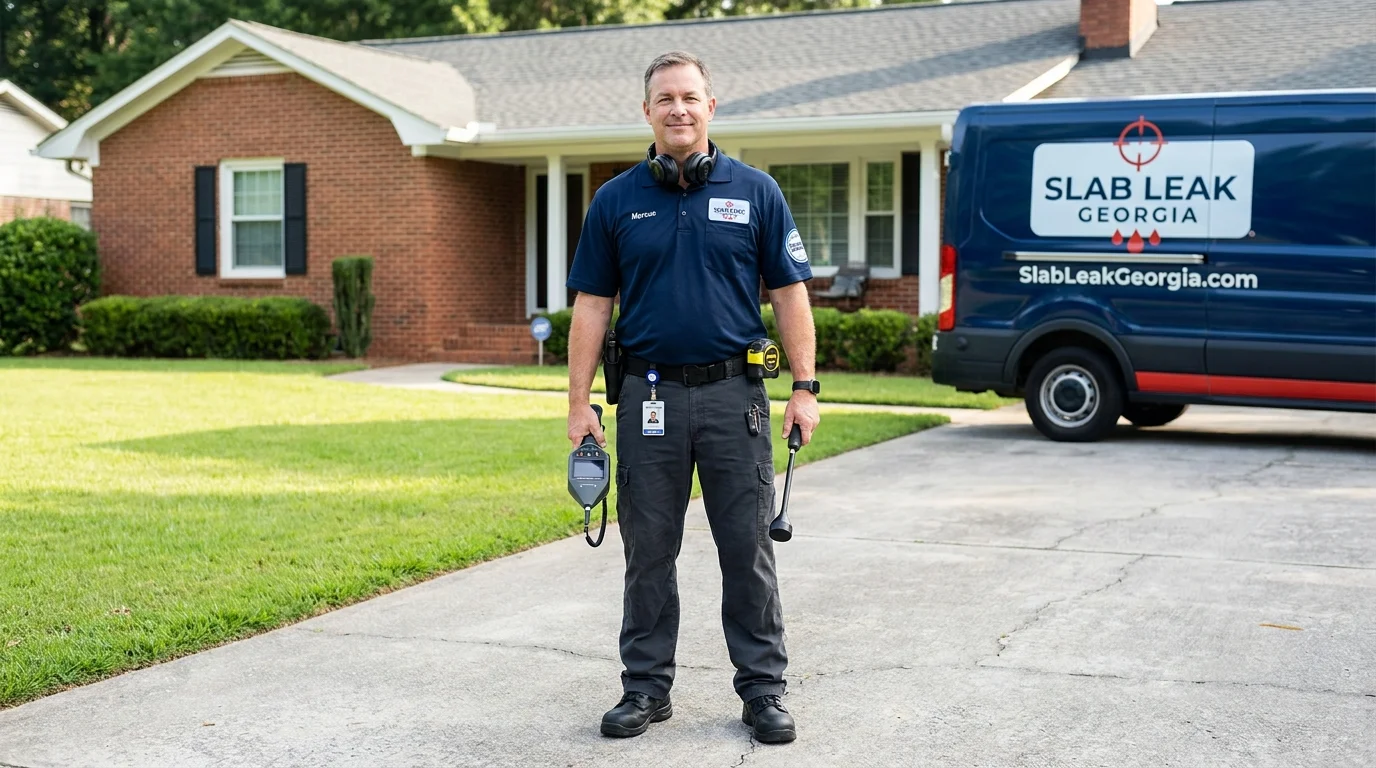
Slab Leak Detection & Repair in Wrightsville, GA
Professional slab leak detection and repair in Wrightsville and Johnson County. Electronic leak location, foundation-safe repairs, and emergency response when you need it most.
Water running with all fixtures off? Call immediately — active slab leak requires urgent attention.
Warm spots on floor or foundation cracks? Early detection prevents costly damage.
Get Your Free Estimate
No obligation. We'll help you understand your options.
Comprehensive Slab Leak Solutions
From electronic detection to complete repairs, we handle every aspect of slab leak service in Wrightsville.
Electronic Leak Detection
Advanced acoustic and thermal imaging equipment pinpoints leaks without breaking concrete. Non-invasive detection saves time and money.
Learn Morearrow_forwardFoundation-Safe Repair
Expert slab leak repairs that protect your foundation integrity. Spot repairs, epoxy lining, or complete re-piping solutions.
Learn Morearrow_forward24/7 Emergency Response
Active slab leaks require immediate attention. Our emergency teams respond fast to prevent catastrophic water damage.
Learn Morearrow_forwardComplete Re-piping
When multiple leaks or old pipes threaten your foundation, complete re-piping provides permanent peace of mind.
Learn Morearrow_forwardLooking for slab leak detection in Wrightsville? Our licensed technicians use advanced electronic equipment to pinpoint under-slab water leaks in Johnson County homes without breaking concrete. Call +1-866-779-0723 for same-day professional leak detection and repair service you can trust.
Do You Have an Emergency?
Check your symptoms — takes 30 seconds
Emergency Urgency Assessment
Check your symptoms to determine urgency level
Nearby Communities We Serve
Within 20 miles of Wrightsville
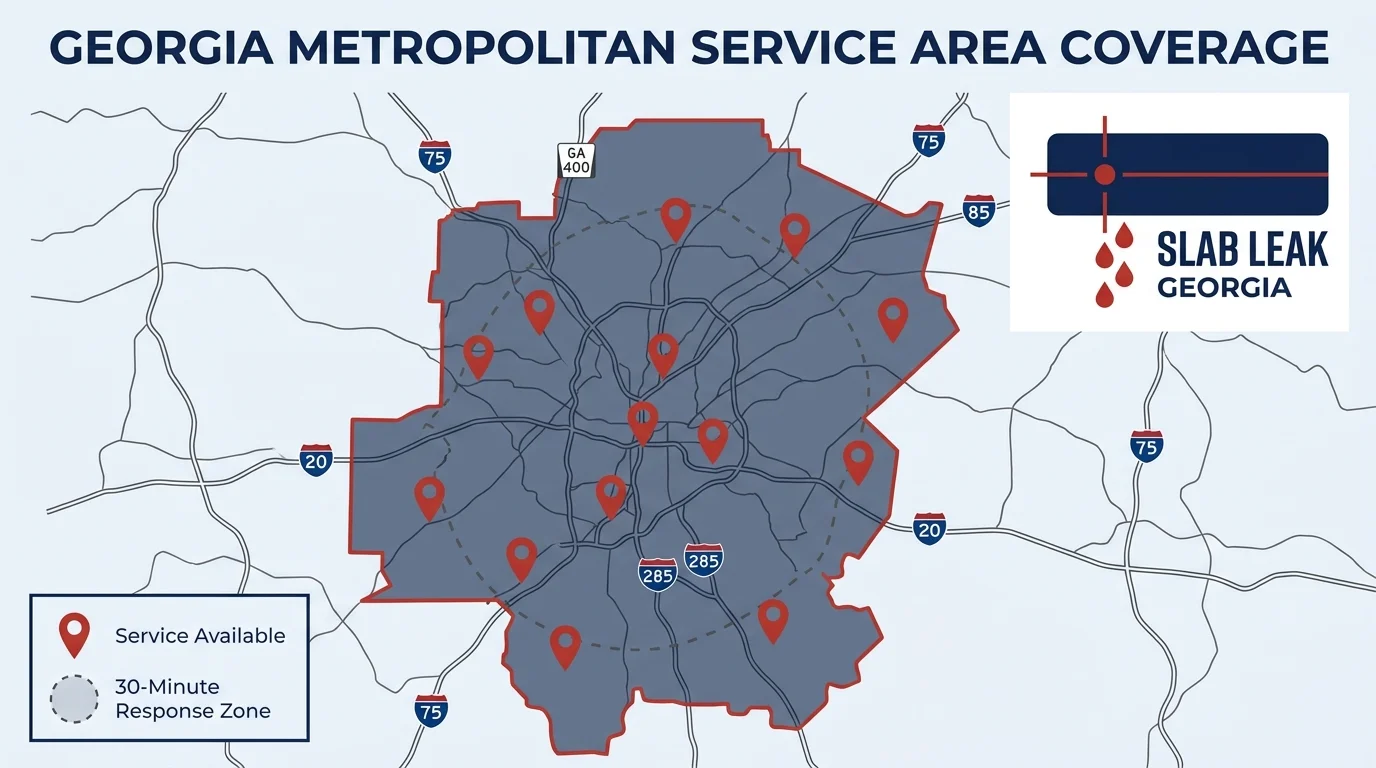
We serve 600+ cities across Georgia
location_searchingView All Service AreasServing Wrightsville and all of Johnson County with expert slab leak detection and foundation-safe repair. Our team has helped hundreds of local homeowners stop water damage before it compromises their foundation. Emergency service available 24/7 — call +1-866-779-0723.
Experiencing These Symptoms?
Select all that apply — we'll help you understand what to do
Slab Leak Symptom Checker
Select all symptoms you're experiencing
What Is Slab Leak Repair in Wrightsville, GA?
Slab leak repair detects and fixes water leaks in supply lines running under your home's concrete foundation. In Wrightsville, these leaks occur when copper or galvanized pipes corrode from age, soil movement stresses connections, or poor installation creates weak points. Repair involves pinpointing the exact leak location using specialized detection equipment, then fixing it through methods ranging from trenchless epoxy lining to pipe rerouting or targeted concrete removal.
Georgia homeowners typically notice slab leaks through warm spots on floors, unexplained water bill spikes, or the sound of running water when all fixtures are off. Foundation cracks may appear as soil erodes beneath the slab from continuous water flow. The urgency depends on symptoms—active water pooling or foundation cracking requires immediate attention, while a hot floor spot or gradually rising bill warrants inspection within a few days.
After detecting foundation leaks in Johnson County for over 15 years, we've seen how Wrightsville's slab-on-grade and post-tension foundations respond differently to water intrusion. Georgia's expansive clay soil compounds the problem: when saturated by a leak, clay swells and shifts, stressing pipes further and creating voids under the slab that lead to settling. Most Wrightsville homes built before 2000 have copper supply lines under the slab—pipes now reaching the 20-30 year corrosion threshold where pinhole leaks become common.
Professional detection uses electronic leak detection, acoustic amplification, or thermal imaging to pinpoint leaks without exploratory digging. Once located, repair options include epoxy pipe lining (no concrete breaking), copper-to-PEX repiping (eliminates future under-slab leaks), tunneling (preserves interior floors), or spot repair with concrete restoration. Foundation damage begins within 2-4 weeks of continuous leaking as soil erodes and the slab settles unevenly, potentially requiring $5,000-10,000 in structural repairs if left unaddressed.
Emergency Service Available
Active leaks need immediate attention
24/7 Emergency Slab Leak Repair in Wrightsville, Georgia
Emergency slab leak repair in Wrightsville provides same-day response to active water leaks under your foundation. When you call +1-866-779-0723, we dispatch technicians immediately to stop water damage, locate leaks using electronic or acoustic detection equipment, and execute temporary mitigation or permanent repairs within hours. We serve all Wrightsville addresses with fully equipped service vehicles ready for 90% of repairs on first visit.
When to Call Immediately
Call for emergency service if you observe:
Active water pooling around foundation perimeter. Water surfacing along your home's exterior indicates a severe under-slab leak saturating the soil. Georgia clay doesn't drain quickly—pooling means continuous water escape large enough to overcome soil absorption.
Hot water completely out with confirmed hot floor spot. No hot water combined with a warm area on your floor confirms a hot water line rupture. The leak is draining your water heater faster than it can recover.
Foundation cracking that worsens visibly. Measure crack width daily with a ruler. Growth exceeding 1/8 inch per week signals soil erosion creating voids under your slab. Foundation settling accelerates without intervention.
Water meter spinning continuously when all water is off. Turn off every fixture and appliance, then check your meter. Continuous movement proves an active leak somewhere in your system requiring immediate location and repair.
Standing water inside home coming up through floor. Water emerging through concrete or carpet indicates a leak severe enough to saturate subsoil and migrate upward—foundation damage is already occurring.
Structural signs progressing. Doors that suddenly stick, windows that won't close properly, or new wall cracks appearing within days indicate foundation movement from water-saturated soil.
Sewage odor from floors. Sewer smell suggests a drain line failure under your slab, not a supply line leak. Requires immediate assessment to prevent health hazards.
Same-Day Service Availability in Wrightsville
We respond to Wrightsville emergency calls with an average 2-4 hour dispatch time, faster for critical scenarios involving active interior flooding or structural risk. Our service area covers Johnson County including Harrison, Kite, Riddleville, East Dublin, Tennille, Adrian, Oconee, Bartow, Dublin, Sandersville, Davisboro, and Norristown, with technicians stationed to reach most addresses within this window during business hours and 3-5 hours after normal business hours.
Service vehicles carry electronic leak detection equipment, acoustic ground microphones, pipe repair materials including epoxy compounds and PEX fittings, concrete patching supplies, and emergency shut-off tools. This equipment preparedness allows us to complete 90% of emergency repairs on the first visit without waiting for specialized materials or return trips.
We maintain 24/7 dispatch with no premium charges for night or weekend emergency calls. The repair itself costs the same whether we arrive at 2 PM or 2 AM—emergency service fees only apply if you request same-day response outside normal scheduling, and we discuss those costs during your initial call before dispatch.
What Happens When You Call for Emergency Service
Phone triage determines urgency and guides immediate actions. When you call +1-866-779-0723, we ask about symptom severity, home age, foundation type, and whether you've located your main water shutoff. If you're experiencing active pooling or interior flooding, we walk you through emergency water shutoff at the main valve before dispatch. Main shutoff valves in Georgia homes typically sit near the water heater, in the garage, or in a basement utility area. Turn clockwise until fully closed to stop all water flow.
Immediate technician dispatch with detection equipment. We dispatch the nearest available technician with leak detection tools and repair materials. You'll receive the technician's name, estimated arrival time, and direct contact number. For true emergencies involving structural risk, we prioritize your call over scheduled appointments.
On-site assessment prioritizes damage control. First action: verify water is shut off at the main or identify which line is leaking so we can isolate it. We assess foundation damage risk by checking for cracking, settling, or active soil erosion. If temporary mitigation is needed before full repair—such as installing a bypass line or emergency pipe clamp—we execute that immediately to stop further damage.
Detection pinpoints exact leak location. Using electronic leak detection for copper pipes or acoustic detection for deep slabs, we locate the leak within 1-2 hours. Detection happens before any concrete breaking to avoid unnecessary demolition. You'll see us pressurize your water lines, scan with detection equipment, and mark the floor at the precise leak point.
Mitigation and repair options presented with costs. Once we've confirmed the leak location, we explain your options: emergency shut-off with bypass routing (fastest, lowest cost), temporary pipe patching to restore service while you plan permanent repair, or immediate permanent repair if conditions allow and you approve the cost. You'll know exactly what we found, what each option costs, and how long each approach takes before any repair work begins. No surprise charges, no pressure—just clear information so you can make the right decision for your situation and budget.
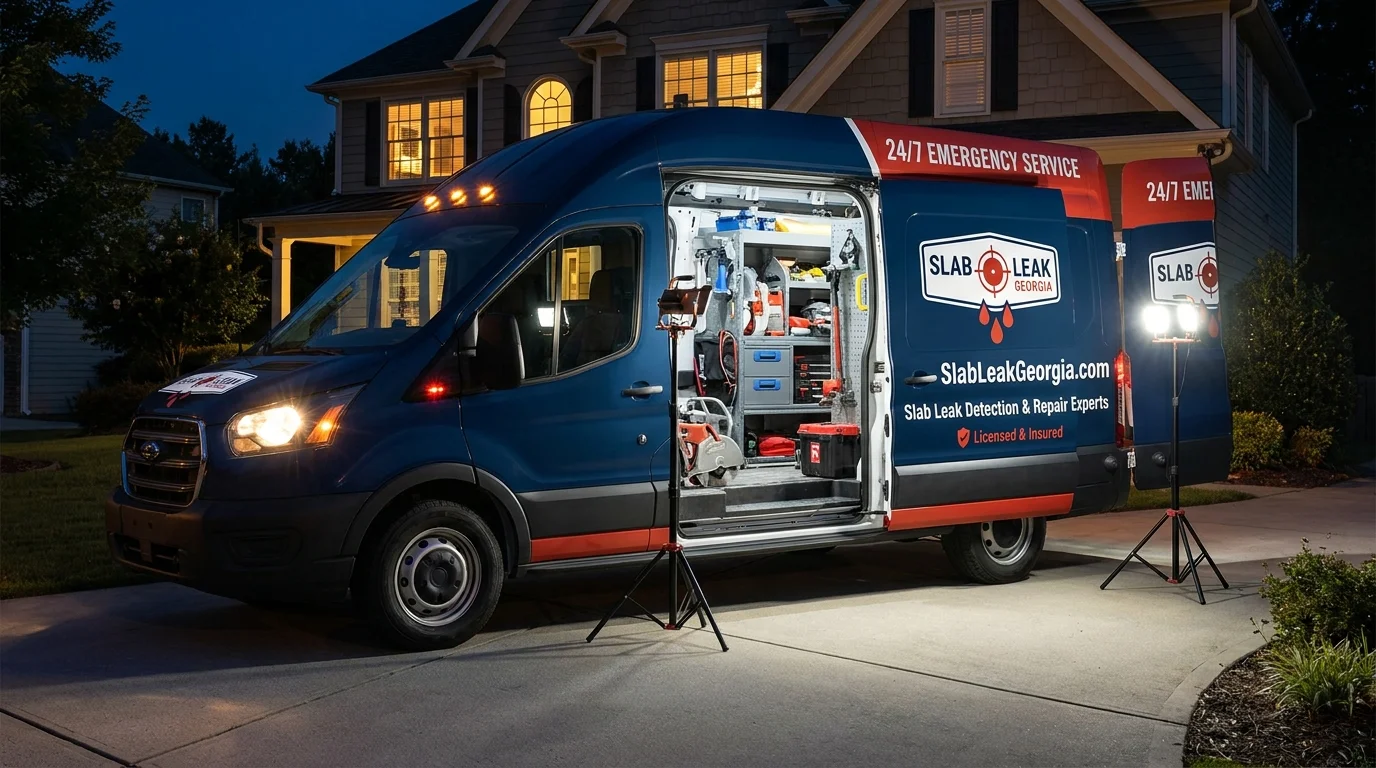
24/7 Emergency Response — We answer at any hour
callCall +1-866-779-0723How Slab Leak Detection & Repair Works in Wrightsville
Slab leak repair in Wrightsville follows a two-phase model: detection first to pinpoint the exact leak location, then repair using the method that best fits your foundation type, budget, and timeline. This sequence prevents unnecessary concrete breaking and allows us to recommend the most cost-effective repair approach based on what we find. Detection typically takes 1-3 hours, while repair timelines range from same-day rerouting to 2-week spot repairs with concrete curing.
Phase 1: Pinpointing the Leak Location
We begin every Wrightsville slab leak job with accurate detection because guessing leak locations leads to exploratory concrete demolition that costs thousands more than targeted detection. Our method selection depends on your home's characteristics and symptoms. For homes with accessible copper pipes and isolated hot spots, electronic leak detection uses electromagnetic pipe locators and ground microphones to pinpoint leaks within 1-2 feet after pressurizing your lines. When dealing with post-tension foundations or deep slabs common in certain Wrightsville construction eras, acoustic detection equipment amplifies the sound frequency of pressurized water escaping through pipe walls, allowing triangulation even through thick concrete.
Thermal imaging works only for hot water leaks, using infrared cameras to identify temperature differentials through flooring—most effective during cooler months when the contrast is strongest. For homes where multiple leaks are suspected or pipe condition is uncertain, we start with static pressure testing to confirm leak existence before deploying invasive methods, often combined with video pipe inspection through existing cleanouts.
During detection in Wrightsville, you'll see technicians working methodically with headphones and sensors, marking your floor with tape as they narrow the location. The process concludes with marked leak coordinates, photographic documentation, and a pipe condition assessment that informs repair recommendations. Detection costs range from $300-1,000 depending on your home's size, foundation accessibility, and whether multiple methods are needed. Georgia's expansive clay soil can dampen acoustic signals, sometimes requiring closer sensor spacing than in other regions.
Phase 2: Repair Method Selection
Once we've pinpointed your leak and assessed surrounding pipe condition, we present repair options across a spectrum from minimally invasive to complete system replacement. Your decision factors include leak location accessibility, the age and condition of adjacent pipes, your budget and timeline, floor type and value, and whether you're planning long-term ownership or near-term sale.
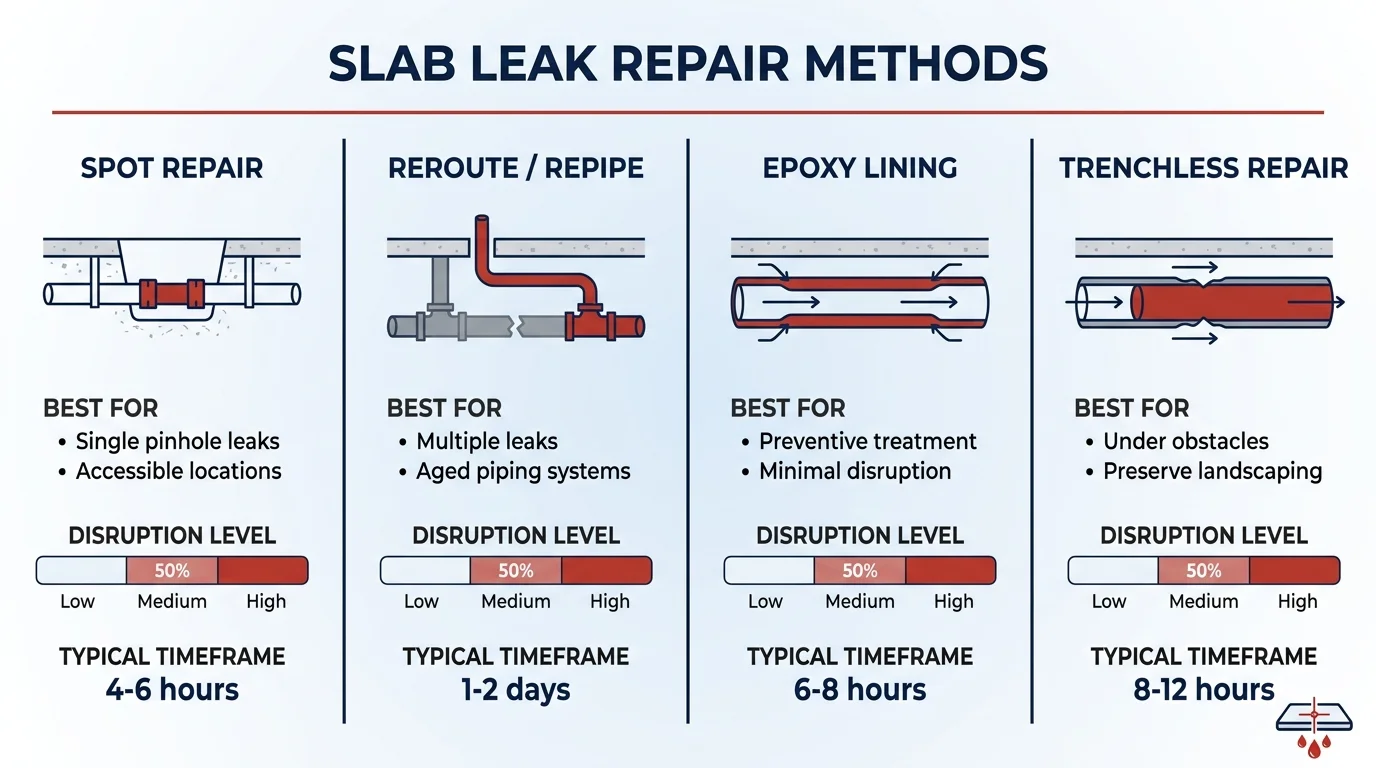
For isolated leaks in accessible pipe sections with good overall system health, trenchless epoxy lining creates a permanent pipe-within-a-pipe seal without breaking concrete—completed in 1-2 days. When leak location sits under high-value tile or hardwood flooring, tunneling under your foundation from the exterior preserves interior finishes while providing direct pipe access, typically requiring 3-7 days depending on tunnel length and soil conditions. Spot repair with targeted concrete removal works well for garage or utility room leaks where floor restoration is straightforward, though concrete curing extends the timeline to 2-3 weeks before full weight-bearing use.
If your Wrightsville home shows multiple weak points or houses aging copper pipes approaching 25-year failure thresholds, rerouting supply lines through attic or crawlspace eliminates future under-slab leak risk entirely—often completed in 2-5 days for whole-house PEX conversions. Some situations call for simple bypass rerouting around the leak as a same-day solution, particularly when other methods face access constraints.
Repair costs in Wrightsville range from $800 for basic rerouting to $15,000 for comprehensive repiping with floor restoration, with most homeowners investing $2,500-6,000 for permanent solutions. Foundation type significantly impacts method selection—slab-on-grade foundations common in Wrightsville residential construction allow different approaches than post-tension slabs. We explain each option's trade-offs transparently, letting you make an informed decision based on complete information about what each method accomplishes and what it costs.
Need slab leak detection in Wrightsville? Call +1-866-779-0723 for same-day service and accurate leak location within hours.
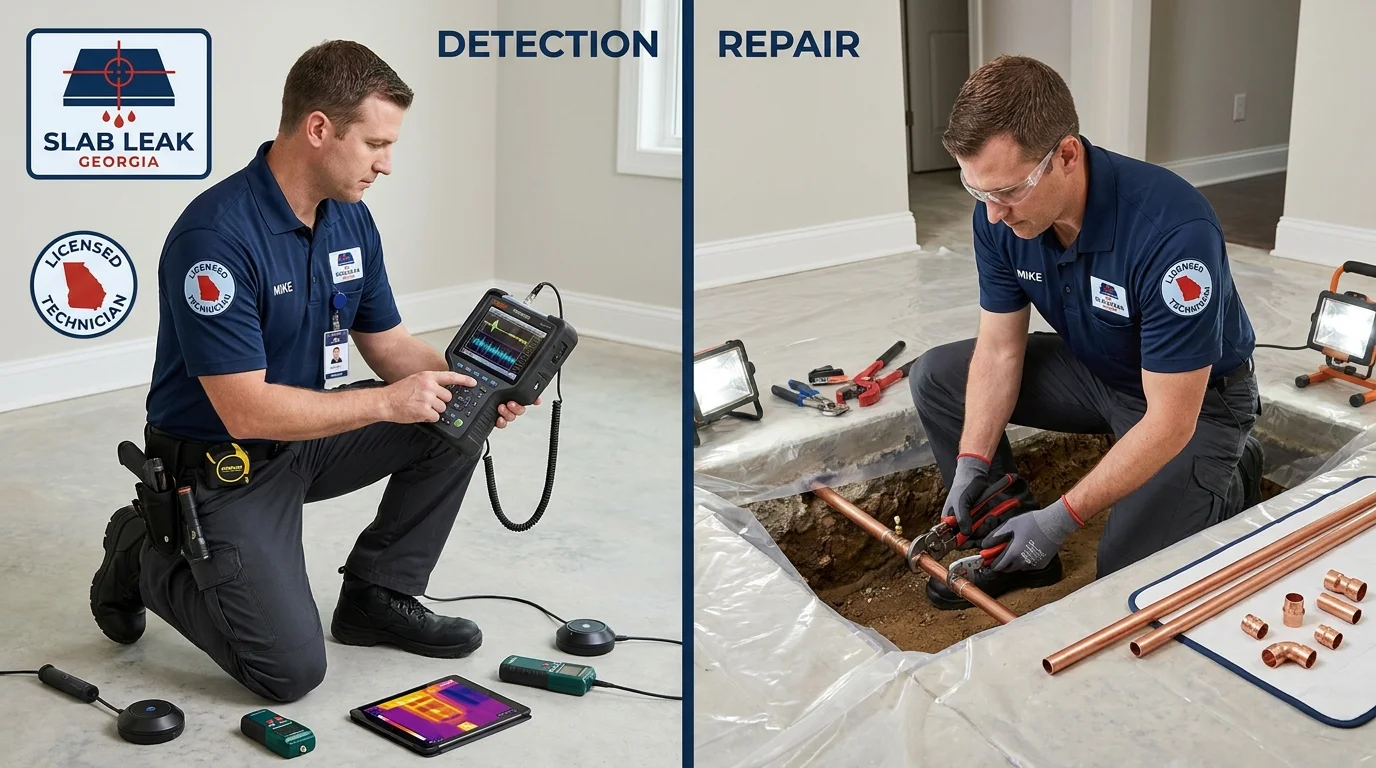
Slab Leak Detection Methods for Wrightsville Homes
Slab leak detection in Wrightsville uses specialized equipment to pinpoint leaks under concrete foundations without exploratory demolition. We choose detection methods based on your pipe material, foundation depth, leak symptoms, and whether the leak involves hot or cold water. Most Wrightsville homes require 1-3 hours for complete detection, with costs ranging from $300-1,000 depending on home size and complexity.
Electronic Leak Detection in Wrightsville
Electronic leak detection uses electromagnetic pipe locators and ground-penetrating microphones to find leaks in copper and PEX supply lines. We pressurize your water system to 80-100 PSI, then trace pipe routes using an electromagnetic field generator that follows metallic pipes through concrete. When pressurized water escapes through a leak point, ground microphones amplify the acoustic signature—a distinct hissing or rushing sound—allowing us to mark the exact location within 1-2 feet.
The technician walks your foundation with headphones connected to amplification equipment, listening for frequency changes that indicate escaping water. Electromagnetic locators work by inducing a current in copper pipes, creating a detectable field that weakens at leak points where water disperses the signal. We correlate acoustic findings with electromagnetic traces to achieve pinpoint accuracy.
Electronic detection works best for copper supply lines under accessible slab-on-grade foundations common in Wrightsville residential construction. It's our first-line method for homes with consistent concrete thickness (4-6 inches typical) and straightforward pipe routing from water heater to fixtures. The method detects pressurized supply leaks but cannot locate drain leaks, which don't pressurize and therefore produce no acoustic signature.
In Wrightsville, we encounter challenges with post-tension foundations where steel tensioning cables interfere with electromagnetic signals, requiring us to rely more heavily on acoustic detection in those structures. Homes built before 1990 typically have simpler copper routing that responds well to electronic detection, while newer construction with complex manifold systems may require longer scanning time to trace multiple branch lines.
Electronic detection takes 1-2 hours for standard single-story homes, up to 3 hours for two-story layouts with multiple bathrooms. Accuracy reaches 95% when conditions are ideal—copper pipes, moderate concrete thickness, single leak point. The method struggles with galvanized steel pipes (poor electromagnetic conductivity), extremely deep foundations over 8 inches thick, or multiple simultaneous leaks creating overlapping acoustic signals.
Detection costs $300-800 in Wrightsville, with variables including home square footage (more area to scan), number of bathrooms (more lines to trace), and foundation accessibility (crawlspace access points speed detection). We perform electronic detection first on most Wrightsville jobs because it's non-invasive, relatively quick, and highly accurate when pipe materials and foundation types align with the technology's strengths.
When electronic detection confirms a leak location, we mark the floor with tape, photograph the findings, document pressure readings, and present repair options. If electronic methods prove inconclusive—common in post-tension slabs or homes with galvanized pipes—we escalate to acoustic detection or combine methods for triangulation.
Acoustic Leak Detection for Deep Foundations
Acoustic leak detection uses sensitive vibration sensors and sound amplification to locate leaks in foundations where electronic methods fail or where extreme precision is required. This method works by detecting the specific frequency signature of water escaping under pressure—typically 400-800 Hz for pressurized supply leaks. We place multiple sensors across your foundation, pressurize the system, and analyze sound patterns to triangulate the leak source within 1-3 feet depending on soil density.
The process involves attaching piezoelectric sensors to your foundation at 8-10 foot intervals, connecting them to a computerized analysis system that filters out ambient noise and isolates leak frequencies. Pressurized water escaping through even a pinhole-sized opening creates vibrations that travel through concrete and soil, detected by sensors as distinct acoustic events. The system calculates leak position by comparing signal strength and arrival time at multiple sensors.
Acoustic detection excels in situations where electronic methods struggle: post-tension foundations with steel cables that interfere with electromagnetic signals, deep slabs over 6 inches thick where electronic signals attenuate, and complex multi-level homes where pipe routing is unclear. We use acoustic methods as first-line detection in Wrightsville neighborhoods with post-tension construction common in homes built after 2000, where foundation design prioritizes structural strength over detection accessibility.
In Wrightsville, soil conditions significantly impact acoustic detection accuracy. Georgia red clay, common throughout the region, transmits vibrations reasonably well but requires closer sensor spacing than sandy or rocky soils. Clay's density means acoustic signals attenuate less over distance, but moisture content in saturated clay can create false signals that experienced technicians must filter out. During wet seasons, we adjust sensor placement and increase the number of measurement points to compensate for soil saturation effects.
The detection process takes 2-3 hours for thorough acoustic analysis in Wrightsville homes. We begin with static pressure testing to confirm a leak exists, then deploy sensors in a grid pattern across suspected areas. The system runs for 15-30 minutes per sensor configuration, collecting acoustic data that software analyzes for leak signatures. For ambiguous results, we reposition sensors and repeat measurements from different angles to improve triangulation accuracy.
Acoustic detection costs $400-900 in Wrightsville, depending on foundation size, number of sensor placements required, and analysis complexity. Post-tension slabs typically fall in the $600-900 range because they demand more measurement points and longer analysis time to work around steel cable interference patterns.
We recommend acoustic detection when electronic methods have failed to produce clear results, when you have a post-tension foundation (identifiable by small circular plastic covers on the slab perimeter where tensioning cables are anchored), or when the leak appears to be in a section of pipe more than 6 inches below the surface. Acoustic detection also serves as a confirmation method when we need absolute certainty before recommending an expensive repair option like tunneling.
Limitations include reduced effectiveness in extremely noisy environments (homes near highways or industrial areas create ambient frequencies that interfere with leak signals) and challenges with very slow leaks under 0.1 gallons per minute that produce insufficient acoustic energy for reliable detection. For complex cases, we combine acoustic detection with electronic methods, using electronic equipment to trace pipe routes and acoustic sensors to pinpoint the exact leak location within those routes.
Thermal Imaging Leak Detection
Thermal imaging leak detection uses infrared cameras to identify temperature differences caused by hot water leaking under your foundation. The camera detects thermal radiation invisible to human eyes, displaying temperature variations as color-coded images where hot water leaks appear as distinct warm signatures against cooler surrounding concrete. This method works exclusively for hot water line leaks and provides visual documentation showing leak location, heat intensity, and affected area size.
The infrared camera scans your floor surfaces systematically, measuring surface temperatures with 0.1-degree precision. Hot water leaking from pressurized supply lines heats the concrete directly above, creating temperature differentials of 5-15 degrees compared to adjacent areas. We capture thermal images from multiple angles, comparing baseline floor temperatures with suspected leak zones to confirm that temperature anomalies match pipe routing and aren't caused by sunlight, radiant heat sources, or heating ducts.
Thermal imaging works best when significant temperature contrast exists between leaking hot water and surrounding concrete—ideal conditions occur in winter months when ambient temperatures are low and hot water maintains 120-140 degree supply temperature. The method requires access to floor surfaces (carpet, tile, hardwood all allow thermal scanning, though carpet provides slight insulation that reduces temperature signature clarity) and benefits from turning off all heating sources for 2-4 hours before detection to eliminate false thermal readings.
In Wrightsville, thermal imaging proves most effective during cooler months when temperature differentials between hot water and concrete maximize detection sensitivity. Summer scanning is possible but requires evening or early morning sessions when outdoor temperatures drop and concrete cools. We use thermal detection as a complementary method alongside electronic or acoustic detection when symptoms clearly indicate a hot water leak—warm floor spots, constant water heater operation, hot water loss—and we need visual confirmation before recommending repair.
The detection process takes 1 hour for thermal scanning plus analysis time to correlate thermal signatures with pipe routing diagrams. We photograph thermal images showing temperature scales, mark hotspot locations on your floor, and verify findings by comparing thermal data with acoustic or electronic detection results. Thermal imaging provides excellent visual evidence for insurance claims, showing clear before-and-after documentation of leak locations and temperatures.
Thermal imaging cannot detect cold water leaks because temperature differentials are insufficient for infrared cameras to register. Cold water typically sits at 50-70 degrees—only 10-20 degrees below typical concrete temperatures—producing thermal signatures too subtle for reliable detection. The method also struggles with leaks under thick carpet padding or in multilevel homes where upper-floor rooms insulate the detection zone.
Thermal detection costs $500-1,000 in Wrightsville, reflecting the specialized camera equipment (professional infrared cameras range from $3,000-15,000) and technician expertise required to interpret thermal images correctly. We include thermal imaging as part of comprehensive detection packages when hot water symptoms are present, using it to confirm locations identified through electronic or acoustic methods.
We recommend thermal imaging when you've noticed warm or hot spots on your floor, when your water heater runs constantly but hot water delivery is poor, or when we need visual documentation of leak location for insurance purposes. The method excels at showing clients exactly where their leak is before we cut concrete or recommend repair methods, providing confidence that we've accurately located the problem.
Pressure Testing & Video Pipe Inspection
Static pressure testing confirms whether leaks exist in your water system before we invest time in pinpoint detection methods. We close all fixtures, attach a pressure gauge to an outdoor hose bib, pressurize the system to 80-100 PSI, then monitor pressure drop over 30-60 minutes. A system losing more than 5 PSI per hour has a leak somewhere; stable pressure indicates no active leaks. This test costs $250-400 and prevents unnecessary detection work on systems where homeowners misinterpreted symptoms.
The pressure test isolates the problem to either supply lines (water coming into your home under pressure) or drain lines (wastewater leaving by gravity). We test supply lines separately from drain lines because they operate under different principles—supply leaks show pressure drops, while drain leaks require water flow tests or smoke tests. For Wrightsville homes showing symptoms like high water bills or meter spinning, static pressure testing proves definitively that water is escaping from pressurized supply pipes under your slab.
Video pipe inspection uses waterproof cameras fed through cleanout access points to examine pipe interiors without excavation. The camera travels through pipes on a flexible cable, transmitting real-time video showing pipe condition, corrosion extent, blockages, root intrusion, and sometimes even active leak points where water sprays into the pipe. Video inspection costs $300-800 depending on how many pipe lines we inspect and whether we encounter obstacles requiring multiple access points.
We use video inspection in Wrightsville when homeowners report multiple leak episodes (suggesting systemic pipe failure rather than isolated leaks), when we need to assess overall pipe condition before recommending spot repair versus whole-house repiping, or when dealing with drain line problems where pressure testing doesn't apply. The video footage documents pipe conditions for insurance claims and helps homeowners make informed decisions about repair scope.
Pressure testing takes 1-2 hours including setup, pressurization, monitoring, and documentation. Video inspection requires 2-4 hours for comprehensive assessment of main supply lines and major drain branches. We access pipes through existing cleanouts (those white or brass caps on your foundation exterior or in utility rooms), avoiding the need to create new access points in most Wrightsville homes built to code with proper cleanout placement.
In Wrightsville, we encounter homes built before 1980 that lack adequate cleanout access, requiring us to recommend cleanout installation before video inspection becomes feasible. Georgia plumbing code since 1980 requires cleanouts at specific intervals, but older homes often have limited or no access points. Installing cleanouts adds $200-500 to inspection costs but provides permanent access for future maintenance.
Pressure testing reveals the existence and severity of leaks but not their precise location—that requires electronic, acoustic, or thermal detection follow-up. Video inspection sometimes captures active leak points on camera when leaks spray into the pipe interior, but most under-slab leaks spray outward into soil and remain invisible to camera inspection. The video's primary value is assessing overall system integrity: if we see 70% of your copper pipes corroded and pitted inside, that indicates whole-house repiping makes more sense than repairing one leak.
We recommend pressure testing as a first diagnostic step when symptoms are ambiguous—is your high water bill caused by a slab leak or by a toilet flapper leak that's cheaper to fix? Pressure testing answers that question definitively. Video inspection makes sense when you've had multiple slab leak repairs already, when your home is 25+ years old with original copper pipes, or when we need documentation showing your entire system is compromised to support insurance claims or repiping recommendations.
Combined pressure testing and video inspection packages cost $400-900 in Wrightsville and provide comprehensive system assessment. After testing, we present findings with video footage, pressure data, and recommendations ranging from "single leak, spot repair recommended" to "systemwide corrosion, repipe recommended within 2 years before multiple failures occur."
Need leak detection in Wrightsville? Call +1-866-779-0723 for accurate pinpointing using the detection method that fits your foundation type and symptoms.
Slab Leak Repair Options Compared
Slab leak repair in Wrightsville ranges from fast, minimally invasive rerouting to comprehensive whole-house repiping, with costs spanning $800-15,000 depending on repair scope and method. We select repair approaches based on leak location, your foundation type, pipe condition throughout your system, floor covering value, budget constraints, and timeline requirements. Each method offers distinct advantages—some prioritize speed and cost, others emphasize floor preservation or long-term prevention.
Trenchless Epoxy Pipe Lining
Epoxy pipe lining creates a permanent seal inside leaking pipes without breaking concrete, making it ideal for Wrightsville homeowners who want to preserve tile, hardwood, or finished floors. The process involves accessing your pipes through existing cleanouts or by creating small access points at pipe ends, then using specialized equipment to clean the pipe interior and apply a two-part epoxy coating that cures into a smooth, durable pipe-within-a-pipe.
We begin by shutting off water and draining the leaking pipe section. Next, we insert a flexible cable with abrasive chains or brushes that scours away corrosion, mineral buildup, and oxidation from the copper pipe interior using mechanical rotation. This cleaning step is critical—epoxy only bonds properly to clean metal surfaces. After cleaning, we flush the pipe thoroughly to remove debris, then dry it using compressed air for 15-30 minutes until moisture content reaches acceptable levels.
The epoxy application process uses specialized equipment that mixes two-part epoxy at precise ratios, then pumps the coating through the cleaned pipe under controlled pressure. The epoxy flows through the pipe, coating interior surfaces in a uniform layer 1.5-3mm thick. We slowly withdraw the application wand while maintaining pressure, ensuring complete coverage without gaps or thin spots. The epoxy cures in place over 4-8 hours, bonding to the copper pipe interior and sealing pinhole leaks, corrosion points, and weak spots along the entire lined section.
Epoxy lining works best for single-line leaks in accessible pipe sections where both pipe ends have access points. We commonly line hot water supply lines running from water heaters to fixtures, cold water trunk lines serving multiple bathrooms, or isolated sections showing early-stage corrosion before complete failure. The method requires that existing pipes retain at least 40% wall thickness—severely corroded pipes with extensive pitting or complete holes don't provide sufficient structural support for epoxy to restore integrity.
In Wrightsville, epoxy lining suits homeowners with high-value flooring they want to protect from concrete demolition. Homes with Italian tile, hardwood floors, or custom finishes benefit enormously from a repair method that works entirely through access points without jackhammering interior floors. The method also appeals to homeowners in Wrightsville's multi-story homes where accessing under-slab leaks from lower levels would require extensive demolition.
Advantages include zero concrete breaking (access through cleanouts only), rapid completion (1-2 days from detection through cured lining), immediate restoration of water service after curing, and lifetime warranty coverage on lined sections. The epoxy coating is NSF-certified for potable water, resists future corrosion, and actually increases flow capacity by smoothing interior surfaces where mineral buildup previously restricted flow.
Limitations include access requirements (pipes need entry points at both ends or at bends where we can insert equipment), unsuitability for severely deteriorated pipes (if the pipe is 70% corroded, epoxy won't restore structural integrity), and the reality that lining addresses one pipe section without preventing corrosion in unlined areas. Epoxy lining costs more than simple spot repair but less than rerouting or repiping.
The process timeline spans 1-2 days: day one involves detection, access point creation if needed, and pipe cleaning; day two covers epoxy application and curing. You'll be without water for 8-12 hours during application and initial curing, then full service resumes. We pressure-test the lined section to 150 PSI before declaring the job complete, ensuring the epoxy seal holds under normal and elevated pressure conditions.
In Wrightsville, epoxy lining costs $2,000-5,000 depending on pipe length (typical hot water line runs 30-50 feet from water heater to far fixtures), number of access points required (existing cleanouts reduce cost; new access points add $150-300 each), and cure time (fast-cure epoxies cost more but restore service in 4 hours versus 8 hours for standard formulations). We provide lifetime warranties against leaks in epoxy-lined sections, backed by the epoxy manufacturer's material warranty.
We recommend epoxy lining when you have a confirmed single-line leak, accessible pipe ends, copper pipes with sufficient wall thickness remaining, and strong preference for avoiding floor demolition. The method particularly suits Wrightsville homes with finished basements, expensive flooring, or structural layouts where rerouting pipes through attics or crawlspaces isn't feasible. If video inspection shows your entire system is corroding and multiple leaks are likely within 3-5 years, whole-house repiping makes more economic sense than lining individual sections as they fail.
Copper to PEX Repiping
Copper to PEX repiping replaces failing under-slab copper pipes with flexible PEX (cross-linked polyethylene) tubing routed through accessible areas—typically attics, crawlspaces, or wall chases—eliminating future under-slab leak risk permanently. This approach abandons leaking copper lines in place and installs an entirely new distribution system using a central manifold that routes individual PEX lines to each fixture.
The manifold system uses a distribution panel installed near your water heater with dedicated shut-off valves for every fixture. From the manifold, we run individual PEX lines through your attic, down interior walls, and directly to each sink, toilet, shower, and appliance. Unlike traditional trunk-and-branch copper systems where one leak affects multiple fixtures, manifold systems isolate each fixture—if one PEX line develops a problem decades from now, you shut off that fixture's valve and everything else continues working.
PEX offers significant advantages over copper for repiping applications: flexibility allows routing through tight spaces and making turns without fittings (fewer connection points mean fewer potential leak sources), freeze resistance (PEX expands without bursting when water freezes, critical for attic routing), corrosion immunity (plastic doesn't corrode from water chemistry or soil contact), and 25-year manufacturer warranties backed by decades of proven performance in residential plumbing.
We complete repiping in phases. First, we install the manifold and route main supply lines from your water meter to the manifold location. Next, we run individual PEX lines through attics or crawlspaces to wall cavities above each fixture. Then we connect PEX to existing fixture stub-outs using brass transition fittings, pressure-test each line to 150 PSI, and verify hot and cold water delivery to all fixtures. Finally, we cap or abandon the old copper under-slab lines, leaving them in place rather than attempting excavation.
Repiping works as either partial rerouting (bypassing one leaking section by running new PEX around it) or whole-house repiping (replacing all supply lines throughout the home). Partial reroutes make sense for isolated leaks when the rest of your system appears sound. Whole-house repipes suit Wrightsville homes with original copper pipes over 20 years old, multiple previous leaks, or video inspection showing systemwide corrosion.
In Wrightsville, we encounter favorable repiping conditions in most single-story and two-story homes built with attic access and interior wall cavities suitable for PEX routing. Homes built on slab foundations with attic trusses provide straightforward routing—we run PEX through the attic, drop lines down interior walls at wet wall locations (walls containing plumbing), and connect to existing fixture risers. Homes without attics or with limited crawlspace access present routing challenges that increase labor time and costs.
Advantages of PEX repiping include permanent elimination of under-slab leak risk (no pipes remain under concrete after full repipe), improved water pressure (dedicated lines with fewer fittings reduce friction loss), individual fixture isolation (manifold shut-offs let you work on one fixture without affecting others), and flexibility for future renovations (adding fixtures requires running one new PEX line rather than tapping into existing copper trunk lines).
Disadvantages include visible piping in some applications (attic routing is concealed, but basement ceiling or garage applications may expose PEX lines that require painting or boxing), higher upfront cost than spot repairs, and the 2-5 day timeline that disrupts household water service intermittently during work phases. Some Wrightsville homeowners object aesthetically to PEX—we address this by routing lines through walls wherever possible and using neat, painted raceway channels when exposure is unavoidable.
The repiping timeline depends on scope: partial reroutes take 1-2 days (detect leak, route new PEX bypassing the problem section, pressure test, restore service), while whole-house repipes require 2-5 days (manifold installation day 1, main line routing day 2, individual fixture connections days 3-4, testing and finish work day 5). You'll have intermittent water service during the project—we restore service each evening if possible, or arrange temporary connections to keep one bathroom functional.
In Wrightsville, repiping costs break down as follows: partial rerouting to bypass a single leak section costs $4,000-8,000 depending on routing complexity and distance from manifold to fixtures; whole-house repiping for 1,500-2,500 square foot homes costs $6,000-12,000 based on number of fixtures (bathrooms, kitchen, laundry, outdoor hose bibs), routing difficulty (straightforward attic runs cost less than wall fishing), and finish work (boxing exposed lines, painting, drywall repair where we access stub-outs).
Georgia code requires pressure testing all new plumbing to 150 PSI for 15 minutes with no pressure drop. We test each PEX line individually as we install it, then perform a final whole-system test before project completion. The PEX manufacturer provides 25-year warranty on materials, and we warranty our installation workmanship for the life of your ownership.
We recommend partial PEX rerouting when you have a confirmed single leak, your overall system shows minimal corrosion on video inspection, and you want faster, less expensive repair than whole-house repiping. We recommend whole-house repiping when you've had multiple slab leaks (indicating systemwide failure), your home is 20+ years old with original copper pipes, video inspection shows extensive interior corrosion, or you're planning long-term ownership and want permanent peace of mind.
Repiping proves especially valuable in Wrightsville for homeowners facing their second or third slab leak repair. The cumulative cost of repeated detection and spot repairs ($2,000-3,500 each time) quickly approaches whole-house repipe costs ($6,000-12,000 once). After two repairs, the third incident makes repiping the economically rational choice that prevents future failures rather than chasing leaks as they appear.
Tunneling Under Foundation
Foundation tunneling accesses under-slab leaks by hand-digging a tunnel from your home's exterior, reaching the leak point from below without disturbing interior floors. This method preserves high-value flooring—tile, hardwood, natural stone—while providing direct access to repair leaking pipes. Tunneling requires exterior access along the foundation perimeter, stable soil conditions, and willingness to accept 3-7 day timelines and $3,000-7,000 costs in exchange for floor preservation.
The tunneling process begins by excavating a 3-foot wide by 4-foot deep trench along your foundation exterior, adjacent to the marked leak location. From this trench, we dig horizontally under your foundation, creating a tunnel 2-3 feet high and wide enough for a technician to crawl through. Tunnel length varies from 4-8 feet for leaks near the foundation perimeter to 12-15 feet for leaks under central areas of your home.
Soil stability determines tunneling feasibility and cost. Georgia red clay, common throughout Wrightsville and surrounding areas, provides excellent tunneling conditions—clay holds its shape when excavated, requires minimal shoring, and doesn't collapse easily even when wet. We shore tunnel walls with plywood panels and adjustable steel posts every 3-4 feet for safety, but clay's natural cohesion means less extensive shoring than sandy or loose soils would demand.
Sandy soils, occasionally encountered in Wrightsville, require extensive shoring because sand doesn't hold vertical faces—tunnels through sand need continuous plywood lining with support posts every 2 feet, adding labor time and materials cost. Rocky subsoil presents different challenges: if we encounter bedrock or extensive rock layers during tunneling, we must jackhammer through obstacles, significantly increasing timeline and costs.
Once the tunnel reaches the leak point, we expose the leaking pipe section by carefully removing soil around it, repair or replace the damaged section using standard copper fittings or PEX connections, pressure-test the repair, then backfill the tunnel. We compact backfill in 6-inch lifts using hand tampers or mechanical compactors, ensuring soil beneath your foundation returns to original density and doesn't create voids that cause settling.
Tunneling works best for leaks within 15 feet of your foundation perimeter, under high-value flooring worth preserving, in homes with exterior access that doesn't require removing landscaping, decks, or permanent structures. The method suits Wrightsville homeowners who've installed expensive Italian tile, restored original hardwood floors, or have specialty finishes that matching would be difficult or impossible.
In Wrightsville, we see tunneling frequently in historic district homes where original flooring is protected or where homeowners value historic preservation over cost. We also tunnel for newer luxury homes with high-end finishes where $5,000 for tunneling costs less than $8,000-12,000 to demolish, repair, and restore custom tile work.
Advantages include complete floor preservation (no interior demolition, no floor covering removal), permanent repair with direct visual confirmation of pipe condition, minimal interior disruption (work occurs entirely outside), and applicability to any leak location accessible from the perimeter. Tunneling also provides opportunity to inspect foundation underside for other issues like cracking, deterioration, or inadequate support.
Disadvantages include higher labor costs than methods like spot repair ($3,000-7,000 typical versus $1,500-3,500 for jackhammering), longer timelines (3-7 days versus 2-3 days for concrete demolition), weather dependency (rain delays tunneling), and unsuitability for leaks far from foundation edges (tunnels longer than 15 feet become prohibitively expensive). Homes on steep slopes or with limited yard access can't accommodate tunneling equipment and material staging.
The timeline breaks down as follows: day 1 involves trench excavation along the foundation exterior and initial tunneling; days 2-3 complete tunnel excavation to the leak point; day 3 includes pipe repair and pressure testing; days 4-5 cover backfilling, compaction, and exterior restoration. Weather can extend timelines—wet soil conditions or rain pauses excavation until soil dries enough to safely tunnel.
Safety protocols include continuous shoring as tunneling progresses, air quality monitoring (tunnels can accumulate carbon dioxide or methane in rare cases), and maximum tunnel length limits based on ventilation and access. We never tunnel more than 20 feet from the entry trench due to safety and practical working limitations.
In Wrightsville, tunneling costs $3,000-7,000 depending on tunnel length (longer tunnels require more shoring and labor), soil conditions (clay is least expensive, sand requires extensive shoring, rock requires jackhammering), and exterior restoration complexity (simple soil backfill costs less than rebuilding landscaping, patios, or walkways we must disturb for access).
We recommend tunneling when your leak is within 12-15 feet of the foundation perimeter, you have high-value interior flooring worth $3,000+ to replace, exterior access doesn't require removing permanent structures, and you're willing to accept the 3-7 day timeline for the benefit of floor preservation. Tunneling proves especially economical when the cost difference between tunneling and floor replacement is small—if your tile work would cost $5,000 to replace, spending $4,000 to tunnel becomes the rational choice.
Spot Repair with Concrete Restoration
Spot repair involves jackhammering a 2x3 foot section of concrete directly over the leak point, excavating to expose the damaged pipe, repairing or replacing the pipe section, then pouring new concrete and restoring floor covering. This method provides direct access to leaks at the lowest cost ($1,500-3,500 in Wrightsville), making it ideal for garage leaks, utility room locations, or budget-conscious homeowners who prioritize cost over floor preservation.
The process begins with marking the leak location on your floor based on detection results. We prepare the work area with plastic sheeting, set up dust extraction equipment, then use electric or pneumatic jackhammers to break concrete in a rectangular section slightly larger than the minimum access needed. Jackhammer noise is significant—hearing protection is mandatory, and we schedule work during daytime hours to minimize neighborhood disruption.
After removing broken concrete, we excavate 12-18 inches of soil and base material beneath the slab to access the leaking pipe. The pipe section sits 4-8 inches below the concrete bottom in typical Wrightsville foundations, embedded in soil or sand backfill. We expose 6-12 inches of pipe on either side of the leak point, cut out the damaged section using copper tubing cutters, and install a new pipe section using copper couplings or PEX transition fittings.
Repair method depends on pipe condition: if corrosion is localized to one pinhole or crack, we cut out a 6-inch section and sweat-solder a new copper section in place using proper torch technique and lead-free solder. If the pipe shows widespread corrosion or multiple thin spots, we extend the cutout and install PEX pipe with push-to-connect fittings, eliminating future corrosion risk in the repaired section.
After completing the plumbing repair, we pressure-test the new section to 150 PSI for 15 minutes, confirming no leaks exist at connection points. Next, we install wire mesh or rebar reinforcement matching the original slab structure, then pour new concrete to match the existing slab thickness (typically 4 inches in Wrightsville homes built to standard). We finish the concrete with a steel trowel, matching the surrounding texture as closely as possible.
Concrete curing timelines control when you can resume using the repaired area: light foot traffic is safe after 24 hours; normal use resumes after 3-7 days; full structural cure requiring 28 days before placing heavy loads. Most homeowners resume normal household use after one week, though we recommend placing rugs over the repair area for the first month to protect curing concrete from stains or damage.
Floor covering restoration adds cost and complexity beyond concrete work. If the leak occurred under tile, we remove affected tiles, complete the plumbing repair and concrete work, then install new tiles to match existing flooring. Tile matching challenges arise in Wrightsville homes where original tiles are discontinued—we source close matches or creative patterns that integrate new tiles aesthetically. If matching proves impossible, homeowners sometimes choose to retile the entire room for consistency.
Carpet repairs involve cutting out the damaged section, completing concrete work, then installing carpet patches. Professional carpet installers stretch and seam new carpet into existing, achieving nearly invisible repairs when carpet style and dye lot match. Hardwood floor repairs over concrete are rare in Wrightsville—most hardwood sits over wood subfloors, not directly on concrete—but when encountered, we sister new hardwood boards into the opening, sand, and finish to match.
Spot repair works best for leaks in unfinished spaces like garages, utility rooms, or unfinished basements where floor aesthetics matter less than functional repair. The method also suits budget-constrained homeowners who accept concrete patching and floor mismatching in exchange for lowest-cost permanent repair. Spot repair proves economical when leak location makes rerouting difficult—some pipe sections are inaccessible from attics or crawlspaces, leaving concrete demolition as the only option besides expensive tunneling.
In Wrightsville, we see spot repairs frequently in garage slab leaks, where homeowners don't mind the appearance of concrete patches, and in older homes where floor coverings have minimal value and matching isn't critical. Spot repair also suits leak locations where tunneling isn't feasible due to distance from foundation edges or where exterior access is blocked by permanent structures.
Advantages include lowest cost ($1,500-3,500 including concrete and basic floor restoration), permanent repair with visual confirmation of pipe condition, faster completion than tunneling (2-3 days repair plus 1-2 weeks curing versus 3-7 days tunneling), and applicability to any leak location regardless of exterior access. Spot repair also allows us to assess pipe condition directly—we can see corrosion extent, evaluate whether additional failures are imminent in adjacent sections, and recommend proactive repairs if inspection reveals concerns.
Disadvantages include interior disruption (jackhammer noise, dust despite extraction equipment, foot traffic restrictions during concrete curing), floor covering challenges (matching tiles or carpet to existing), and aesthetic impact (repaired areas often show slight color or texture differences from surrounding concrete even with skilled finishing). Homeowners must also accept 1-2 week cure timelines before resuming full use of repaired areas.
The repair timeline spans 2-3 days for plumbing work: day 1 involves concrete demolition, excavation, and pipe repair; day 2 covers concrete pouring and initial finishing; day 3 handles floor covering restoration if applicable. Concrete then cures for 1-2 weeks before full weight-bearing use, though light foot traffic resumes after 24 hours.
Spot repair costs $1,500-3,500 in Wrightsville, including jackhammer work, pipe repair, concrete materials and labor, and basic floor restoration. Cost variables include floor covering type (tile restoration adds $200-600, carpet patching adds $150-300, epoxy garage coatings add $300-500), concrete thickness (6-inch slabs cost
When a slab leak threatens your Wrightsville home, every hour counts. Our Johnson County technicians arrive with electronic detection equipment, pinpoint the exact leak location, and provide upfront pricing before any work begins. Call +1-866-779-0723 for rapid response.
How Much Will It Cost?
Get an instant estimate based on your situation
Slab Leak Cost Estimator
Get estimated costs based on your situation
Why Slab Leaks Happen in Wrightsville, Georgia Homes
Wrightsville homes face slab leak risk from a combination of expansive clay soil, aging copper plumbing, and water chemistry that accelerates pipe corrosion. Understanding what causes slab leaks in your area helps you recognize warning signs early and choose repair methods that address the root problem, not just patch the current leak. Georgia's soil conditions and construction patterns create specific vulnerabilities that differ from other regions.
Soil Conditions and Foundation Movement
Like much of Georgia, Wrightsville sits on expansive clay soil that swells when saturated and shrinks during dry periods. This seasonal movement—often 10-15% volume change between wet and dry states—creates constant stress on rigid copper pipes installed under concrete slabs. As clay expands from rain or irrigation, it pushes upward against the foundation. When drought conditions arrive, the soil contracts and pulls away, leaving voids under the slab. This cycle repeats year after year, flexing copper pipes at joints and creating stress points that eventually develop pinhole leaks or complete joint failures.
Homes built on slab-on-grade foundations experience the most direct soil pressure since pipes rest directly on the soil with only minimal gravel bedding. Post-tension slab foundations distribute weight differently but still transfer soil movement forces to embedded plumbing. The problem intensifies in Wrightsville areas where poor drainage keeps soil moisture levels inconsistent—sections with heavy clay retention near the foundation perimeter while interior soil under the center of the slab stays drier.
This is why we often recommend flexible PEX repiping over spot repairs for Wrightsville homes experiencing repeat leaks. PEX flexes with soil movement rather than cracking, and rerouting pipes through attics or crawlspaces removes them from the soil contact zone entirely. For homes where rerouting isn't feasible, we address drainage issues around the foundation perimeter to reduce the wet-dry cycling that stresses pipes.
Water Chemistry and Pipe Corrosion
Georgia's water hardness varies by source, but many areas including Wrightsville have moderately hard to hard water that deposits minerals inside copper pipes over time. Combined with chlorine treatment used by most municipal water systems, this mineral content accelerates internal corrosion through a two-stage process. First, calcium and magnesium deposits create rough interior surfaces that disrupt smooth water flow. Then, chlorine in the water reacts with copper pipe walls behind these mineral deposits, creating pitting corrosion that eats through the pipe from inside.
This process typically takes 20-30 years to reach critical pipe wall thinness, which explains why Wrightsville homes built in the 1970s-1990s now experience widespread slab leak problems. External corrosion from soil contact happens simultaneously—clay soil with high moisture retention stays in constant contact with copper pipe exteriors, creating electrochemical corrosion through galvanic reaction between copper and soil minerals.
Hot water lines fail more frequently than cold water lines because heat accelerates both internal mineral deposition and chemical corrosion rates. The combination of 120-140°F water temperature, mineral content, and chlorine creates an aggressive corrosion environment that reduces pipe lifespan by 30-40% compared to cold water lines.
Water softeners can extend the life of existing copper plumbing by reducing mineral buildup, but they can't reverse corrosion that's already weakened pipe walls. For Wrightsville homes over 25 years old showing signs of internal corrosion—reduced water pressure, discolored water, multiple small leaks—whole-house repiping often makes more economic sense than addressing leaks one at a time over several years.
Construction Era and Pipe Material Patterns
Homes built before 1990 typically have copper pipes routed under the slab because that was standard construction practice when labor costs made under-slab installation cheaper than routing through walls and attics. Builders embedded copper supply lines in the concrete pour, creating a permanent installation that's difficult and expensive to access for repairs. These pipes are now 30-50 years old—well past the 25-35 year service life manufacturers typically cite for copper in soil contact.
Homes built after 2000 increasingly used PEX or CPVC for supply lines, often routed through attics or crawlspaces rather than under slabs. This shift happened partly because building codes evolved to recognize the long-term maintenance advantages of accessible plumbing, and partly because PEX material costs dropped enough to make above-slab routing economically competitive.
Wrightsville homes built during peak construction decades face specific failure patterns based on the installation standards and pipe quality available at the time. Homes from the 1960s-1970s often have thinner-wall copper than later installations, making them more vulnerable to pinhole leaks. Homes from the 1980s-1990s typically have better-quality copper but still face age-related corrosion after 25-40 years of service.
For Wrightsville homes over 25 years old with original plumbing, we recommend pressure testing and video pipe inspection to assess overall system condition rather than waiting for leaks to appear. Static pressure testing reveals hidden leaks before they cause visible damage, while video inspection shows internal corrosion levels throughout your supply lines. This information helps you decide between spot repairs for isolated problems versus proactive whole-house repiping before multiple failures create emergency situations and water damage.
Climate and Seasonal Factors
Georgia's humid subtropical climate means Wrightsville experiences significant seasonal soil moisture changes that stress foundations and under-slab plumbing year-round. Summer droughts cause clay soil to shrink and pull away from foundation perimeters, creating gaps where water from fall rains can penetrate and cause rapid soil expansion. Winter typically brings higher rainfall that saturates clay soil and creates maximum expansion pressure against foundations. Spring weather fluctuates between wet and dry periods, creating multiple expansion-contraction cycles in short time spans.
This annual wet-dry cycle stresses rigid copper pipes constantly. Unlike PEX or other flexible materials that can bend slightly with soil movement, copper pipes either hold their position—transferring all stress to joints—or crack under repeated flexing. The stress accumulates over decades until a joint separates or a pipe wall cracks through.
Foundation drainage systems designed to manage this moisture cycling—perimeter drains, proper grading, gutter systems that direct water away from foundations—reduce the severity of wet-dry soil volume changes. Homes without adequate drainage experience more extreme soil movement and correspondingly higher slab leak risk.
This is why foundation drainage improvements and moisture barriers work better in Wrightsville's climate than attempting to reinforce rigid copper pipes. Controlling the moisture levels around your foundation reduces the soil movement that stresses plumbing, while modern repiping with PEX provides inherent flexibility to handle remaining movement without failure.
Concerned about how Wrightsville's soil or water conditions affect your home's plumbing? Call +1-866-779-0723 for a risk assessment based on your home's age, foundation type, and construction era. We'll test your water pressure, inspect accessible pipe sections, and explain which factors create the highest risk for your specific situation.
Wrightsville & Johnson Conditions
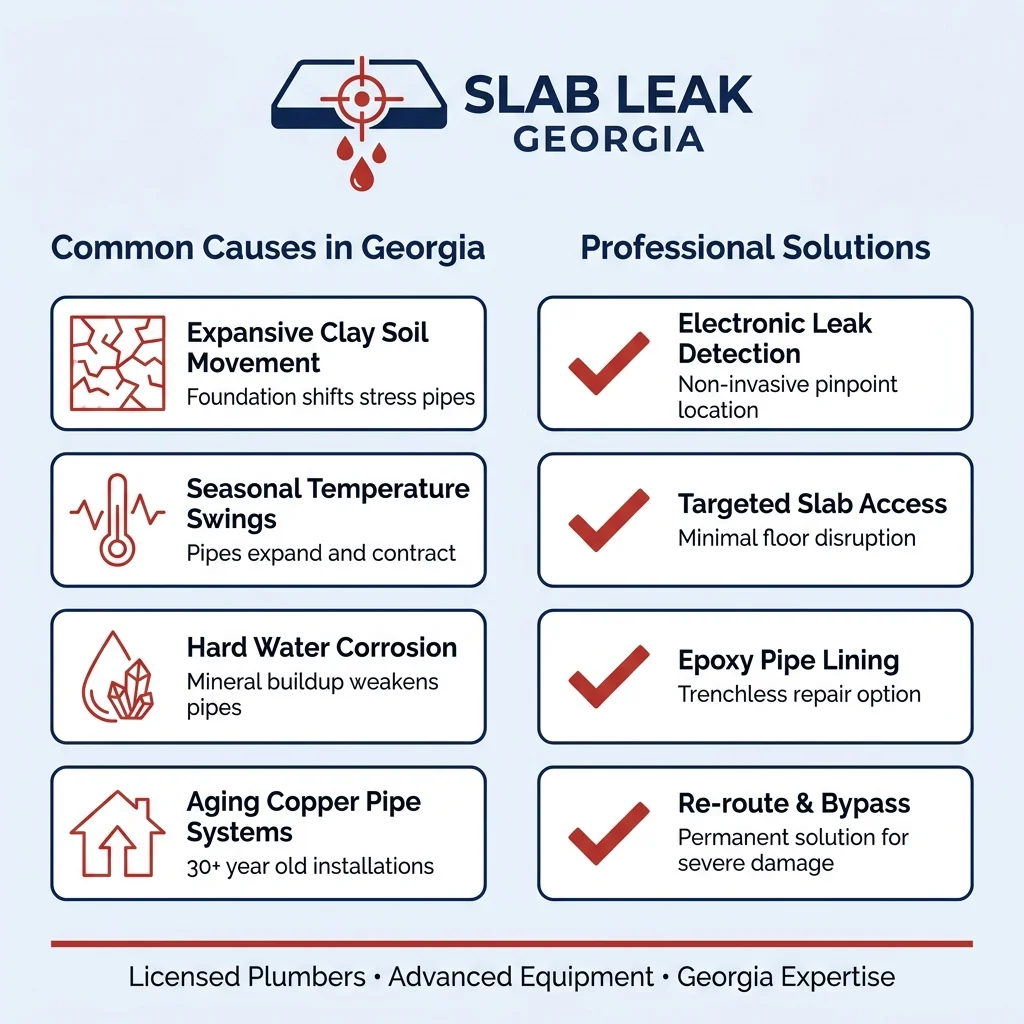
Expansive clay soil — Georgia's clay swells and contracts with moisture, stressing under-slab pipes.
Aging copper pipes — Homes built 1980-2000 are entering the 25-40 year corrosion failure window.
High water pressure — Many Atlanta-area homes receive 80-100 PSI, accelerating pipe wear.
Licensed slab leak contractors in Wrightsville, Johnson County — we handle all permitting, inspections, and insurance documentation. Our electronic detection technology finds leaks without exploratory concrete breaking. Call +1-866-779-0723 for a free estimate and same-day service.
Why Wrightsville Homeowners Trust SlabLeakGeorgia.com
When your home's foundation is at risk, you need experienced professionals with the right equipment and commitment to quality.
Licensed & Certified
Every technician holds a Georgia Master Plumber License and undergoes continuous training on the latest detection technology.
24/7 Emergency Response
Active slab leaks don't wait for business hours. Our emergency teams are always ready to respond when you need us most.
Advanced Detection Equipment
We invest in professional-grade acoustic, thermal, and pressure testing equipment that pinpoints leaks without unnecessary damage.
Transparent Pricing
Written estimates before we start, no hidden fees, and detailed documentation for insurance claims.
Warranty Protection
All repairs backed by comprehensive warranties. We stand behind our work with guaranteed quality.
Local Expertise
We understand Georgia's unique soil conditions, building codes, and the specific challenges that cause foundation leaks in your area.
Slab Leak Repair Costs in Wrightsville, GA
No hidden fees. No surprise charges. Just honest pricing for quality slab leak services.
Leak Detection
- check_circleComplete home inspection
- check_circleAcoustic leak detection
- check_circleThermal imaging scan
- check_circlePressure testing
- check_circleWritten location report
- check_circleRepair estimate included
Spot Repair
- check_circleDetection included
- check_circleConcrete access & removal
- check_circlePipe repair or replacement
- check_circlePressure testing
- check_circleConcrete restoration
- check_circle1-year warranty
Complete Re-piping
- check_circleAll new water lines
- check_circleCeiling/wall routing (no slab)
- check_circleModern PEX materials
- check_circleFull system pressure test
- check_circleSame-day water restoration
- check_circle10-year warranty
Insurance & Financing Information
Many homeowners insurance policies cover the cost of accessing and repairing slab leaks. We provide detailed documentation for insurance claims. Ask about financing options for repairs not covered by insurance.
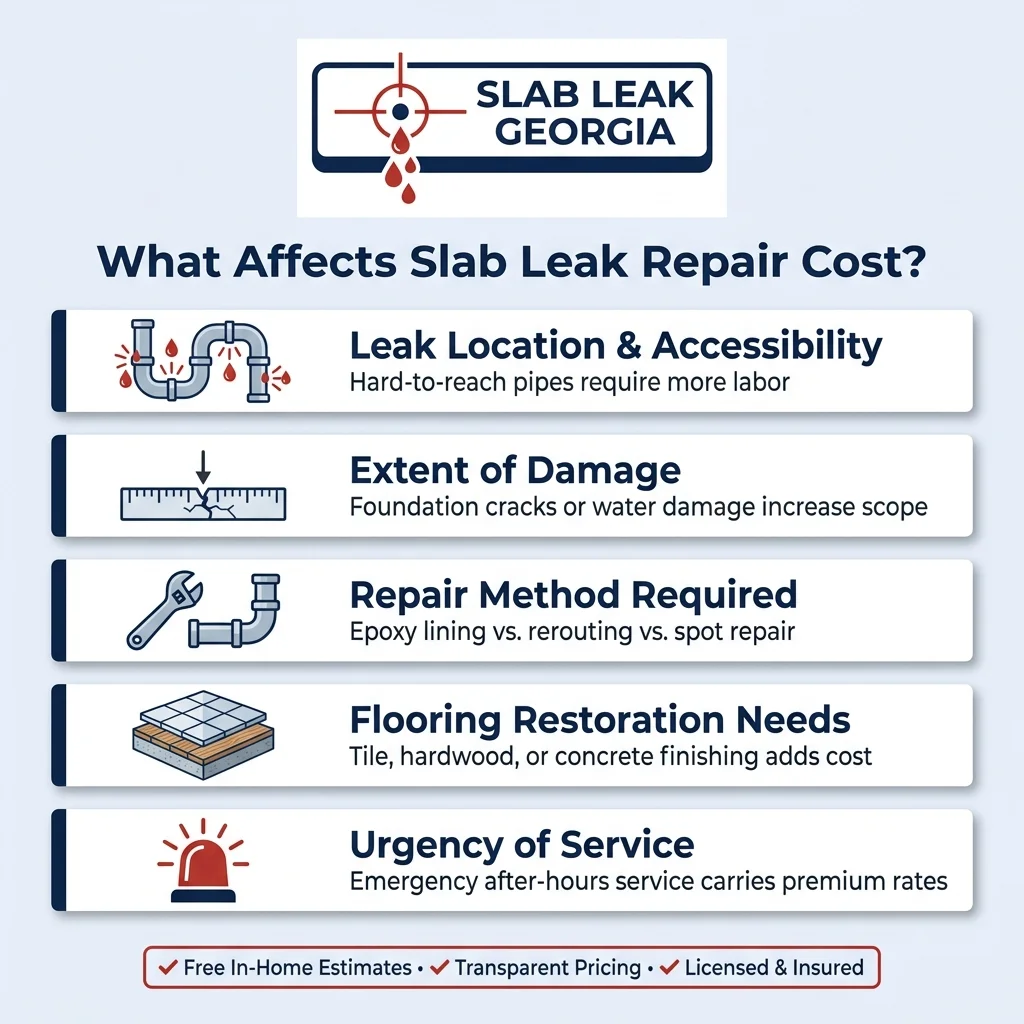
Factors affecting cost: Leak depth, accessibility, number of leaks, pipe material, foundation type, and chosen repair method. We provide written estimates before starting any work.
How Slab Leak Repair Works
From detection to repair, we make the process simple and stress-free for Georgia homeowners.
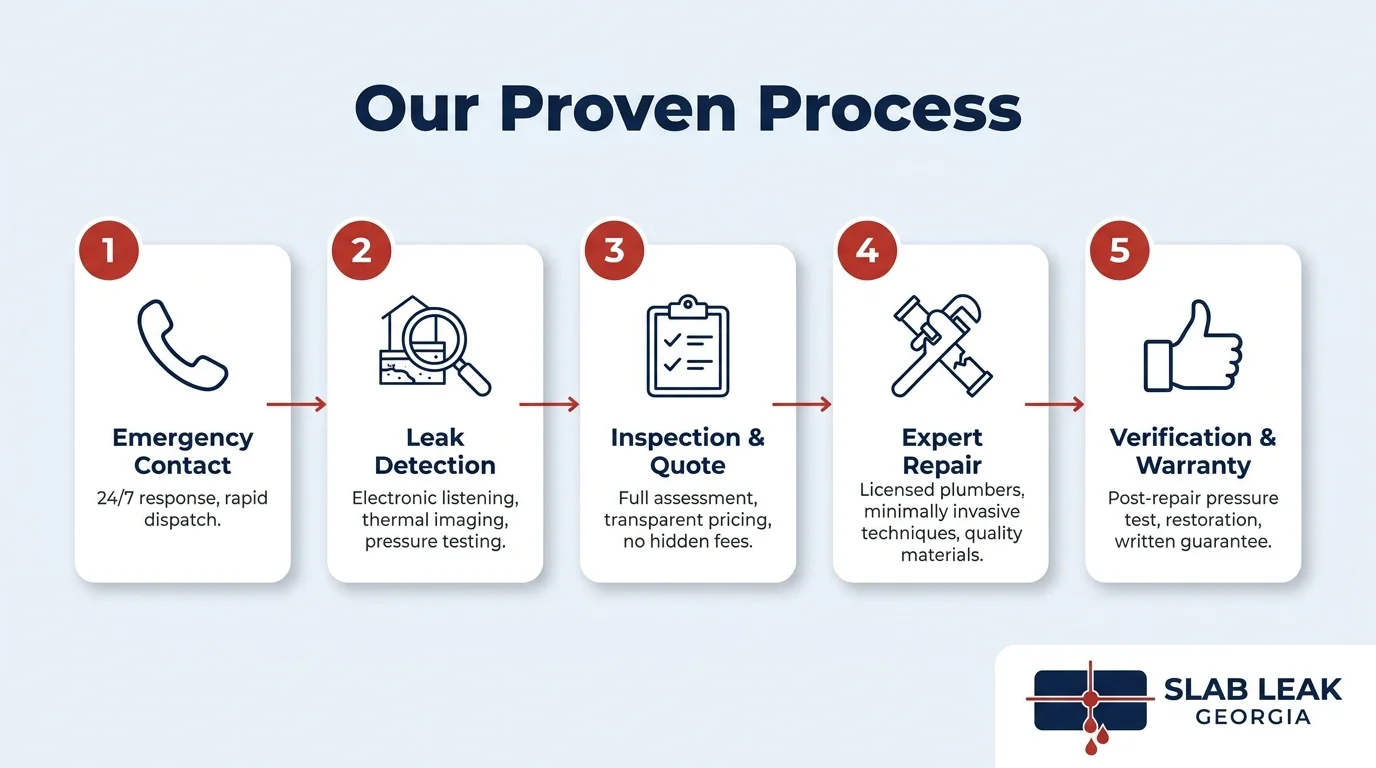
Call for Inspection
Contact us for a comprehensive slab leak inspection. We'll ask about symptoms and schedule a convenient time.
Electronic Detection
Our technicians use acoustic listening devices and thermal imaging to pinpoint the exact leak location without breaking concrete.
Repair Options & Estimate
We present all repair options with transparent pricing: spot repair, epoxy lining, or re-piping. You choose what's best for your home.
Expert Repair & Warranty
Licensed technicians complete foundation-safe repairs with minimal disruption. All work backed by comprehensive warranty.
Don't let an under-slab water leak in Wrightsville destroy your foundation. Johnson County's trusted slab leak specialists offer trenchless epoxy lining, spot repair, and complete repiping with full warranties. Call +1-866-779-0723 now — we answer 24/7.
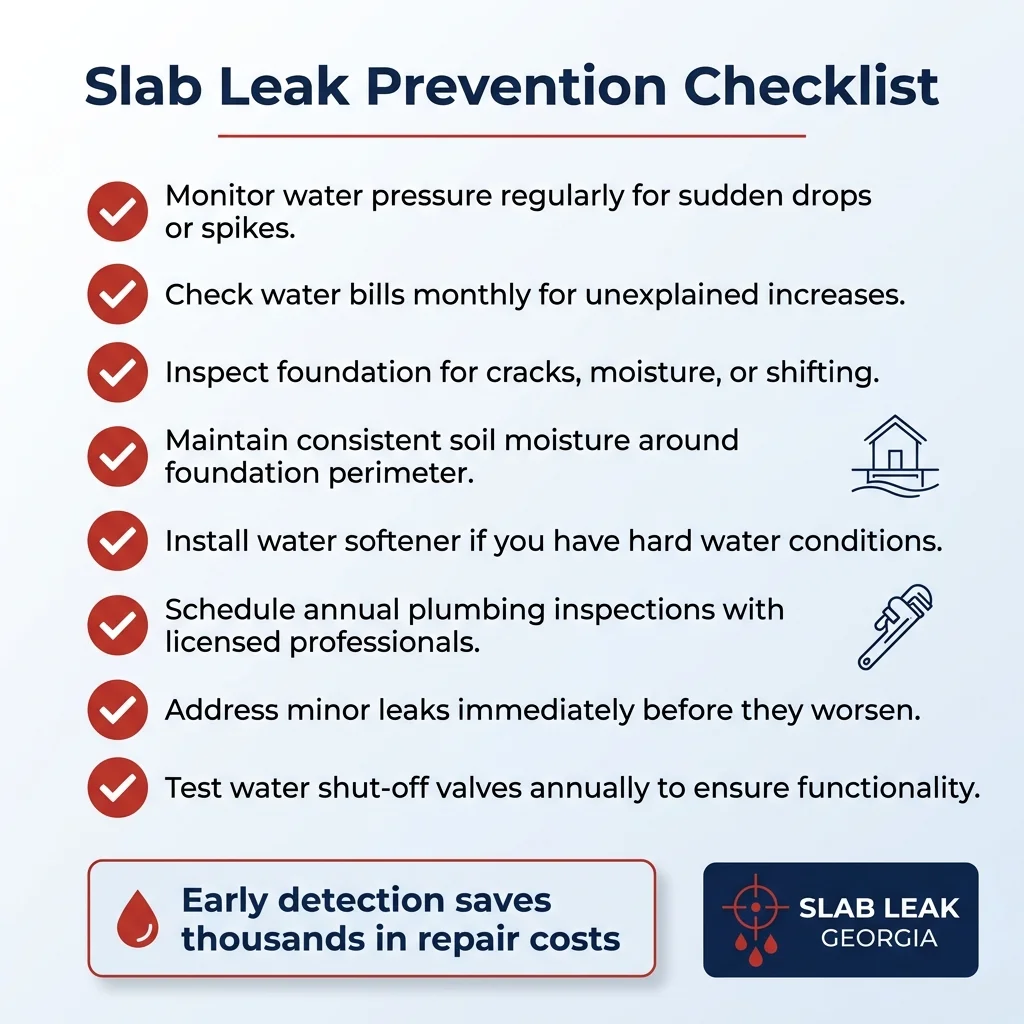
Slab Leak Prevention for Wrightsville Homes
Understand your risk factors and take action before a leak damages your foundation
Aging Copper Pipes
Homes built 1980-2000 with original copper plumbing are entering the 25-40 year failure window. If your home is in this range, annual pressure testing is recommended.
Expansive Clay Soil
Georgia's clay soil swells 10-15% when wet and shrinks when dry, bending rigid copper pipes with each cycle. Poor drainage around your foundation amplifies this stress.
Water Chemistry
Atlanta's moderately hard water (8-12 gpg) combined with chlorine creates internal pipe corrosion. High pressure above 80 PSI accelerates wear by 30-50%.
Prevention Strategies That Work
Why Professional Slab Leak Service Matters in Wrightsville
DIY attempts often cost more in the long run — here's the real comparison
DIY Attempt
- dangerousNo accurate detectionConsumer moisture meters can't sense through concrete. Exploratory holes cost $800-2,000 each.
- dangerousFoundation damage riskBreaking concrete without shoring causes slab sagging, wall cracks, and structural shifts.
- dangerousInsurance voidedDIY repairs are excluded from coverage. One attempt can void your entire claim.
- dangerousCode violationsFulton County requires licensed contractors for permits. Unpermitted work fines: $500-2,500.
Professional Service
- check_circleElectronic leak detectionPinpoints leaks within 1-2 feet without breaking concrete. No guessing, no exploratory holes.
- check_circleFoundation-safe repairsLicensed technicians use proper shoring and techniques that protect your home's structure.
- check_circleInsurance-compliantFull documentation, permits, and inspection reports support your claim if needed.
- check_circleCode-compliant + warrantedAll work permitted, inspected, and backed by warranty. Peace of mind included.
Wrightsville, Johnson County — licensed, insured, and ready to help
callCall +1-866-779-0723Licensed & Certified for Wrightsville
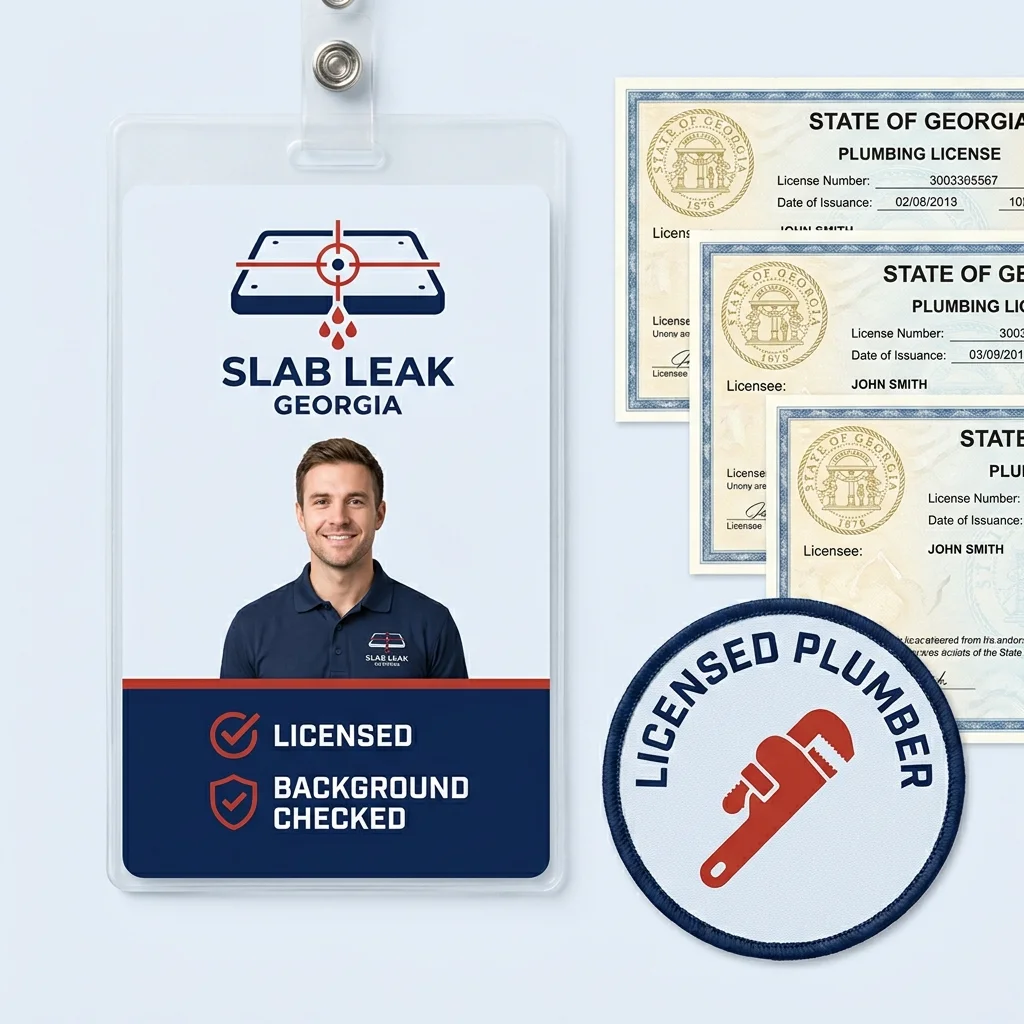
Every technician is a Georgia Master Plumber with credentials you can verify
Georgia Master Plumber
Licensed by the Georgia State Board of Construction Industry. Full compliance with all state and local requirements.
$1M+ Insured
Comprehensive general liability and workers' compensation insurance protects your home and our team.
Permits & Inspections
We handle all Wrightsville permit applications and coordinate required inspections. Code-compliant work guaranteed.
Workmanship Warranty
Every repair comes with a comprehensive warranty. If anything goes wrong, we fix it — no questions asked.
callCall +1-866-779-0723Slab Leak Warning Signs in Wrightsville
Most homeowners don't recognize slab leaks until foundation damage forces costly emergency repairs
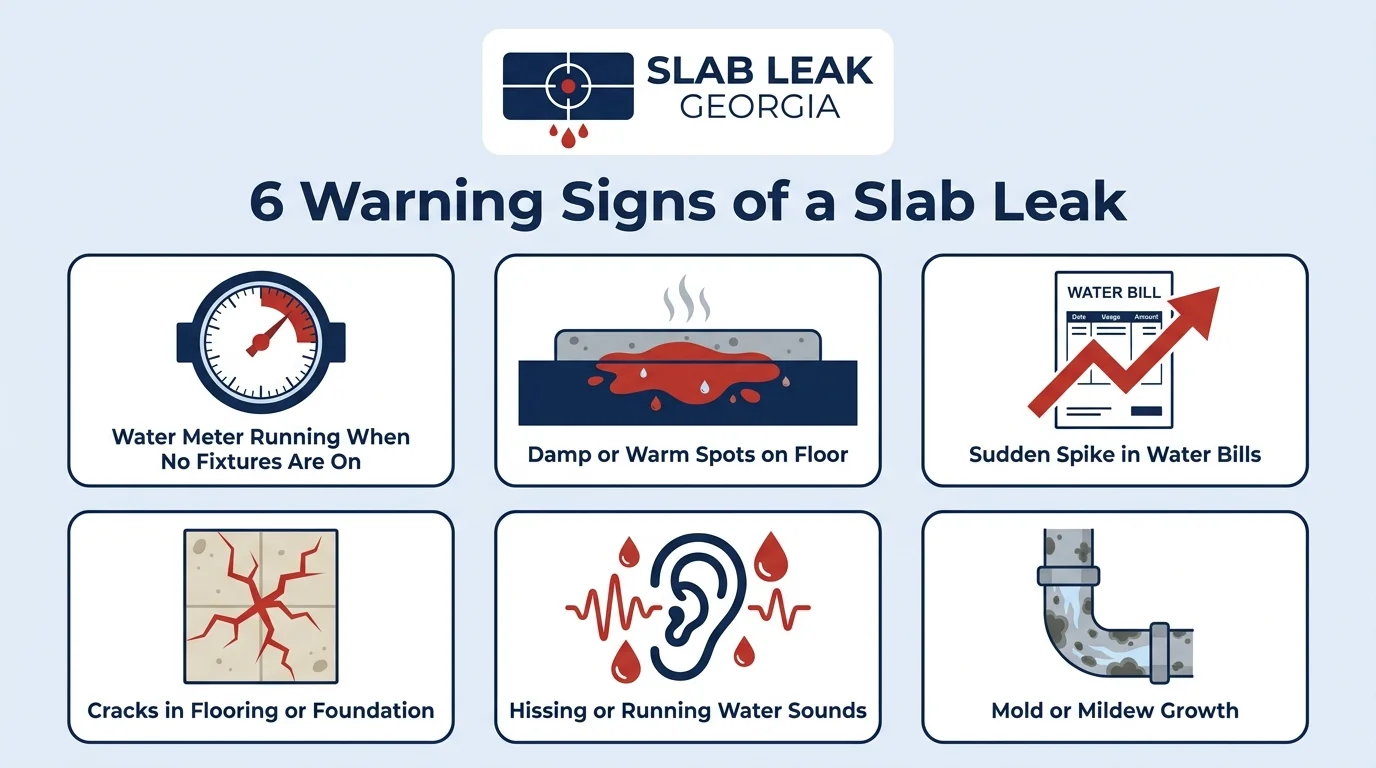
thermostatHot or Warm Spots on Your Floor
MODERATEA hot water supply line is leaking directly beneath that spot — active pressurized leak losing 20-100 gallons/day
expand_more
Hot or Warm Spots on Your Floor
MODERATEA hot water supply line is leaking directly beneath that spot — active pressurized leak losing 20-100 gallons/day
Turn off all hot water fixtures and water heater. Wait 30 min, then feel the warm area. If it stays warm, it's a continuous leak.
$2,000-5,000 in foundation repairs + $1,500-4,000 mold remediation after 2-3 months.
receipt_longSudden Water Bill Increase
HIGH30-50%+ jump with no usage change means pressurized supply line leak running 24/7
expand_more
Sudden Water Bill Increase
HIGH30-50%+ jump with no usage change means pressurized supply line leak running 24/7
Turn off all fixtures. Watch your water meter for 30 min. If the dial moves, you have a leak. Document with video.
$30-75/month in wasted water for moderate leaks. $100-300/month for severe leaks losing 200+ gallons/day.
hearingSound of Running Water
HIGHAudible hissing or rushing sound when all fixtures are off — leak losing 50-200+ gallons/day
expand_more
Sound of Running Water
HIGHAudible hissing or rushing sound when all fixtures are off — leak losing 50-200+ gallons/day
Turn off main water valve. Wait 5 min. If sound stops, it's a supply line leak. Note where sound is loudest.
Foundation repairs $5,000-10,000 if you wait months. Immediate detection limits damage to pipe repair only.
crisis_alertFoundation Cracks
URGENTNew cracks or widening existing cracks = soil erosion under slab from active leak
expand_more
Foundation Cracks
URGENTNew cracks or widening existing cracks = soil erosion under slab from active leak
Mark cracks with tape and date. Measure width daily. Growth >1/8 inch per week = immediate action needed.
$5,000 crack injection to $20,000+ underpinning. Fix leak within days limits damage to $0-2,000.
speedLow Water Pressure
MODERATELarge leak diverting water or decades of mineral buildup restricting flow in aging pipes
expand_more
Low Water Pressure
MODERATELarge leak diverting water or decades of mineral buildup restricting flow in aging pipes
Attach pressure gauge to outdoor hose bib. Normal: 50-70 PSI. Below 40 PSI = problem. Test at different times of day.
Continued corrosion leads to imminent leaks. Emergency repairs cost premium rates vs. planned replacement.
waterStanding Water Around Foundation
URGENTWater pooling at foundation with no recent rain = 100-300+ gallons/day leak, immediate structural risk
expand_more
Standing Water Around Foundation
URGENTWater pooling at foundation with no recent rain = 100-300+ gallons/day leak, immediate structural risk
Mark wet area. Turn off main water overnight. If drier in morning, source is plumbing, not groundwater.
Foundation waterproofing $3,000-8,000 + pipe repair. Severe cases requiring underpinning reach $15,000-25,000.
airMold or Mildew Smell
HIGHMusty odor or visible mold from chronic moisture under flooring — leak active long enough for mold colonization
expand_more
Mold or Mildew Smell
HIGHMusty odor or visible mold from chronic moisture under flooring — leak active long enough for mold colonization
Document with photos. Don't touch mold — disturbing releases spores. Open windows. Call for detection.
Early: $500-2,000 cleanup. Spread through walls/HVAC: $5,000-15,000 comprehensive remediation.
speedWater Meter Spinning
HIGHMeter shows flow with all fixtures off — definitive proof of active leak. No other explanation
expand_more
Water Meter Spinning
HIGHMeter shows flow with all fixtures off — definitive proof of active leak. No other explanation
Turn off ALL water-using devices. Watch meter for 30 min. Any movement = leak. Document spin rate on video.
$150-400/month in wasted water. $900-2,400 over 6 months + potential foundation damage on top.
Don't wait for foundation damage — call now for professional leak detection in Wrightsville
callCall +1-866-779-0723Trusted by Wrightsville Homeowners
"They found our leak in under 2 hours without tearing up our whole kitchen floor. The price was exactly what they quoted — no surprises."
— Sarah M., Wrightsville
"Emergency call at midnight on a Sunday. They answered immediately and had someone here within 2 hours. Saved our home from major water damage."
— Mike R., Johnson County
Repair or Replace?
Answer 5 questions — we'll recommend the best option
Repair vs Replace Decision Tool
Should you repair the leak or re-pipe the entire system?
Common Questions from Wrightsville Residents
Frequently Asked Questions
Get answers to common questions about slab leak detection and repair in Wrightsville.
How much does slab leak detection cost in Wrightsville?
expand_more
Professional electronic leak detection typically costs $300-$600 in Wrightsville. This includes a complete inspection with thermal imaging and acoustic equipment to pinpoint the exact leak location without breaking concrete. Many your County homeowners find this investment prevents thousands in unnecessary foundation damage.
What are the warning signs of a slab leak?
expand_more
Common signs include: unexplained water bill increases, sound of running water when all fixtures are off, warm spots on floors, cracks in walls or floors, mildew or excessive moisture, reduced water pressure, and foundation shifting. If you notice any of these signs in your Wrightsville home, call immediately for inspection.
How long does slab leak repair take?
expand_more
Most slab leak repairs in Wrightsville are completed within 1-3 days depending on the repair method. Simple spot repairs may take 6-8 hours, while epoxy pipe lining can be done in 1-2 days. Complete re-piping typically requires 2-4 days. We provide accurate timelines after inspection.
Will my homeowners insurance cover slab leak repair?
expand_more
Many Wrightsville homeowners insurance policies cover the cost of accessing and repairing the leak itself, though not the damage caused by long-term leaks. Coverage varies by policy. We provide detailed documentation for insurance claims and work directly with adjusters in your County.
Can you detect a slab leak without breaking my floor?
expand_more
Yes! We use advanced electronic detection equipment including acoustic listening devices, thermal imaging cameras, and pressure testing to pinpoint leaks without damaging your Wrightsville home. We only break concrete at the exact leak location after confirming its position.
What causes slab leaks in Georgia homes?
expand_more
In Wrightsville, common causes include: shifting clay soil that stresses pipes, corrosion from Georgia's mineral-rich water, poor installation during construction, ground settlement, and pipe friction from expansion/contraction. Homes built before 1980 with copper pipes are especially vulnerable in your County.
Hiring a Slab Leak Contractor?
15 critical points to verify before you hire anyone
Contractor Verification Checklist
Use this checklist when hiring a slab leak contractor
badgeLicensing & Insurance
precision_manufacturingDetection Equipment & Methods
receipt_longPricing & Business Practices
history_eduExperience & Reputation
Recommended minimum: 12/15 checked before hiring
Don't Let a Slab Leak Destroy Your Wrightsville, GA Home
Every hour counts when you have an active foundation leak. Our licensed technicians respond fast with professional electronic detection and expert repairs that protect your home's structural integrity.