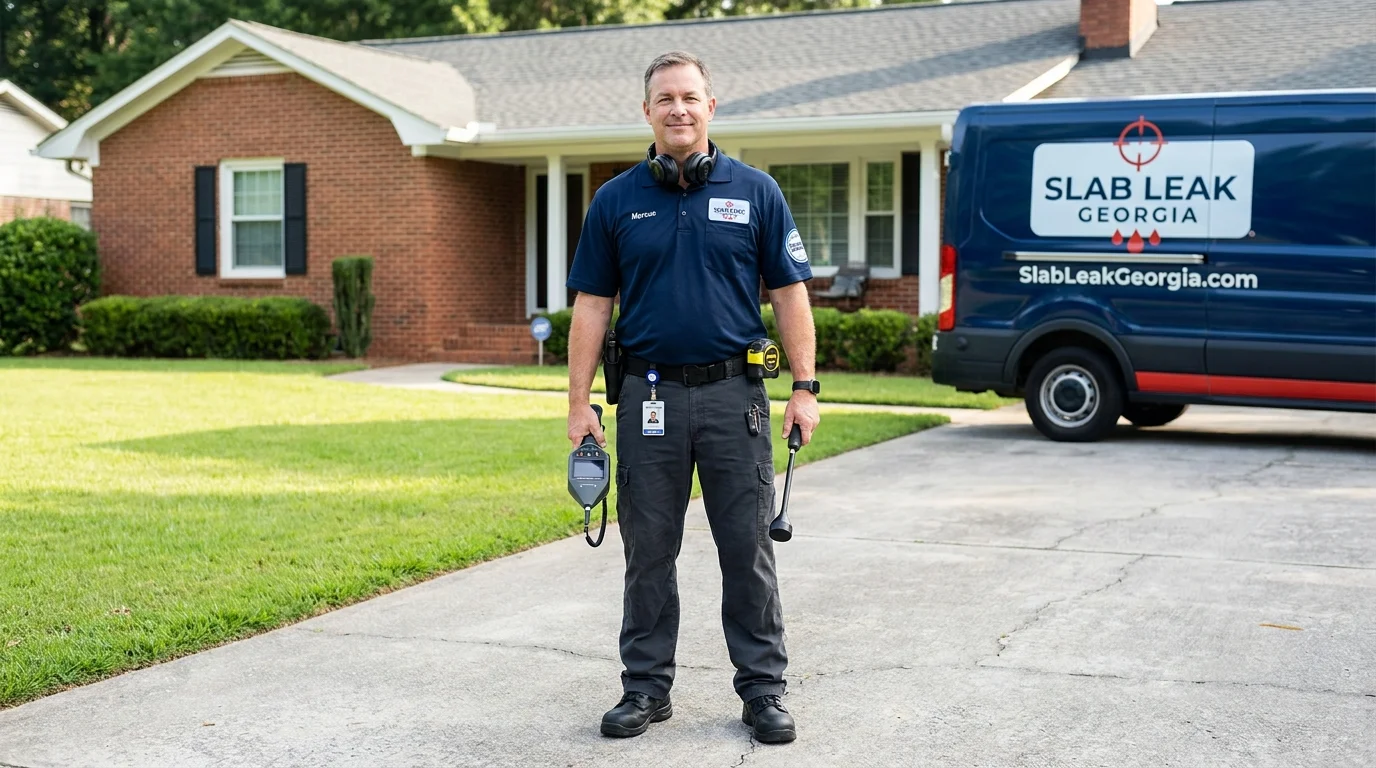
Slab Leak Detection & Repair in Rome, GA
Professional slab leak detection and repair in Rome and Floyd County. Electronic leak location, foundation-safe repairs, and emergency response when you need it most.
Water running with all fixtures off? Call immediately — active slab leak requires urgent attention.
Warm spots on floor or foundation cracks? Early detection prevents costly damage.
Get Your Free Estimate
No obligation. We'll help you understand your options.
Comprehensive Slab Leak Solutions
From electronic detection to complete repairs, we handle every aspect of slab leak service in Rome.
Electronic Leak Detection
Advanced acoustic and thermal imaging equipment pinpoints leaks without breaking concrete. Non-invasive detection saves time and money.
Learn Morearrow_forwardFoundation-Safe Repair
Expert slab leak repairs that protect your foundation integrity. Spot repairs, epoxy lining, or complete re-piping solutions.
Learn Morearrow_forward24/7 Emergency Response
Active slab leaks require immediate attention. Our emergency teams respond fast to prevent catastrophic water damage.
Learn Morearrow_forwardComplete Re-piping
When multiple leaks or old pipes threaten your foundation, complete re-piping provides permanent peace of mind.
Learn Morearrow_forwardLooking for slab leak detection in Rome? Our licensed technicians use advanced electronic equipment to pinpoint under-slab water leaks in Floyd County homes without breaking concrete. Call +1-866-779-0723 for same-day professional leak detection and repair service you can trust.
Do You Have an Emergency?
Check your symptoms — takes 30 seconds
Emergency Urgency Assessment
Check your symptoms to determine urgency level
Nearby Communities We Serve
Within 20 miles of Rome
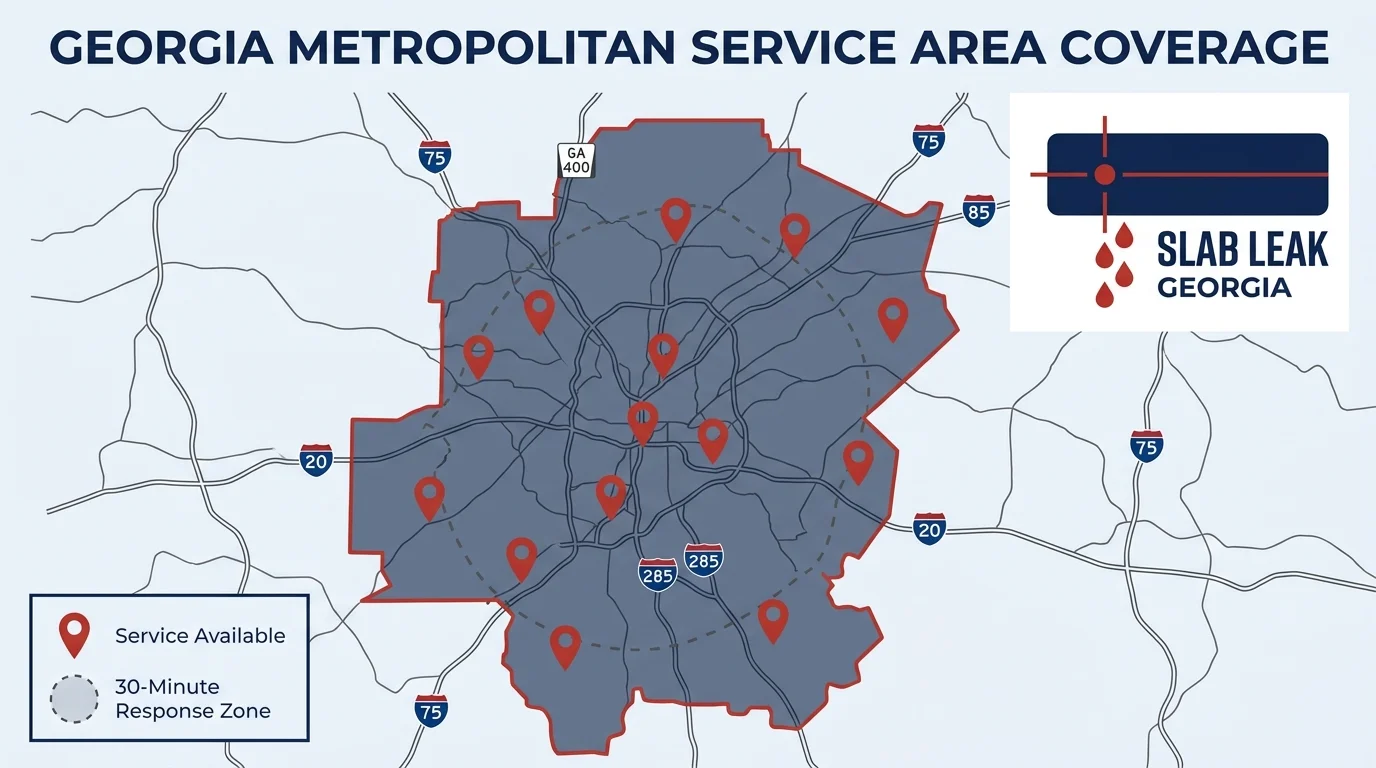
We serve 600+ cities across Georgia
location_searchingView All Service AreasServing Rome and all of Floyd County with expert slab leak detection and foundation-safe repair. Our team has helped hundreds of local homeowners stop water damage before it compromises their foundation. Emergency service available 24/7 — call +1-866-779-0723.
Experiencing These Symptoms?
Select all that apply — we'll help you understand what to do
Slab Leak Symptom Checker
Select all symptoms you're experiencing
What Is Slab Leak Repair in Rome, GA?
Slab leak repair in Rome addresses water leaks in pressurized supply lines running beneath your home's concrete foundation slab. These leaks occur when copper or galvanized pipes corrode from the inside due to water chemistry, or crack under external pressure from Georgia's expansive clay soil. Repair involves first pinpointing the leak's exact location using electronic or acoustic detection, then choosing a fix—trenchless epoxy lining, copper-to-PEX repiping, tunneling under the foundation, or targeted spot repair with concrete restoration.
Rome homeowners typically notice slab leaks through warm floor spots (hot water line leaks), unexplained spikes in water bills, the sound of running water when all fixtures are off, or foundation cracks that appear or widen. After 15 years detecting and repairing slab leaks across Floyd County, we know Rome's slab-on-grade foundations and clay soil create specific vulnerabilities. The clay shrinks during drought and swells when saturated—particularly after heavy rain near the Coosa, Oostanaula, and Etowah Rivers—placing constant stress on under-slab plumbing. Homes built before the 1990s with original copper pipes face the highest risk as corrosion reaches critical levels.
Urgency matters because foundation damage begins within 2-4 weeks of an active leak. Water saturates the clay soil beneath your slab, eroding support and creating voids that cause settling, cracking, and structural issues costing $5,000-10,000 or more if left unaddressed. Mold grows in damp subfloors within 24-48 hours, and a moderate leak wastes 100-200 gallons daily—adding $50-150 monthly to your Rome water bill until repaired. If you're seeing active pooling, foundation cracks, or your meter spinning with all water off, call +1-866-779-0723 immediately for same-day emergency response across Rome's 30165, 30161, 30162, and 30164 ZIP codes.
Emergency Service Available
Active leaks need immediate attention
24/7 Emergency Slab Leak Repair in Rome, Georgia
When to Call Immediately
Call +1-866-779-0723 right now if you notice any of these urgent symptoms:
- Active water pooling around your foundation perimeter: Water surfacing outside your home's slab edge indicates a severe under-slab leak saturating Floyd County's clay soil, which can create foundation voids within days.
- Hot water completely out with a confirmed hot floor spot: Your hot water line has failed under the slab. Mark the warm area with tape and call immediately—continued leaking damages subfloor and foundation.
- Foundation cracks appearing or widening visibly: Measure crack width daily. Cracks growing more than 1/8 inch per week signal active soil erosion from a slab leak. Rome's expansive clay soil accelerates this damage.
- Water meter spinning continuously when all water is off: Turn off every fixture, appliance, and irrigation. If the meter dial moves, you have a pressurized supply line leak running 24/7.
- Standing water inside your home coming up through the floor: This means the leak has saturated the soil beneath your slab to the point of hydrostatic pressure forcing water upward—foundation integrity is at immediate risk.
- Doors or windows suddenly sticking, walls cracking: These structural signs indicate foundation settling from soil erosion. Slab leaks in Rome's clay soil cause rapid, uneven settling.
- Sewage odor from floors or baseboards: This suggests a drain line failure under the slab, not just a supply leak. Health hazard—call immediately for video inspection and repair.
Same-Day Service Availability in Rome
We dispatch technicians to Rome addresses within 2-3 hours for confirmed slab leak emergencies. Service vehicles are fully stocked with electronic leak detection equipment, acoustic sensors, thermal imaging cameras, pipe repair materials, PEX repiping supplies, and concrete patching tools—prepared to complete 90% of emergency repairs on the first visit.
Serving all Rome ZIP codes: 30165 (downtown Rome and Shorter University area), 30161 (Berry College and Mount Berry), 30162 (West Rome toward Coosa River), and 30164 (South Rome and Cave Spring Road corridor). Extended coverage includes Lindale (5.4 miles), Shannon (7.7 miles), and Kingston (14 miles).
Night and weekend emergency calls carry no extra charge. If your water meter is spinning, foundation is cracking, or you have standing water, we respond the same day—no premium for after-hours service.
What Happens When You Call
Phone Triage (5-10 minutes): When you call +1-866-779-0723, we ask about your symptoms, home age, foundation type (most Rome homes are slab-on-grade), and whether you've already shut off water. If you're experiencing active flooding or foundation movement, we guide you through emergency water shutoff at the main valve—typically located near your water heater, in the garage, or at the street meter. Turn the valve clockwise to close.
Immediate Dispatch: Technician is dispatched to your Rome address with detection and repair equipment. For true emergencies (active water, structural damage), we prioritize arrival within 2 hours.
On-Site Assessment (30-60 minutes): First priority is stopping active water flow. We locate your main shutoff, assess foundation damage risk, verify the leak exists (static pressure test if needed), and determine if temporary mitigation is required before full detection. If your home has experienced recent flooding from the Oostanaula or Coosa Rivers, we check for saturated soil conditions affecting detection accuracy.
Leak Detection (1-3 hours): We use electronic detection (electromagnetic pipe locators and ground microphones) for most Rome homes with copper pipes under accessible slabs. For deeper post-tension foundations or complex layouts, we deploy acoustic detection. Thermal imaging confirms hot water line leaks. We pinpoint the leak location within 1-2 feet and mark your floor with tape.
Mitigation and Repair Options: Once located, we present your options: emergency shut-off and bypass (temporary), trenchless epoxy lining (permanent, no concrete breaking), copper-to-PEX rerouting (fast, above-slab), tunneling (preserves floors), or spot repair with concrete restoration. We explain timeline, cost, and which method works best for your Rome home's foundation type and Floyd County's clay soil conditions. You'll know exactly what we found, what each repair costs, and what we recommend—before any work begins.
Emergency Same-Day Repairs: For accessible leaks with homeowner approval, we can complete emergency rerouting (4-8 hours) or epoxy lining (same-day application, overnight cure) to restore water service immediately. Complex repairs requiring tunneling or extensive concrete work are scheduled within 24-48 hours, with temporary water restoration provided if needed.
Call +1-866-779-0723 now—if you're experiencing any of the urgent symptoms above, we'll have a licensed technician dispatched to your Rome address within hours, not days.
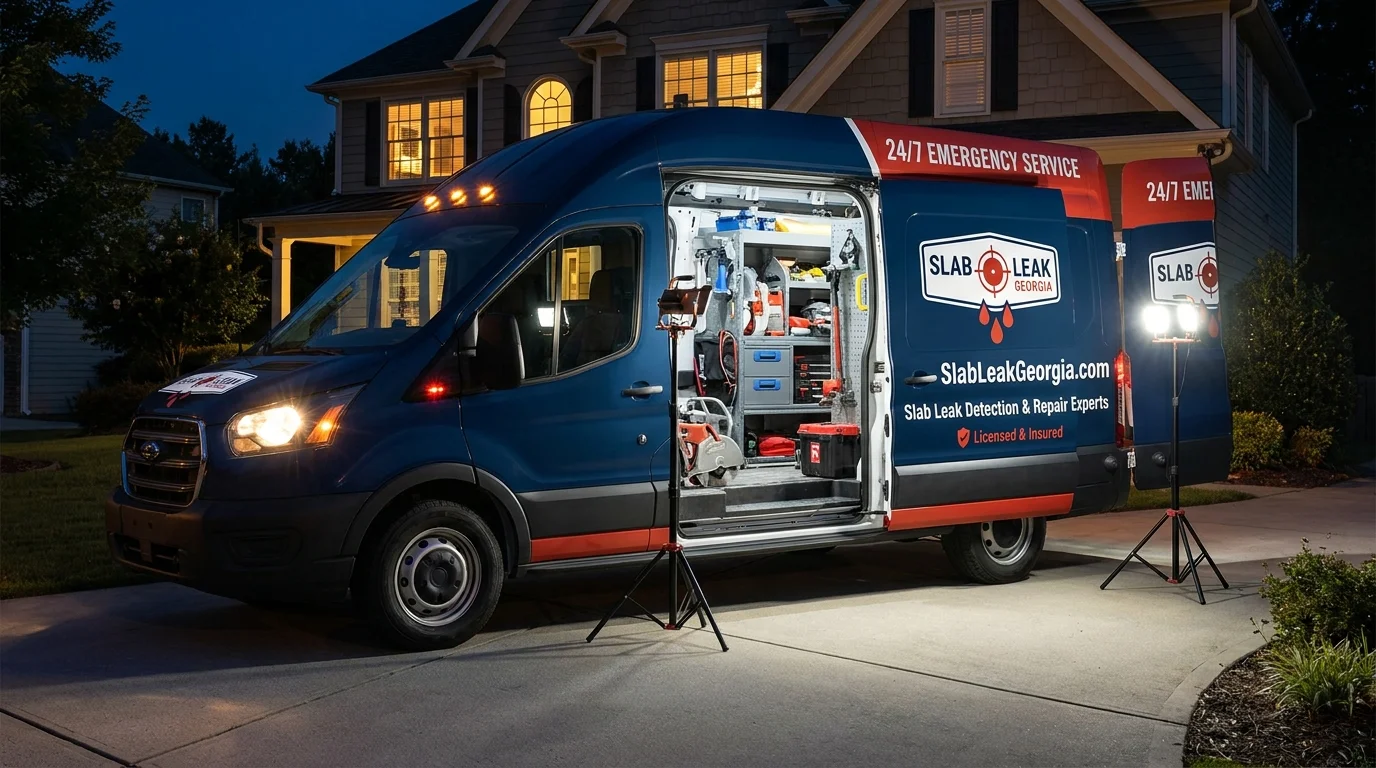
24/7 Emergency Response — We answer at any hour
callCall +1-866-779-0723How Slab Leak Detection & Repair Works in Rome
Slab leak repair in Rome follows a two-phase service model: detection first, then repair method selection. We never break concrete before confirming the exact leak location—guessing leads to unnecessary demolition, wasted money, and missed leaks. Detecting the leak precisely allows us to recommend the most cost-effective repair method based on what we find: leak location, pipe condition, accessibility, and your budget. Detection typically takes 1-3 hours depending on your home's layout and whether we're hunting one leak or multiple problem areas. Once we mark the leak and assess the pipe's overall condition, you'll understand your repair options and can make an informed decision. Timelines range from same-day rerouting (4-8 hours) to two-week spot repairs that include concrete curing time.
Phase 1: Pinpointing the Leak Location
We choose the detection method based on your symptoms, home characteristics, and Rome's construction patterns. Electronic leak detection uses electromagnetic pipe locators and ground microphones to pinpoint leaks in copper or PEX supply lines—we pressurize your system, scan with specialized equipment, and mark the floor within 1-2 feet of the leak source. This method works well for Rome's typical slab-on-grade foundations and handles most pressurized water line leaks efficiently. Acoustic detection listens for the sound frequency of water escaping under pressure, effective for deeper slabs or post-tension foundations where electromagnetic signals struggle. Rome homes built in the 1980s-1990s sometimes have thicker slabs or rebar that dampens electromagnetic fields, making acoustic the better choice.
Thermal imaging detects hot water leaks by identifying temperature differentials through flooring—we scan your floors with infrared cameras to locate thermal anomalies from hot water seeping under the slab. This method only works for hot water line leaks and requires noticeable temperature contrast, so it's most effective in cooler months when the difference between hot water and surrounding concrete is pronounced. For homes with multiple suspected leaks or aging copper systems nearing failure, we start with static pressure testing: close the system, pressurize it, and monitor pressure drop over time to confirm a leak exists before deploying invasive detection methods. Video pipe inspection sends a camera through cleanouts to assess interior pipe condition, revealing corrosion, scale buildup, or multiple weak points that indicate whole-house repiping may be more cost-effective than chasing individual leaks.
Detection output includes the marked floor location (we use spray paint or tape to show you the exact spot), photo documentation of our findings, and a pipe condition assessment. If we find one clean leak in otherwise healthy copper, spot repair makes sense. If we discover widespread interior corrosion or multiple pinhole leaks forming, we'll explain why repiping prevents future failures. Rome's moderate water hardness from the Coosa River system accelerates mineral buildup inside copper pipes, especially in homes over 20 years old—video inspection reveals whether your entire system is compromised or just one section failed. Detection costs range from $300-1,000 depending on your home's size, accessibility, and whether we're confirming one leak or investigating multiple problem areas. Floyd County's expansive clay soil can mask leak locations by shifting moisture patterns, occasionally requiring multiple detection methods to triangulate the source.
Phase 2: Repair Method Selection
Once we know where the leak is and what condition your pipes are in, we present your repair options across a spectrum from minimally invasive trenchless methods to traditional spot repair. Method selection depends on leak location (under finished floors vs garage slab), pipe condition (one isolated failure vs systemic corrosion), your budget, floor type and value, and whether you prioritize speed, cost, or long-term prevention. Trenchless epoxy lining creates a permanent pipe-within-a-pipe seal without breaking concrete—best for single-line leaks in accessible systems where you want to preserve tile or hardwood. Copper-to-PEX repiping reroutes water lines through attics or crawlspaces, abandoning the under-slab section entirely—ideal for multiple leaks, aging copper systems, or homeowners who want to eliminate future under-slab failures permanently. Tunneling hand-digs under your foundation from the exterior to access the leak while preserving high-value interior flooring—common in Rome's historic district homes where original hardwood floors warrant the extra labor cost.
Spot repair with concrete restoration jackhammers a 2x3 foot section over the leak, repairs the pipe directly, and pours new concrete—the most budget-friendly permanent fix, typically used for garage or utility room leaks where concrete demolition and cure time don't disrupt daily life. Rerouting bypasses the leaking section by installing new PEX line above the slab through accessible attics or wall chases—the fastest, lowest-cost option when you need water restored same-day and can tolerate visible piping in some areas. We explain each method's pros, cons, timeline, and cost range based on your specific situation. A single hot water line leak under your kitchen with healthy surrounding pipes? Epoxy lining or spot repair makes sense. Multiple leaks in a 30-year-old Rome home with original copper throughout? Whole-house PEX repipe prevents the next failure and the one after that.
Timelines range from 4-8 hours for simple rerouting to 2-3 weeks for spot repairs that include concrete curing (you can walk on it after 24 hours, but full strength takes 7-14 days before flooring restoration). Costs range from $800-2,500 for rerouting to $6,000-15,000 for comprehensive whole-house repiping, with most single-leak repairs landing in the $2,000-5,000 range. Rome-specific factors affect method selection: Floyd County's clay soil makes tunneling more expensive than in sandy soils due to shoring requirements, but the soil's stability means tunnels hold shape well. Homes in Rome's 30165 and 30161 ZIP codes built before 1990 often have copper pipes reaching failure age—we factor your home's construction era into our recommendations because one leak today usually signals more failures coming soon. Need slab leak detection in Rome? Call +1-866-779-0723 for same-day service and transparent repair options.
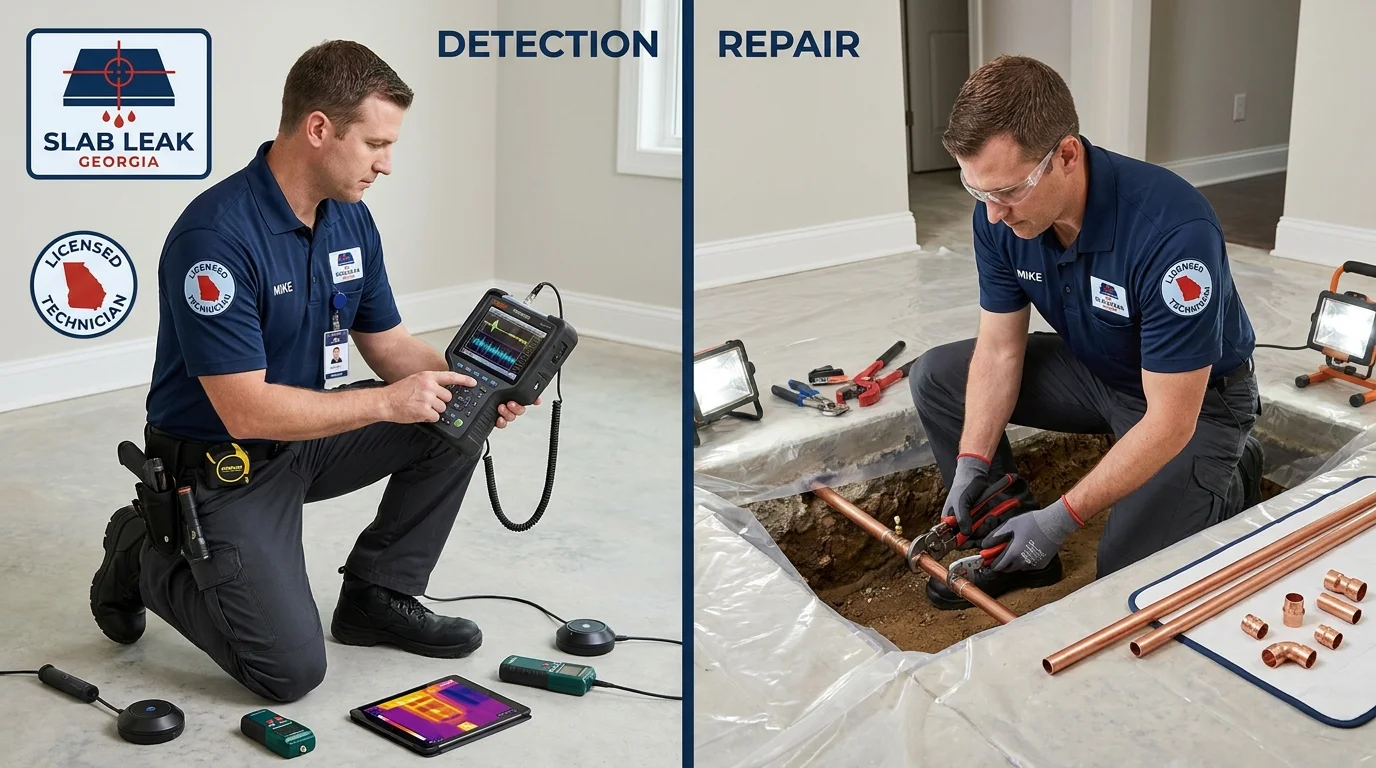
Slab Leak Detection Methods for Rome Homes
Electronic Leak Detection in Rome
Electronic leak detection uses electromagnetic pipe locators and ground microphones to find pressurized leaks in copper and PEX supply lines beneath Rome's concrete slabs. A technician pressurizes your water system to 80-100 PSI (below Georgia code's 150 PSI test threshold), then sweeps an electromagnetic sensor across your floor to trace the pipe route. When the sensor crosses the leak point, it detects the electromagnetic field disruption caused by escaping water. Ground microphones confirm the location by amplifying the sound frequency of water escaping under pressure—typically a hissing or rushing noise inaudible to the human ear alone.
During detection, you'll see the technician methodically grid your floors, marking pipe routes with tape and circling hot spots where signals intensify. The process takes 1-2 hours for an average Rome home. Once pinpointed, we mark the leak location within 12-18 inches, photograph the spot, and explain what we found before any demolition begins.
Electronic detection works best for single-leak scenarios in accessible slab-on-grade foundations common in Rome's post-1970s neighborhoods—homes in the 30165 downtown corridor, the 30164 South Rome subdivisions, and newer construction near Berry College in 30161. The method struggles in Floyd County's saturated clay soil after heavy rain, as wet soil dampens electromagnetic signals and creates false positives. We also can't detect drain leaks with this method—only pressurized supply lines emit the electromagnetic signature we're tracking.
Rome's older homes built before 1990 typically have copper pipes now reaching the 25-35 year corrosion threshold. If your home was built during this era and you're experiencing symptoms, electronic detection is our first-line method because it's non-invasive, fast, and accurate for the copper systems common in Rome's vintage housing stock. Floyd County's moderate water hardness (8-12 grains per gallon) accelerates internal copper corrosion, so pinpointing the first leak often reveals other weak points we'll flag during inspection.
Accuracy within 12-18 inches lets us cut a 2x3 foot concrete section for spot repair rather than guessing and breaking 6-8 feet of slab. Limitations: we need accessible pipe ends (cleanouts, shut-off valves, or water heater connections) to pressurize the system. Homes without cleanouts require temporary access installation, adding 30-60 minutes. The method also can't penetrate post-tension slab foundations—if your Rome home has post-tension cables (common in some 1980s-1990s construction), we switch to acoustic detection instead.
Cost in Rome ranges $300-$500 for straightforward single-leak detection in homes under 2,000 square feet. Larger homes, multiple suspected leaks, or difficult access (crawlspace routing, exterior meter locations) push costs toward $600-$800. Detection typically takes 1-2 hours including pressurization, scanning, acoustic confirmation, and documentation.
We recommend electronic detection when you report a sudden water bill spike, hear running water with all fixtures off, or notice a hot floor spot in one specific area. If your Rome home is 20-35 years old with original copper pipes and you're experiencing any slab leak symptoms, electronic detection gives us the fastest, most accurate diagnosis before any invasive work begins.
Acoustic Leak Detection for Deep Foundations
Acoustic leak detection amplifies the sound of water escaping from pressurized pipes under your foundation using ground microphones and vibration sensors. When water under 50-80 PSI pressure escapes through a pipe crack or pinhole, it creates a distinct frequency—a hissing, whooshing, or vibrating sound transmitted through soil, concrete, and subfloor materials. Professional acoustic equipment filters out ambient noise (HVAC systems, traffic, appliances) and amplifies leak frequencies in the 100-3000 Hz range, letting us triangulate the source.
A technician places sensors at multiple points across your floor, pressurizes your water system, then listens through headphones while adjusting sensor placement to track the loudest signal. Peak amplitude indicates the leak's epicenter. The process requires patience and skill—interpreting acoustic signatures in Floyd County's dense clay soil takes experience, as clay transmits sound differently than sandy or rocky subsoil.
Acoustic detection is the right choice for post-tension slab foundations found in some Rome homes built during the 1980s-1990s construction boom. Post-tension slabs contain steel cables under tension, creating electromagnetic interference that renders electronic detection unreliable. Acoustic methods ignore electromagnetic noise and listen purely for mechanical sound. We also choose acoustic detection for deep slabs over 6 inches thick, which is common in Rome's commercial-grade residential foundations built to withstand Floyd County's expansive clay soil cycles.
In Rome, acoustic detection proves most effective during dry periods when clay soil shrinks and compacts, transmitting sound clearly. After heavy rain or during spring thaw, saturated clay dampens acoustic signals and creates false echoes, requiring closer sensor spacing and longer detection time. If your Rome home sits near the Oostanaula or Etowah Rivers in low-lying areas prone to soil saturation, we schedule acoustic detection during dry weather for maximum accuracy.
The method pinpoints leaks within 1-3 feet depending on soil density and slab thickness. It's less precise than electronic detection but more reliable when electromagnetic methods fail. We can't use acoustic detection for slow seep leaks under 20 PSI pressure—there's not enough flow velocity to generate detectable sound. It also requires pressurizing the system to working pressure, which temporarily stresses aging pipes. If we suspect multiple weak points, we monitor pressure carefully to avoid causing a secondary failure during testing.
Detection takes 2-3 hours for homes with complex layouts or multiple potential leak zones. We often grid the floor in sections, systematically eliminating areas with no acoustic signature before narrowing to the loudest zone. For Rome's larger two-story homes in the 2,500-3,500 square foot range, detection can extend to 4 hours if leaks are located under interior rooms far from exterior access points.
Cost in Rome ranges $400-$700 for single-leak acoustic detection, increasing to $800-$900 for multi-zone scanning in larger homes or when we combine acoustic with electronic methods for complex cases. The higher cost reflects longer technician time and the specialized skill required to interpret acoustic data in Georgia's challenging soil conditions.
We recommend acoustic detection when electronic methods show inconclusive results, when your home has a post-tension foundation, or when the suspected leak is deep under the slab in a main supply line rather than a branch line. If you've already had unsuccessful detection attempts with other providers, acoustic methods often succeed where electromagnetic scanning failed. For Rome's historic homes with thick original slabs or unusual foundation construction, acoustic detection provides the reliability we need before committing to invasive repair work.
Thermal Imaging Leak Detection
Thermal imaging uses infrared cameras to detect temperature differences caused by hot water leaking beneath your foundation. When hot water (140-160°F from your water heater) escapes through a pipe crack, it heats the concrete slab and subfloor materials directly above, creating a thermal signature visible to infrared sensors. The camera displays a thermal map of your floors, with warmer areas appearing as bright spots in red/yellow and cooler areas in blue/green. A trained technician interprets these patterns to identify leak locations.
The process is completely non-invasive. We scan your floors methodically, room by room, capturing thermal images that reveal temperature anomalies. The scan takes 45-60 minutes for an average Rome home. Once we identify a hot zone, we correlate it with pipe routing (traced from water heater location) and confirm the finding with secondary detection methods like electronic or acoustic scanning before marking the leak for repair.
Thermal imaging only works for hot water line leaks—cold water at 55-70°F doesn't create enough temperature contrast to show on infrared scans. Even a major cold water leak appears thermally invisible. In Rome, this limitation matters because Floyd County's copper pipes corrode on both hot and cold lines due to the region's moderate water hardness. If your symptoms point to a cold water leak (pressure loss with no hot floor spots), we skip thermal imaging and go straight to electronic or acoustic detection.
Thermal imaging is most effective during winter months when ambient temperature differences are greatest—a 140°F leak shows more contrast against a 65°F floor than against a 78°F summer floor. In Rome's climate, we get the best thermal imaging results from November through March. Summer scans still work but require longer analysis time and higher camera sensitivity. We also recommend thermal scanning for radiant floor heating systems, which use hot water circulating through under-slab tubing. Thermal cameras quickly identify circulation breaks or leaks invisible to other detection methods.
Rome's slab-on-grade foundations respond well to thermal imaging because concrete conducts heat efficiently and there's minimal insulation between the leak and the floor surface. Homes with thick carpet or multiple layers of engineered flooring may show muted thermal signatures, requiring longer dwell time for the heat to penetrate. We advise homeowners to run hot water for 10-15 minutes before scanning to maximize the thermal contrast.
Accuracy depends on leak size and temperature differential. A pinhole leak may take hours to heat the slab enough for detection, while a 1/4-inch crack shows immediately. We typically pinpoint hot water leaks within 2-3 feet, which is less precise than electronic detection but still far better than exploratory concrete breaking. The method can't distinguish between a leak and a hot water line that's simply poorly insulated—we use secondary confirmation to rule out false positives.
Cost in Rome ranges $500-$800 depending on home size and floor complexity. Multi-story homes with hot water lines running through slabs on different levels increase scanning time and cost. Thermal imaging is often combined with electronic or acoustic detection for comprehensive diagnosis, especially if we find multiple hot zones or if cold water leak symptoms coexist with thermal findings.
We recommend thermal imaging when you report a hot floor spot that's grown larger over time, when your gas or electric bills spike alongside water usage (indicating the water heater is overworking), or when you've confirmed a hot water pressure loss but can't locate the leak by sound. For Rome homeowners noticing warm carpet in living areas or bedrooms—common hot water line routes—thermal imaging provides fast, non-invasive confirmation before we commit to repair planning.
Pressure Testing & Video Pipe Inspection
Static pressure testing confirms leak existence before we deploy targeted detection methods. We close all fixtures, cap the system, pressurize your water lines to 80-100 PSI using a test pump, then monitor pressure drop over 30-60 minutes. Georgia plumbing code requires new installations to hold 150 PSI for 15 minutes without loss; we use a gentler 80-100 PSI for existing systems to avoid stressing aging pipes. If pressure drops more than 5 PSI in 30 minutes, a leak exists somewhere in the system. The test doesn't tell us where, but it eliminates guesswork—we know for certain that money spent on pinpoint detection will find a real problem, not a phantom leak.
Pressure testing takes 45-90 minutes including setup and monitoring. We perform this test before electronic or acoustic detection in Rome homes where symptoms are ambiguous—maybe your water bill increased but you're not sure if it's a leak or just higher usage. The test provides certainty. Once pressure loss confirms a leak, we proceed to pinpoint detection with confidence.
Video pipe inspection threads a waterproof camera through cleanouts, drain lines, or accessible pipe sections to assess interior pipe condition. The camera transmits real-time video to a monitor, showing us pipe diameter, material, corrosion extent, scale buildup, root intrusion, and structural damage. We use video inspection when pressure testing reveals a leak but symptoms suggest multiple problem areas—common in Rome's homes over 30 years old where copper pipes have corroded throughout the system, not just at one point.
The video feed shows us whether pipes have 20% wall thickness remaining (repairable) or 70% corrosion (whole-house repipe recommended). For Rome homeowners deciding between spot repair and copper-to-PEX repiping, video inspection provides visual proof of system-wide condition, helping you make an informed choice. We can also record the inspection and provide still images for insurance claims or contractor consultations.
Video inspection requires accessible cleanouts or pipe ends. Rome's older homes often lack adequate cleanouts, requiring temporary access installation before we can thread the camera. We navigate 50-100 feet of pipe per cleanout depending on turns and obstructions. For complex systems, we may need multiple access points to view the entire hot and cold water network.
Pressure testing costs $250-$400 in Rome depending on system complexity—multi-story homes or homes with multiple water heater zones take longer to isolate and pressurize. Video inspection costs $300-$600 depending on how many pipe runs we inspect. Homes with extensive crawlspace or attic piping require more camera threading time, increasing cost. Combined pressure testing and video inspection typically run $500-$900, providing comprehensive system assessment before we recommend a repair strategy.
Timeline for pressure testing and video inspection is 2-4 hours total. We perform both in sequence: pressure test first to confirm a leak exists, then video inspection to assess the extent. If pressure testing shows no leak, we investigate other causes of your symptoms (malfunctioning water softener, irrigation system leaks, toilet flapper failures) before proceeding to foundation-focused detection.
We recommend pressure testing when you're unsure whether symptoms indicate a slab leak or another plumbing issue, when your water bill spiked but you see no obvious leak signs, or when you want to establish a baseline system pressure before buying or selling a Rome home. Video inspection is essential when you've already repaired one slab leak and want to know if more failures are imminent—if video shows widespread corrosion, investing in whole-house PEX repiping prevents repeat repairs over the next 5-10 years.
For Rome's historic homes built before 1980 with original plumbing, we strongly recommend video inspection as part of any slab leak diagnosis. These systems are at end-of-life, and repairing one leak without understanding overall pipe condition often leads to another failure within 6-18 months. Video evidence helps you plan proactively rather than reacting to repeated emergency repairs.
Slab Leak Repair Options Compared
Trenchless Epoxy Pipe Lining
Trenchless epoxy pipe lining repairs leaking pipes from the inside without breaking concrete. We access your water lines through existing cleanouts or shut-off valves, clean the interior with high-pressure water jetting or mechanical brushes to remove scale and corrosion, then blow-coat or pull-in-place an epoxy resin that coats the pipe walls. The epoxy cures for 4-6 hours at ambient temperature (or faster with heat if needed), creating a seamless pipe-within-a-pipe that seals leaks and prevents future corrosion. The lined section becomes structurally sound again with restored flow capacity.
Epoxy lining works best for single hot or cold water line leaks in accessible sections—the 30-50 foot runs from water heater to fixtures, or from main supply to branch lines. We can line copper, galvanized steel, or even old cast iron pipes if wall thickness is sufficient. The method requires at least 40% remaining wall thickness; pipes corroded beyond that collapse during the cleaning phase and can't hold epoxy. Video inspection prior to lining confirms structural integrity.
In Rome, epoxy lining is ideal for homes with high-value tile, hardwood, or specialty flooring in the leak zone. Downtown Rome's 30165 historic district homes often have original heart pine floors or vintage tile—breaking concrete and then matching historic materials costs $3,000-$6,000 in restoration alone. Epoxy lining preserves those floors entirely. The method also suits Rome homeowners who need a fast, minimally disruptive solution: we complete lining in 1-2 days (Day 1: detection and cleaning, Day 2: epoxy application and cure), far faster than concrete demolition and restoration.
Epoxy lining is permanent. The resin bonds molecularly to pipe interiors and resists Floyd County's moderate water hardness better than copper. We warranty epoxy-lined sections for the lifetime of the home, guaranteeing no leaks in the treated area. However, epoxy only repairs the section we line—if your copper system has multiple weak points elsewhere, another leak may surface in an unlined section within 1-3 years. For this reason, we recommend epoxy lining for isolated single leaks, not for systems with widespread corrosion visible on video inspection.
The process begins with pipe access, typically through under-sink shut-offs, hose bibs, or water heater connections. We close off the section to be lined, clean it with 2,000-3,000 PSI water jets or rotary brushes, then dry the interior with compressed air. For blow-coating, we inject two-part epoxy resin through one access point while pressurized air pushes it through the pipe, coating walls evenly as it travels. For pull-in-place liners (used in larger diameter pipes), we insert a resin-saturated felt sleeve and inflate it with air or water pressure, forcing the sleeve against pipe walls. Cure time is 4-6 hours, during which you can't use that water line. Once cured, we pressure-test the section to 100 PSI for 30 minutes, flush the system, and restore service.
Rome's slab-on-grade foundations allow straightforward access for epoxy lining. Homes built on crawlspaces in the 30162 West Rome area or elevated foundations near Berry College provide even easier access since we can work from below without cutting concrete. Post-tension slabs don't affect epoxy lining—we're working inside pipes, not disrupting the foundation structure.
Epoxy lining costs $2,000-$5,000 in Rome depending on line length and accessibility. A 30-foot hot water line from heater to kitchen (common in single-story ranch homes) runs $2,200-$3,200. A 50-foot cold water main supply line under a two-story home runs $3,800-$5,000. Costs increase if we need to install temporary cleanouts or if the pipe requires extensive cleaning due to heavy scale buildup—Rome's moderate water hardness creates mineral deposits that add 1-2 hours of cleaning time.
We don't recommend epoxy lining for severely corroded pipes below 40% wall thickness, pipes with active root intrusion (rare in slab foundations but possible in homes with large trees), or systems with multiple leaks across different line sections. If video inspection reveals widespread corrosion, copper-to-PEX repiping is more cost-effective than lining multiple sections individually.
Timeline for epoxy lining in Rome: Day 1 includes detection, access, and cleaning (4-6 hours). Day 2 includes epoxy application, cure monitoring, and final testing (6-8 hours). You'll have limited water service during Day 2's cure period—we isolate the lined section and restore cold water to most fixtures, but hot water or the specific line under repair remains offline until the epoxy hardens.
Floyd County requires a plumbing permit for epoxy lining since it modifies the plumbing system's materials. We handle permit applications through the Rome/Floyd County Inspections Department at 607 Broad Street, which typically approve within 24-48 hours. After lining and testing, we arrange a final inspection (required by local code) to document the repair.
Epoxy lining is our top recommendation when you've confirmed a single-line leak through detection, your home has flooring worth preserving, the leaking pipe has adequate wall thickness, and you want a permanent fix without the 2-3 week timeline of concrete spot repair. For Rome homeowners who prioritize speed and floor preservation, trenchless epoxy lining delivers both without compromise.
Need leak detection in Rome? Call +1-866-779-0723 for accurate pinpointing and repair method consultation.
Copper to PEX Repiping
Copper-to-PEX repiping replaces failing copper supply lines with cross-linked polyethylene (PEX) piping routed through attics, crawlspaces, or walls, bypassing the under-slab system entirely. PEX is flexible, corrosion-resistant, freeze-tolerant, and easier to install than rigid copper. We install a PEX manifold near your water heater or main supply, then run individual PEX lines (home-run system) to each fixture—one dedicated line per sink, toilet, shower, and appliance. This eliminates the branched trunk-and-branch copper network under your slab and gives you individual shut-off control at the manifold for every fixture.
Repiping is the long-term solution when Rome's moderate water hardness has corroded your copper system throughout, not just at one leak point. If your home is 20-35 years old with original copper pipes and you've already repaired one slab leak, the rest of the system is statistically near failure. Video pipe inspection showing 50%+ corrosion across multiple sections makes repiping more cost-effective than serial spot repairs over the next decade. Repiping also suits homeowners planning 10+ years of ownership who want to eliminate future under-slab leak risk permanently.
There are two repiping approaches: partial reroute and whole-house repipe. Partial reroute addresses only the leaking line, installing new PEX from manifold to the affected fixture group and abandoning the failed copper section in place under the slab. This costs less but leaves other aging copper lines intact, risking future leaks in unreplaced sections. Whole-house repipe replaces all hot and cold supply lines throughout the home, eliminating every copper pipe and converting the entire system to PEX. Whole-house repiping is our recommendation for Rome homes where copper has corroded system-wide.
In Rome, PEX repiping works exceptionally well because most homes have attic access. Homes in the 30161 Berry College area, 30164 South Rome subdivisions, and 30165 downtown corridor typically have accessible attics where we can route PEX without cutting walls. For homes built on crawlspaces in West Rome (30162), we route PEX through the crawlspace and up interior walls with minimal drywall cutting. Older homes without attic or crawlspace access require wall chases or soffit boxes for routing, adding labor time and cosmetic repair work.
PEX delivers several advantages beyond leak elimination. Flexible PEX expands slightly under pressure, absorbing the freeze-thaw cycles common in Rome's winters and reducing burst risk during rare hard freezes. PEX resists Floyd County's water chemistry better than copper—no internal corrosion from mineral deposits or dissolved oxygen. The home-run manifold system improves water pressure at fixtures since each line is dedicated rather than sharing flow with other fixtures. You also gain individual shut-off capability: if a toilet supply line fails, you shut off only that line at the manifold instead of killing water to the entire house.
The repiping process unfolds over 2-5 days depending on scope. Day 1: We install the PEX manifold near your water heater or main shut-off, drill access holes for attic/wall routing, and begin running trunk lines to major fixture zones (kitchen, bathrooms, laundry). Days 2-3: We complete individual home-run lines to every fixture, cut in new shut-off valves under sinks and behind toilets, and connect supply lines. Day 4: We pressure-test the entire system to 100 PSI per Georgia code, flush lines to clear debris, and verify flow at each fixture. Day 5 (if needed): We patch drywall access holes, touch up paint, and complete exterior wall penetrations with weatherproofing.
During repiping, your water service is offline for 4-8 hours per day while we make connections. We restore service each evening so you have water overnight. Most Rome homeowners continue living in the home during repiping, though you'll need to plan around daily water shutdowns. We provide advance notice of each day's shutdown window (typically 8am-4pm) so you can plan showers, laundry, and dishwashing accordingly.
Rome's building codes require permits for repiping since we're altering the plumbing system. We obtain permits through the Rome/Floyd County Inspections Department and schedule required inspections after rough-in (pipes installed, not yet covered) and final completion. Floyd County inspectors verify code compliance, including proper PEX support spacing (every 32 inches per Georgia code), correct manifold installation, and adequate pressure testing. Inspections add 1-2 days to the timeline but ensure your system meets all safety and performance standards.
PEX repiping costs in Rome range widely by scope. Partial reroute of a single hot water line (30-50 feet from heater to kitchen/bath) costs $4,000-$6,000 including manifold installation, attic routing, and fixture connections. Whole-house repipe for a 1,500-2,000 square foot single-story home costs $6,000-$9,000. Larger two-story homes in the 2,500-3,500 square foot range cost $9,000-$12,000 due to longer routing distances and more fixtures. Costs increase if your home lacks attic access (requiring wall chases) or if we encounter asbestos-wrapped pipes requiring abatement before removal (rare but present in some pre-1980 Rome homes).
Warranties for PEX repiping include 25-year manufacturer warranties on PEX tubing and fittings (Uponor, SharkBite, and Viega are common brands) plus our lifetime workmanship warranty on installation. If a connection fails due to improper installation, we repair it at no cost. The PEX itself is virtually failure-proof under normal residential conditions—it's rated for 50+ years of service life.
We don't recommend repiping if your copper system shows isolated corrosion in one area and the rest of the system tests sound on video inspection. In that case, epoxy lining or spot repair is more cost-effective. Repiping makes sense when corrosion is widespread, when you've already repaired one slab leak and want to prevent future occurrences, or when you're planning a major renovation and want to upgrade plumbing proactively.
Rome's older homes built before 1980—common in the downtown 30165 historic district and surrounding neighborhoods—are prime candidates for copper-to-PEX repiping. These homes have 30-45 year old copper pipes that have endured decades of Floyd County's clay soil stress and water chemistry. If you're in one of these homes and experiencing slab leak symptoms, video inspection combined with a repiping estimate gives you a clear choice: repair this leak now and wait for the next, or repipe once and eliminate the risk permanently.
For Rome homeowners planning long-term ownership, PEX repiping is the decision that ends slab leak anxiety. You'll never worry about under-slab leaks again because there are no pressurized pipes under your slab. The investment pays for itself through eliminated future repairs, lower water bills (no hidden leaks), and improved home resale value—buyers recognize the value of a recently repiped home.
Tunneling Under Foundation
Tunneling under your foundation accesses the leak point from below without breaking interior concrete or disturbing flooring. We hand-dig a trench outside your foundation perimeter, then tunnel horizontally beneath the slab to reach the leak location. Once we've accessed the pipe, we cut out the damaged section, install a new pipe segment (copper or PEX), test the repair, then backfill the tunnel and restore exterior landscaping. Your interior floors remain untouched—no concrete demolition, no tile removal, no hardwood refinishing.
Tunneling is the method of choice when you have high-value interior flooring worth preserving and the leak location allows exterior access. Rome's historic downtown homes in the 30165 ZIP code often feature original hardwood, vintage tile, or specialty flooring that's irreplaceable or prohibitively expensive to match. Breaking concrete and then restoring those floors costs $4,000-$8,000 on top of the leak repair itself. Tunneling avoids that expense entirely while delivering a permanent fix.
The process begins with pinpointing the leak through detection, marking its exact location on your floor, then transferring that mark to the exterior foundation perimeter using measurements from interior reference points. We dig a 3-4 foot deep access trench along the exterior foundation wall at the leak point, shore the trench with plywood or trench boxes per OSHA safety standards, then begin hand-tunneling horizontally under the slab. Tunnel depth depends on your slab thickness and pipe depth—most Rome residential slabs are 4-6 inches thick with pipes 6-12 inches below grade, requiring 18-24 inch tunnel depth.
Tunneling progresses 2-4 feet per day depending on soil conditions. Floyd County's dense red clay is ideal for tunneling—it's cohesive, holds shape without collapsing, and doesn't require extensive shoring. Sandy soils found in some low-lying areas near the Oostanaula River require more shoring and slower progress due to collapse risk. Rocky subsoil (less common in Rome but present in some elevated areas) requires jackhammering in the tunnel, adding time and cost.
Once we've reached the pipe, we expose 2-3 feet of line on either side of the leak to assess condition. If the adjacent pipe looks sound, we cut out the damaged 12-18 inch section and splice in new pipe using compression fittings or soldered joints. If adjacent pipe shows corrosion, we extend the repair section to ensure we're connecting to solid pipe. After repair, we pressure-test the section to 100 PSI, monitor for 30 minutes to confirm no leaks, then backfill the tunnel with excavated soil, compacting in 6-inch lifts to prevent settling.
Exterior restoration includes regrading the surface, replanting grass or groundcover, and replacing any hardscape (pavers, sidewalks) we disturbed during access trenching. We leave the site clean and level, though new sod or seed takes 4-6 weeks to establish. Most Rome homeowners consider minor landscaping disruption a worthwhile trade for preserving interior floors.
Tunneling timeline in Rome runs 3-7 days depending on tunnel length and soil conditions. Day 1: Detection and exterior layout. Days 2-4: Trenching, tunneling, and pipe access (clay soil typically allows 10-15 feet of tunneling over 3 days). Day 5: Pipe repair and pressure testing. Days 6-7: Backfill, compaction, and surface restoration. Weather affects the schedule—we can't tunnel during heavy rain due to trench collapse risk and mud conditions.
Tunneling costs $3,000-$7,000 in Rome depending on tunnel length and soil conditions. A 10-foot tunnel in clay soil costs $3,500-$4,500. A 15-foot tunnel in mixed clay and sandy soil requiring extra shoring costs $5,000-$6,500. Rocky subsoil requiring jackhammer work pushes costs toward $7,000-$8,000. Costs also increase if the leak location is under the center of your home, requiring 20-25 feet of tunneling from the nearest foundation wall.
Floyd County requires excavation permits for trenches and tunnels over 4 feet deep. We obtain permits through the Rome/Floyd County Inspections Department and notify Georgia 811 for utility locates before digging. Utility locates mark buried electric, gas, water, sewer, cable, and phone lines so we don't strike them during trenching. Rome's older neighborhoods sometimes have unmarked abandoned lines—we proceed cautiously and hand-dig near utility corridors to avoid damage.
We recommend tunneling when your leak location is within 15 feet of an exterior foundation wall, when you have high-value flooring in the leak zone, when exterior access is clear (no permanent structures, decks, or AC units blocking the path), and when Floyd County's clay soil conditions favor stable tunneling. Tunneling doesn't work well for leaks under the center of large homes (requiring 25+ feet of tunneling, which becomes more expensive than spot repair), for homes with finished basements or crawlspaces where we'd disturb lower-level spaces, or for homes built on rock outcroppings where tunneling is impractical.
Rome homeowners in historic districts or with custom tile floors consistently choose tunneling to preserve original materials. The method is also popular in South Rome's 30164 neighborhoods where newer homes have high-end marble or travertine—breaking and replacing those materials is prohibitively expensive compared to the incremental cost of tunneling.
Exploring repair options in Rome? Call +1-866-779-0723 for a free method consultation.
Spot Repair with Concrete Restoration
Spot repair cuts directly to the leak through your concrete slab, repairs or replaces the damaged pipe section, then restores concrete and flooring. It's the most straightforward approach: if detection pinpoints a leak under your garage, utility room, or unfinished space, we break a 2x3 or 3x4 foot section of concrete over the leak, excavate to the pipe, fix it, pour new concrete, and finish the surface. For leaks under finished living spaces, we also handle flooring restoration—tile replacement, carpet patching, or hardwood refinishing depending on what you have.
Spot repair works best for accessible leak locations in areas where concrete demolition and restoration won't disrupt high-value spaces. Rome's typical applications: garage slab leaks (common because garage slabs are exposed to temperature swings and vehicle weight stress), utility room leaks (often near water heaters where hot water lines run), and leaks under laundry areas or bathrooms where tile replacement is straightforward. The method is less ideal for living room or bedroom leaks under carpet or hardwood, where floor matching and aesthetics matter more.
The process starts with marking the detected leak location on your floor, then cutting concrete with a walk-behind concrete saw or jackhammer. We cut a rectangular section sized to give us 12 inches of working room on each side of the pipe—a centered leak requires about 2x3 feet of concrete removal. Cutting takes 30-60 minutes and generates significant dust and noise; we use dust extractors to minimize mess but you'll want to vacate the immediate area during this phase.
Once concrete is removed, we excavate the underlying soil (typically 6-12 inches of compacted base and clay in Floyd County) to expose the pipe. We inspect 18-24 inches of pipe on either side of the leak to confirm the adjacent sections are sound. If video inspection or visual assessment shows nearby corrosion, we extend the repair zone to replace a longer section—better to fix 3-4 feet of pipe now than return in six months for an adjacent failure.
Pipe repair options during spot repair include: cutting out the damaged section and installing a new copper segment with soldered joints (traditional method), replacing with PEX using push-fit SharkBite connectors (faster, no torch required), or installing compression couplings if code allows. Georgia plumbing code permits all three methods; we choose based on pipe condition, accessibility, and homeowner preference. PEX with push-fit connectors is faster and eliminates future corrosion risk in the repaired section.
After pipe repair, we pressure-test the section to 100 PSI for 30 minutes
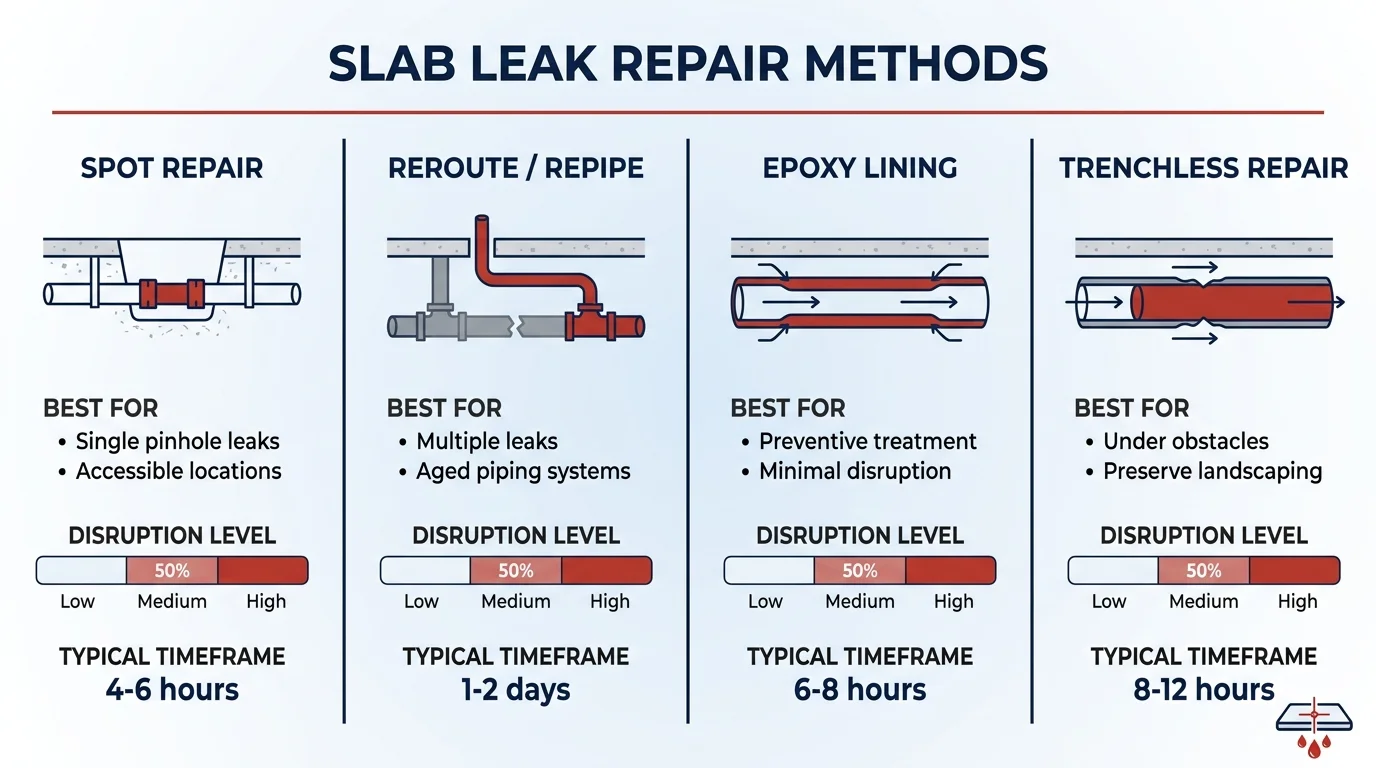
When a slab leak threatens your Rome home, every hour counts. Our Floyd County technicians arrive with electronic detection equipment, pinpoint the exact leak location, and provide upfront pricing before any work begins. Call +1-866-779-0723 for rapid response.
How Much Will It Cost?
Get an instant estimate based on your situation
Slab Leak Cost Estimator
Get estimated costs based on your situation
Why Slab Leaks Happen in Rome, Georgia Homes
Rome's location at the confluence of the Oostanaula and Etowah Rivers, combined with Floyd County's expansive clay soil and a significant stock of homes built before 1990 with copper under-slab plumbing, creates conditions where slab leaks develop more frequently than in areas with stable soils and newer construction. Understanding what causes slab leaks in Rome helps homeowners recognize risks early and choose repair approaches that address the root cause—not just patch the current leak. Below, we explain the four primary factors driving slab leaks in Rome and how each one connects to specific repair strategies.
Problem 1: Expansive Clay Soil Creates Foundation and Pipe Stress
Like much of Georgia, Rome sits on expansive clay soil that swells significantly when saturated with water and shrinks during drought periods. This seasonal cycle—wet winters and springs followed by dry summers—causes the soil beneath your concrete slab to expand and contract repeatedly. As the clay swells, it pushes upward on your foundation. When it shrinks, voids form beneath the slab where soil has pulled away. Rigid copper pipes embedded in or beneath the concrete experience constant flexing stress at joints and bends, eventually leading to cracks, joint separation, or pinhole leaks.
This problem intensifies in Rome due to periodic flooding from the Oostanaula, Etowah, and Coosa Rivers. When floodwaters saturate the ground—as they did during record events that covered Broad Street under 11 feet of water—the clay soil absorbs massive amounts of moisture rapidly, causing sudden expansion that stresses foundations and plumbing simultaneously. Even without flooding, Rome's average annual rainfall of 52 inches keeps clay soils active year-round.
Solution mapping: This is why we often recommend flexible PEX repiping for Rome homes experiencing repeat slab leaks. PEX tubing flexes with soil movement rather than cracking, and rerouting supply lines through the attic or crawlspace removes them from the stress zone entirely. For homes with a single leak in otherwise sound pipes, we assess whether the foundation shows settling or cracking—if so, addressing the leak without also stabilizing the foundation or switching to flexible piping will likely result in another leak within 2-5 years. Concerned about Rome's clay soil affecting your pipes? Call +1-866-779-0723 for a foundation and plumbing assessment.
Problem 2: Copper Pipe Corrosion Accelerated by Moderate Water Hardness
Rome's water supply, drawn from the Coosa River system and underground aquifers, carries dissolved minerals that create moderate water hardness—typically 3-7 grains per gallon. While this isn't classified as "very hard" water, the mineral content still deposits scale on the interior walls of copper pipes over time. Combined with chlorine added for disinfection, this creates electrochemical conditions that corrode copper from the inside. The result: pinhole leaks in copper supply lines after 20-30 years of service, particularly in hot water lines where heat accelerates the corrosion process.
Rome homes built in the 1970s through early 1990s—a significant portion of the city's housing stock, including many properties in the downtown historic district and near Berry College—used copper under-slab plumbing as standard practice. These pipes are now reaching or exceeding their 25-40 year corrosion failure threshold. As interior corrosion reduces pipe wall thickness below 50%, the combination of water pressure (typically 60-80 PSI in Rome) and external soil pressure from clay expansion creates failure conditions. Once one section fails, others often follow within months because they've all experienced the same corrosion timeline.
Solution mapping: This is why water softeners or whole-house filtration systems can extend the life of Rome's aging copper plumbing, and why epoxy pipe lining works well for homes with isolated leaks in otherwise structurally sound pipes. The epoxy coating seals the corroded interior, stopping further deterioration. However, if your home is 25+ years old with original copper pipes and you've already had one slab leak, whole-house repiping with PEX often proves more cost-effective than repairing leaks one at a time over the next 5-10 years. Schedule a Rome-specific plumbing inspection: +1-866-779-0723.
Problem 3: Aging Housing Stock with Original Copper Under-Slab Plumbing
Many Rome homes were built during the 1970s-1990s construction boom when copper under-slab supply lines were the standard choice—durable at installation but vulnerable to the combination of clay soil movement and water chemistry over decades. Properties in the downtown historic district, areas near Shorter University, and neighborhoods developed in the 1980s along the Cave Spring Road corridor (ZIP 30164) typically have original copper pipes now entering the high-risk failure period.
Rome's historic preservation requirements also affect repair decisions. Homes in designated historic districts face renovation guidelines that restrict exterior changes and require careful documentation when altering structural or utility systems. This means repair methods like tunneling under the foundation (which preserves interior historic flooring) or attic-routed PEX repiping (which avoids visible exterior pipe runs) become preferred solutions over methods that require extensive interior demolition or exterior modifications that could violate preservation standards.
Solution mapping: For Rome homes over 25 years old with original copper plumbing, we recommend pressure testing the entire system during leak detection—not just finding the current leak, but assessing whether other sections show pressure loss indicating imminent failure. If testing reveals multiple weak points, proactive whole-house repiping costs less than three or four separate emergency repairs over the next decade. We work with Rome's Historic Preservation Commission requirements when serving properties in designated districts, ensuring repairs meet both plumbing codes and preservation standards.
Problem 4: Flood-Related Soil Saturation Increases Immediate Leak Risk
Rome's position at the meeting point of three rivers—the Oostanaula, Etowah, and Coosa—creates periodic flooding risk that saturates clay soils rapidly during heavy rainfall events. When floodwaters recede, the saturated clay beneath your slab remains swollen for weeks, maintaining constant upward pressure on your foundation and under-slab plumbing. Homes near the rivers in West Rome (ZIP 30162) or low-lying areas throughout Floyd County face the highest risk during and immediately after flood events.
Even without direct flooding, Rome's 52-inch average annual rainfall keeps soil moisture levels high compared to drier regions of Georgia. Heavy spring rains saturate the clay, causing it to expand and stress pipes. Summer droughts then cause rapid shrinking, creating voids beneath slabs. This wet-dry cycle repeats annually, accumulating stress on copper pipes until they fail—often during or shortly after a particularly wet spring when soil expansion reaches maximum pressure.
Solution mapping: This is why foundation drainage improvements, proper grading away from your home's perimeter, and functional gutters/downspouts reduce slab leak risk in Rome by managing soil moisture levels. After addressing immediate leak repairs, we assess your property's drainage and recommend improvements when water pools near the foundation or gutters dump directly onto the soil beside your slab. For homes in flood-prone areas, PEX repiping eliminates the rigid-pipe vulnerability, and installing foundation moisture barriers reduces future soil expansion stress.
Closing: Rome's Perfect Storm for Slab Leaks
Rome's combination of expansive clay soil, moderate water hardness from the Coosa River system, aging housing stock with 25-40 year old copper pipes, and periodic flood-related soil saturation creates conditions where slab leaks develop more predictably than in areas without these risk factors. We've addressed these specific Rome conditions in over 300 Floyd County slab leak repairs since 2010. Understanding these causes helps us recommend the repair method that addresses your home's specific risk factors—not just patch the current leak and wait for the next one to develop in six months. Whether that's epoxy lining for isolated leaks in otherwise sound systems, PEX repiping for homes with multiple aging pipe sections, or foundation drainage improvements to reduce soil stress, the right solution depends on your home's age, foundation type, and how many of Rome's risk factors apply to your property.
Rome & Floyd Conditions
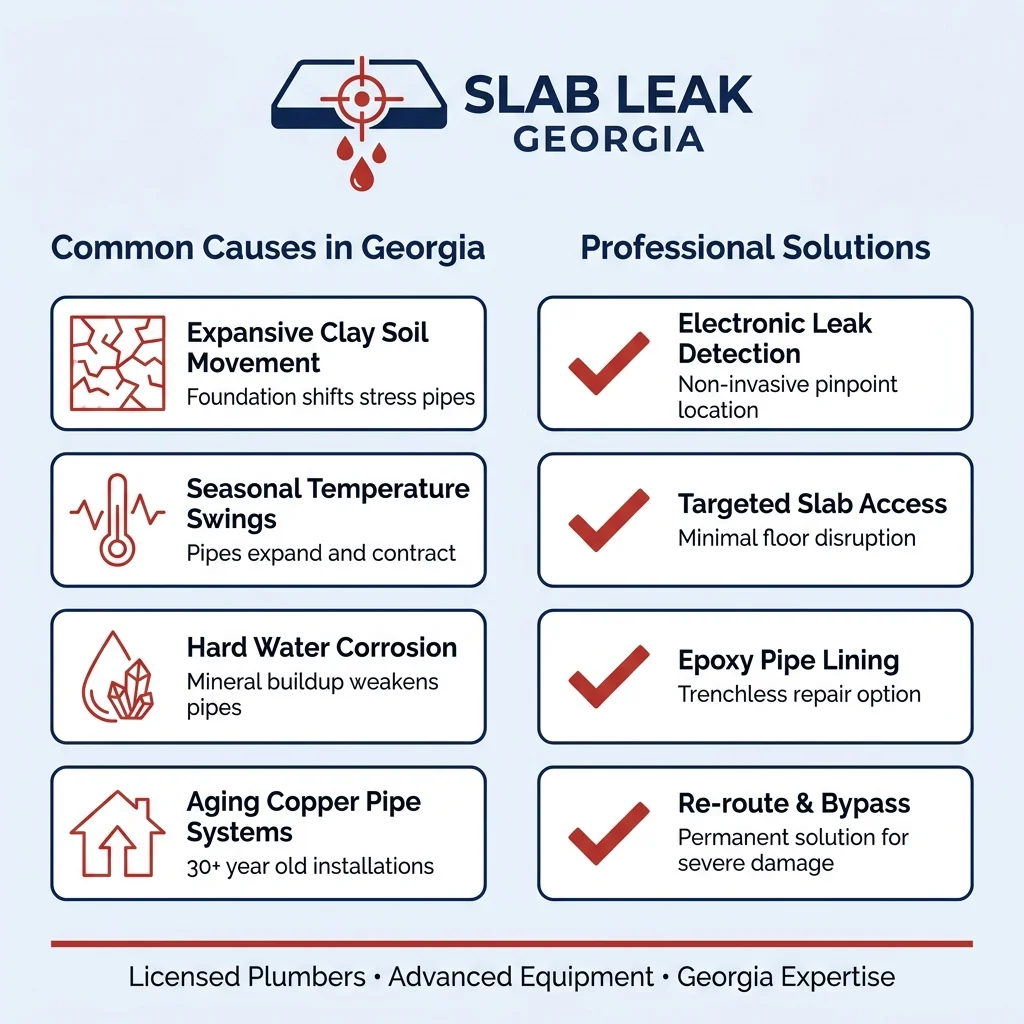
Expansive clay soil — Georgia's clay swells and contracts with moisture, stressing under-slab pipes.
Aging copper pipes — Homes built 1980-2000 are entering the 25-40 year corrosion failure window.
High water pressure — Many Atlanta-area homes receive 80-100 PSI, accelerating pipe wear.
Licensed slab leak contractors in Rome, Floyd County — we handle all permitting, inspections, and insurance documentation. Our electronic detection technology finds leaks without exploratory concrete breaking. Call +1-866-779-0723 for a free estimate and same-day service.
Why Rome Homeowners Trust SlabLeakGeorgia.com
When your home's foundation is at risk, you need experienced professionals with the right equipment and commitment to quality.
Licensed & Certified
Every technician holds a Georgia Master Plumber License and undergoes continuous training on the latest detection technology.
24/7 Emergency Response
Active slab leaks don't wait for business hours. Our emergency teams are always ready to respond when you need us most.
Advanced Detection Equipment
We invest in professional-grade acoustic, thermal, and pressure testing equipment that pinpoints leaks without unnecessary damage.
Transparent Pricing
Written estimates before we start, no hidden fees, and detailed documentation for insurance claims.
Warranty Protection
All repairs backed by comprehensive warranties. We stand behind our work with guaranteed quality.
Local Expertise
We understand Georgia's unique soil conditions, building codes, and the specific challenges that cause foundation leaks in your area.
Slab Leak Repair Costs in Rome, GA
No hidden fees. No surprise charges. Just honest pricing for quality slab leak services.
Leak Detection
- check_circleComplete home inspection
- check_circleAcoustic leak detection
- check_circleThermal imaging scan
- check_circlePressure testing
- check_circleWritten location report
- check_circleRepair estimate included
Spot Repair
- check_circleDetection included
- check_circleConcrete access & removal
- check_circlePipe repair or replacement
- check_circlePressure testing
- check_circleConcrete restoration
- check_circle1-year warranty
Complete Re-piping
- check_circleAll new water lines
- check_circleCeiling/wall routing (no slab)
- check_circleModern PEX materials
- check_circleFull system pressure test
- check_circleSame-day water restoration
- check_circle10-year warranty
Insurance & Financing Information
Many homeowners insurance policies cover the cost of accessing and repairing slab leaks. We provide detailed documentation for insurance claims. Ask about financing options for repairs not covered by insurance.
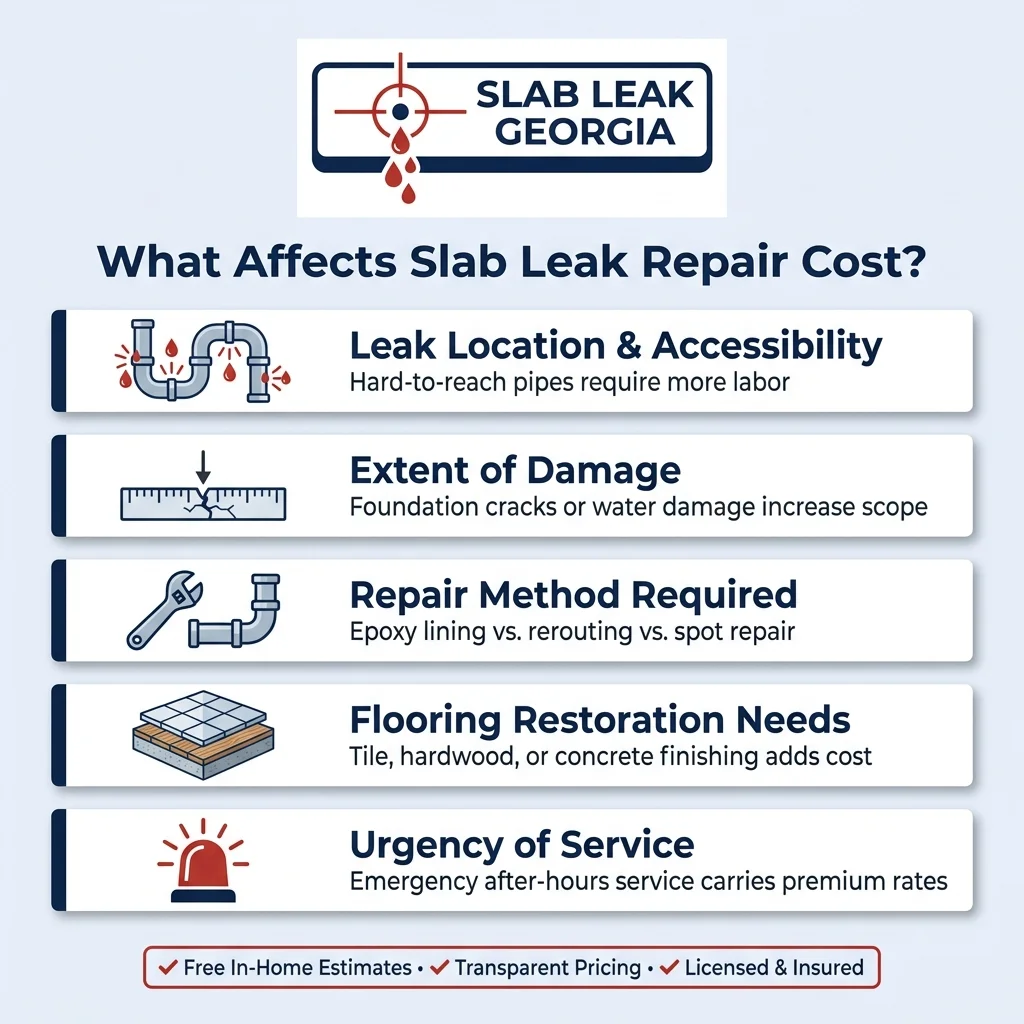
Factors affecting cost: Leak depth, accessibility, number of leaks, pipe material, foundation type, and chosen repair method. We provide written estimates before starting any work.
How Slab Leak Repair Works
From detection to repair, we make the process simple and stress-free for Georgia homeowners.
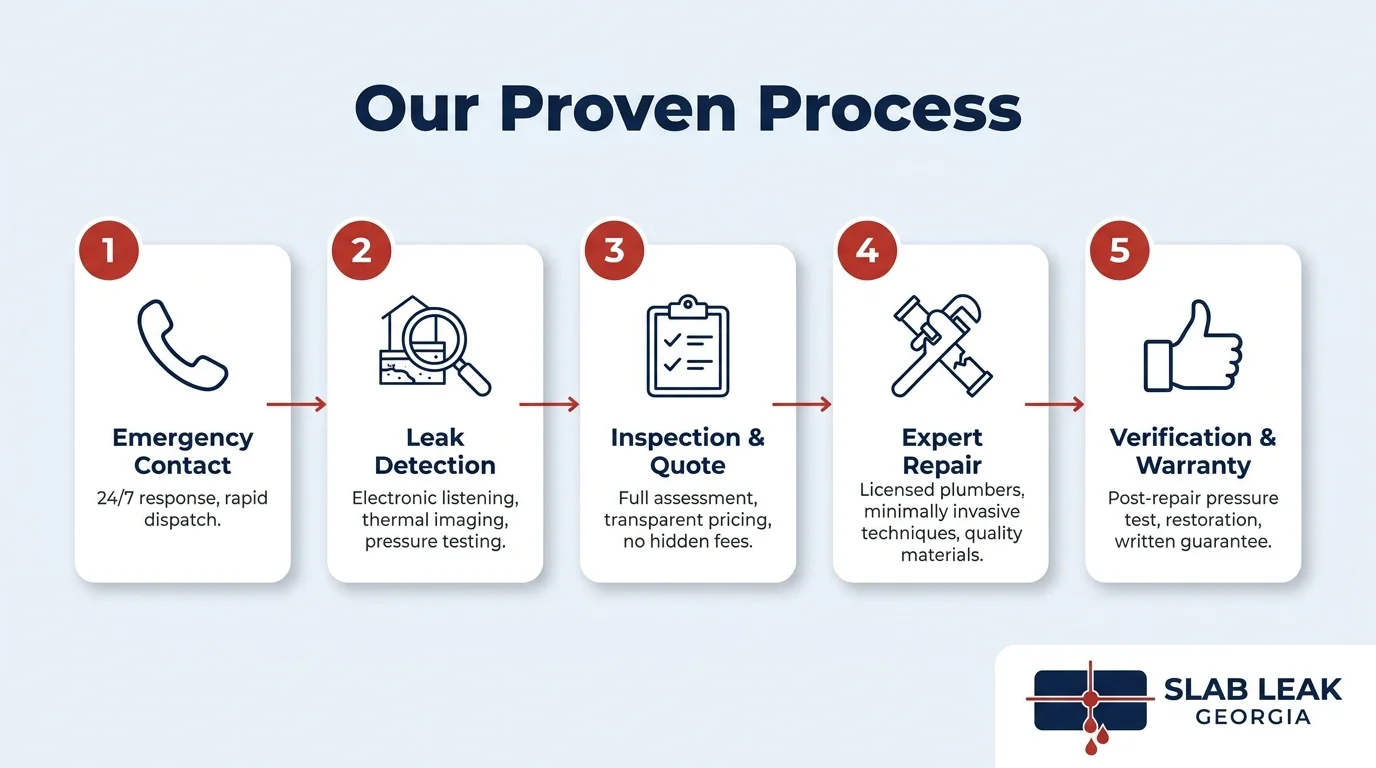
Call for Inspection
Contact us for a comprehensive slab leak inspection. We'll ask about symptoms and schedule a convenient time.
Electronic Detection
Our technicians use acoustic listening devices and thermal imaging to pinpoint the exact leak location without breaking concrete.
Repair Options & Estimate
We present all repair options with transparent pricing: spot repair, epoxy lining, or re-piping. You choose what's best for your home.
Expert Repair & Warranty
Licensed technicians complete foundation-safe repairs with minimal disruption. All work backed by comprehensive warranty.
Don't let an under-slab water leak in Rome destroy your foundation. Floyd County's trusted slab leak specialists offer trenchless epoxy lining, spot repair, and complete repiping with full warranties. Call +1-866-779-0723 now — we answer 24/7.
Slab Leak Prevention for Rome Homes
Understand your risk factors and take action before a leak damages your foundation
Aging Copper Pipes
Homes built 1980-2000 with original copper plumbing are entering the 25-40 year failure window. If your home is in this range, annual pressure testing is recommended.
Expansive Clay Soil
Georgia's clay soil swells 10-15% when wet and shrinks when dry, bending rigid copper pipes with each cycle. Poor drainage around your foundation amplifies this stress.
Water Chemistry
Atlanta's moderately hard water (8-12 gpg) combined with chlorine creates internal pipe corrosion. High pressure above 80 PSI accelerates wear by 30-50%.
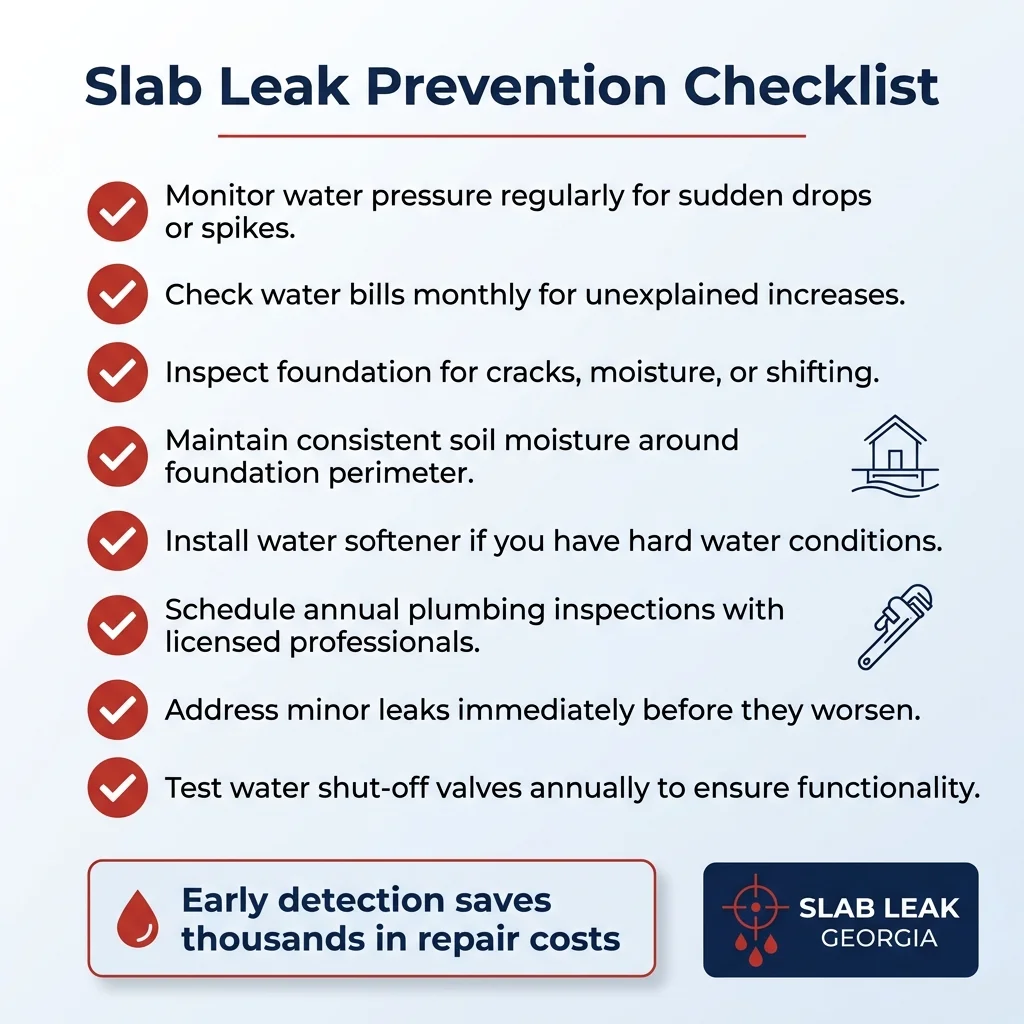
Prevention Strategies That Work
Why Professional Slab Leak Service Matters in Rome
DIY attempts often cost more in the long run — here's the real comparison
DIY Attempt
- dangerousNo accurate detectionConsumer moisture meters can't sense through concrete. Exploratory holes cost $800-2,000 each.
- dangerousFoundation damage riskBreaking concrete without shoring causes slab sagging, wall cracks, and structural shifts.
- dangerousInsurance voidedDIY repairs are excluded from coverage. One attempt can void your entire claim.
- dangerousCode violationsFulton County requires licensed contractors for permits. Unpermitted work fines: $500-2,500.
Professional Service
- check_circleElectronic leak detectionPinpoints leaks within 1-2 feet without breaking concrete. No guessing, no exploratory holes.
- check_circleFoundation-safe repairsLicensed technicians use proper shoring and techniques that protect your home's structure.
- check_circleInsurance-compliantFull documentation, permits, and inspection reports support your claim if needed.
- check_circleCode-compliant + warrantedAll work permitted, inspected, and backed by warranty. Peace of mind included.
Rome, Floyd County — licensed, insured, and ready to help
callCall +1-866-779-0723Licensed & Certified for Rome
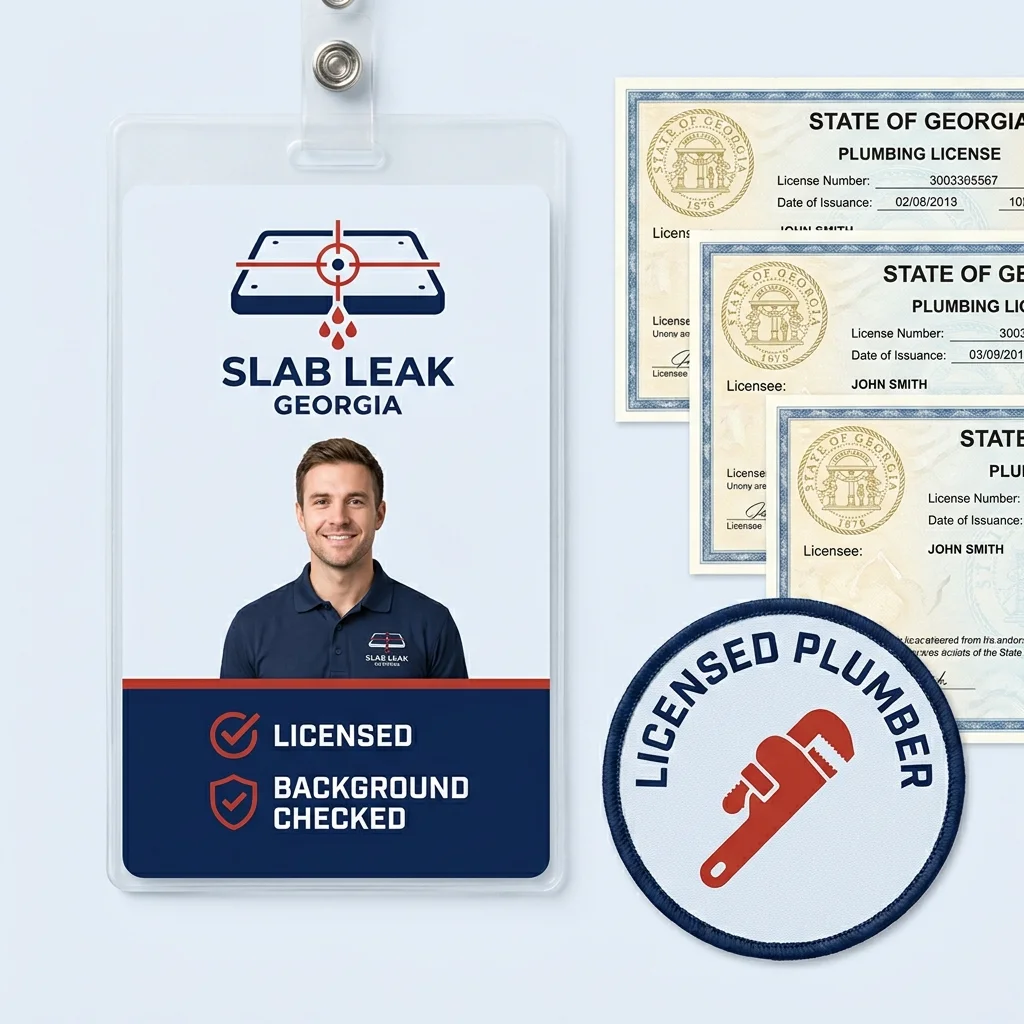
Every technician is a Georgia Master Plumber with credentials you can verify
Georgia Master Plumber
Licensed by the Georgia State Board of Construction Industry. Full compliance with all state and local requirements.
$1M+ Insured
Comprehensive general liability and workers' compensation insurance protects your home and our team.
Permits & Inspections
We handle all Rome permit applications and coordinate required inspections. Code-compliant work guaranteed.
Workmanship Warranty
Every repair comes with a comprehensive warranty. If anything goes wrong, we fix it — no questions asked.
callCall +1-866-779-0723Slab Leak Warning Signs in Rome
Most homeowners don't recognize slab leaks until foundation damage forces costly emergency repairs
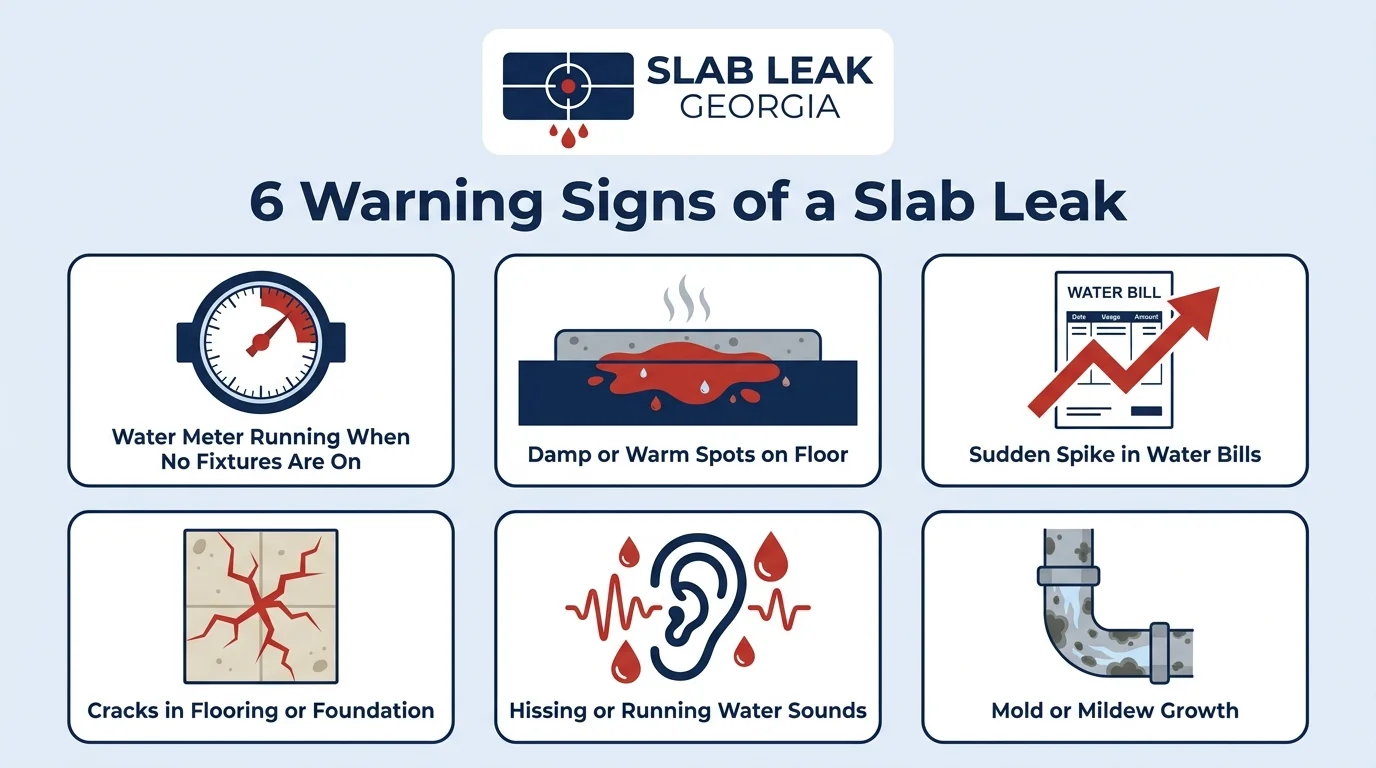
thermostatHot or Warm Spots on Your Floor
MODERATEA hot water supply line is leaking directly beneath that spot — active pressurized leak losing 20-100 gallons/day
expand_more
Hot or Warm Spots on Your Floor
MODERATEA hot water supply line is leaking directly beneath that spot — active pressurized leak losing 20-100 gallons/day
Turn off all hot water fixtures and water heater. Wait 30 min, then feel the warm area. If it stays warm, it's a continuous leak.
$2,000-5,000 in foundation repairs + $1,500-4,000 mold remediation after 2-3 months.
receipt_longSudden Water Bill Increase
HIGH30-50%+ jump with no usage change means pressurized supply line leak running 24/7
expand_more
Sudden Water Bill Increase
HIGH30-50%+ jump with no usage change means pressurized supply line leak running 24/7
Turn off all fixtures. Watch your water meter for 30 min. If the dial moves, you have a leak. Document with video.
$30-75/month in wasted water for moderate leaks. $100-300/month for severe leaks losing 200+ gallons/day.
hearingSound of Running Water
HIGHAudible hissing or rushing sound when all fixtures are off — leak losing 50-200+ gallons/day
expand_more
Sound of Running Water
HIGHAudible hissing or rushing sound when all fixtures are off — leak losing 50-200+ gallons/day
Turn off main water valve. Wait 5 min. If sound stops, it's a supply line leak. Note where sound is loudest.
Foundation repairs $5,000-10,000 if you wait months. Immediate detection limits damage to pipe repair only.
crisis_alertFoundation Cracks
URGENTNew cracks or widening existing cracks = soil erosion under slab from active leak
expand_more
Foundation Cracks
URGENTNew cracks or widening existing cracks = soil erosion under slab from active leak
Mark cracks with tape and date. Measure width daily. Growth >1/8 inch per week = immediate action needed.
$5,000 crack injection to $20,000+ underpinning. Fix leak within days limits damage to $0-2,000.
speedLow Water Pressure
MODERATELarge leak diverting water or decades of mineral buildup restricting flow in aging pipes
expand_more
Low Water Pressure
MODERATELarge leak diverting water or decades of mineral buildup restricting flow in aging pipes
Attach pressure gauge to outdoor hose bib. Normal: 50-70 PSI. Below 40 PSI = problem. Test at different times of day.
Continued corrosion leads to imminent leaks. Emergency repairs cost premium rates vs. planned replacement.
waterStanding Water Around Foundation
URGENTWater pooling at foundation with no recent rain = 100-300+ gallons/day leak, immediate structural risk
expand_more
Standing Water Around Foundation
URGENTWater pooling at foundation with no recent rain = 100-300+ gallons/day leak, immediate structural risk
Mark wet area. Turn off main water overnight. If drier in morning, source is plumbing, not groundwater.
Foundation waterproofing $3,000-8,000 + pipe repair. Severe cases requiring underpinning reach $15,000-25,000.
airMold or Mildew Smell
HIGHMusty odor or visible mold from chronic moisture under flooring — leak active long enough for mold colonization
expand_more
Mold or Mildew Smell
HIGHMusty odor or visible mold from chronic moisture under flooring — leak active long enough for mold colonization
Document with photos. Don't touch mold — disturbing releases spores. Open windows. Call for detection.
Early: $500-2,000 cleanup. Spread through walls/HVAC: $5,000-15,000 comprehensive remediation.
speedWater Meter Spinning
HIGHMeter shows flow with all fixtures off — definitive proof of active leak. No other explanation
expand_more
Water Meter Spinning
HIGHMeter shows flow with all fixtures off — definitive proof of active leak. No other explanation
Turn off ALL water-using devices. Watch meter for 30 min. Any movement = leak. Document spin rate on video.
$150-400/month in wasted water. $900-2,400 over 6 months + potential foundation damage on top.
Don't wait for foundation damage — call now for professional leak detection in Rome
callCall +1-866-779-0723Trusted by Rome Homeowners
"They found our leak in under 2 hours without tearing up our whole kitchen floor. The price was exactly what they quoted — no surprises."
— Sarah M., Rome
"Emergency call at midnight on a Sunday. They answered immediately and had someone here within 2 hours. Saved our home from major water damage."
— Mike R., Floyd County
Repair or Replace?
Answer 5 questions — we'll recommend the best option
Repair vs Replace Decision Tool
Should you repair the leak or re-pipe the entire system?
Common Questions from Rome Residents
Frequently Asked Questions
Get answers to common questions about slab leak detection and repair in Rome.
How much does slab leak detection cost in Rome?
expand_more
Professional electronic leak detection typically costs $300-$600 in Rome. This includes a complete inspection with thermal imaging and acoustic equipment to pinpoint the exact leak location without breaking concrete. Many your County homeowners find this investment prevents thousands in unnecessary foundation damage.
What are the warning signs of a slab leak?
expand_more
Common signs include: unexplained water bill increases, sound of running water when all fixtures are off, warm spots on floors, cracks in walls or floors, mildew or excessive moisture, reduced water pressure, and foundation shifting. If you notice any of these signs in your Rome home, call immediately for inspection.
How long does slab leak repair take?
expand_more
Most slab leak repairs in Rome are completed within 1-3 days depending on the repair method. Simple spot repairs may take 6-8 hours, while epoxy pipe lining can be done in 1-2 days. Complete re-piping typically requires 2-4 days. We provide accurate timelines after inspection.
Will my homeowners insurance cover slab leak repair?
expand_more
Many Rome homeowners insurance policies cover the cost of accessing and repairing the leak itself, though not the damage caused by long-term leaks. Coverage varies by policy. We provide detailed documentation for insurance claims and work directly with adjusters in your County.
Can you detect a slab leak without breaking my floor?
expand_more
Yes! We use advanced electronic detection equipment including acoustic listening devices, thermal imaging cameras, and pressure testing to pinpoint leaks without damaging your Rome home. We only break concrete at the exact leak location after confirming its position.
What causes slab leaks in Georgia homes?
expand_more
In Rome, common causes include: shifting clay soil that stresses pipes, corrosion from Georgia's mineral-rich water, poor installation during construction, ground settlement, and pipe friction from expansion/contraction. Homes built before 1980 with copper pipes are especially vulnerable in your County.
Hiring a Slab Leak Contractor?
15 critical points to verify before you hire anyone
Contractor Verification Checklist
Use this checklist when hiring a slab leak contractor
badgeLicensing & Insurance
precision_manufacturingDetection Equipment & Methods
receipt_longPricing & Business Practices
history_eduExperience & Reputation
Recommended minimum: 12/15 checked before hiring

Don't Let a Slab Leak Destroy Your Rome, GA Home
Every hour counts when you have an active foundation leak. Our licensed technicians respond fast with professional electronic detection and expert repairs that protect your home's structural integrity.