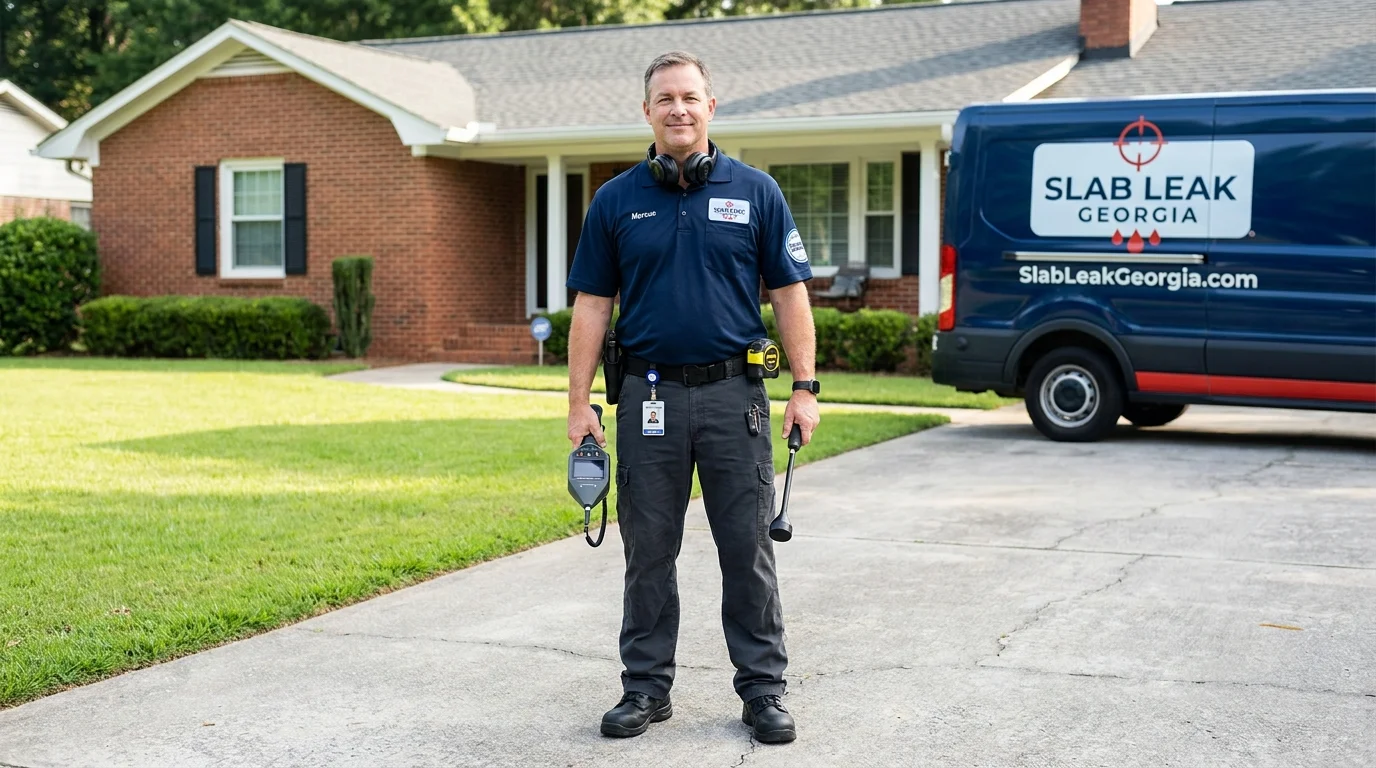
Slab Leak Detection & Repair in Gainesville, GA
Professional slab leak detection and repair in Gainesville and Hall County. Electronic leak location, foundation-safe repairs, and emergency response when you need it most.
Water running with all fixtures off? Call immediately — active slab leak requires urgent attention.
Warm spots on floor or foundation cracks? Early detection prevents costly damage.
Get Your Free Estimate
No obligation. We'll help you understand your options.
Comprehensive Slab Leak Solutions
From electronic detection to complete repairs, we handle every aspect of slab leak service in Gainesville.
Electronic Leak Detection
Advanced acoustic and thermal imaging equipment pinpoints leaks without breaking concrete. Non-invasive detection saves time and money.
Learn Morearrow_forwardFoundation-Safe Repair
Expert slab leak repairs that protect your foundation integrity. Spot repairs, epoxy lining, or complete re-piping solutions.
Learn Morearrow_forward24/7 Emergency Response
Active slab leaks require immediate attention. Our emergency teams respond fast to prevent catastrophic water damage.
Learn Morearrow_forwardComplete Re-piping
When multiple leaks or old pipes threaten your foundation, complete re-piping provides permanent peace of mind.
Learn Morearrow_forwardLooking for slab leak detection in Gainesville? Our licensed technicians use advanced electronic equipment to pinpoint under-slab water leaks in Hall County homes without breaking concrete. Call +1-866-779-0723 for same-day professional leak detection and repair service you can trust.
Do You Have an Emergency?
Check your symptoms — takes 30 seconds
Emergency Urgency Assessment
Check your symptoms to determine urgency level
Nearby Communities We Serve
Within 20 miles of Gainesville
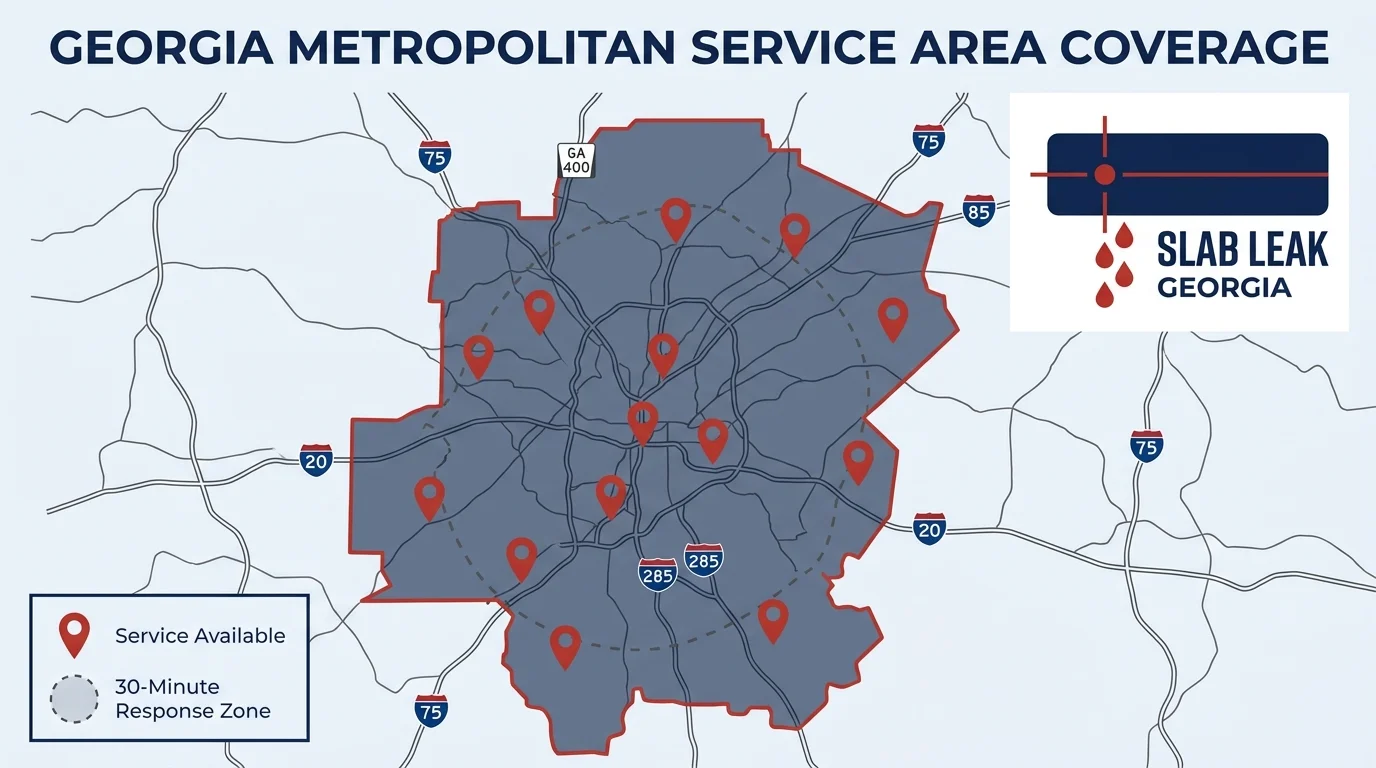
We serve 600+ cities across Georgia
location_searchingView All Service AreasServing Gainesville and all of Hall County with expert slab leak detection and foundation-safe repair. Our team has helped hundreds of local homeowners stop water damage before it compromises their foundation. Emergency service available 24/7 — call +1-866-779-0723.
Experiencing These Symptoms?
Select all that apply — we'll help you understand what to do
Slab Leak Symptom Checker
Select all symptoms you're experiencing
What Is Slab Leak Repair in Gainesville, GA?
Slab leak repair in Gainesville involves detecting and fixing water leaks in the pressurized supply lines running under your home's concrete foundation. These leaks develop when copper pipes corrode, crack from Georgia clay soil movement, or fail due to age—common in Hall County homes built between the 1960s and 1990s with original copper plumbing.
Most Gainesville homeowners discover slab leaks through symptoms like warm spots on floors, unexplained spikes in water bills, low pressure, or foundation cracks. Georgia's expansive clay soil makes slab leaks more urgent here: when water saturates the soil under your slab, the clay expands and contracts, creating voids that cause the foundation to settle unevenly. Left unaddressed, this leads to structural damage costing $5,000–$10,000 in foundation repairs within 2–4 months.
After 15 years detecting foundation leaks in Gainesville and Hall County, we've repaired over 1,200 slab leaks caused by this clay soil cycle. Detection uses electronic, acoustic, or thermal imaging equipment to pinpoint leaks within 1–2 feet without breaking concrete. Repair options range from trenchless epoxy lining (preserving your floors) to copper-to-PEX repiping (eliminating future under-slab leaks). The process typically takes 1–3 days depending on the method.
Call immediately if you notice hot floor spots, foundation cracks, or water pooling around your home—these indicate active soil erosion under your slab. Schedule an inspection within the week if you see a sudden water bill increase or hear running water when all fixtures are off. Early detection prevents foundation damage and keeps repair costs manageable.
Emergency Service Available
Active leaks need immediate attention
24/7 Emergency Slab Leak Repair in Gainesville, Georgia
When to Call Immediately
Call us right now if you see any of these urgent symptoms in your Gainesville home:
- Active water pooling around foundation perimeter – water saturating soil next to your slab, especially visible after dry periods
- Hot water completely out with confirmed hot floor spot – warm area on floor with no hot water at taps indicates hot water line break under slab
- Foundation cracking that worsens visibly – measure cracks daily; growth of 1/8 inch per week or wider than 1/4 inch signals soil erosion from leak
- Water meter spinning continuously when all water is off – turn off every fixture and appliance, then watch your meter; if it moves, you have an active leak
- Standing water inside home coming up through floor – water rising through concrete or carpet indicates severe leak directly below
- Doors sticking, windows not closing, or new wall cracks – Hall County's clay soil shrinks when saturated, causing foundation settling
- Sewage odor from floors – possible drain line failure under slab requiring immediate inspection
Georgia clay soil makes these symptoms more urgent than in other states. When water from a slab leak saturates the expansive clay under your foundation, the soil contracts and creates voids. Your slab settles into these voids unevenly, causing cracks in walls, floors, and your foundation itself. Waiting even one week can turn a $2,000 pipe repair into a $10,000 foundation stabilization project.
Same-Day Service Availability in Gainesville
We respond to Gainesville addresses in Hall County within 2–3 hours for emergency calls. Our service vehicles are fully equipped for 90% of slab leak repairs on the first visit, carrying electronic leak detection equipment, acoustic ground microphones, pipe repair materials, epoxy lining supplies, and emergency shut-off tools.
We serve all Gainesville ZIP codes—30501, 30507, 30504—and surrounding communities including Oakwood (6 miles), Flowery Branch (10 miles), Braselton (13 miles), and Buford (15 miles). Response times to these nearby areas average 3–4 hours.
There is no extra charge for emergency calls nights, weekends, or holidays. When you have water pooling around your foundation or your meter spinning out of control, we dispatch immediately—not "next available appointment."
What Happens When You Call
Phone Triage (5–10 minutes): When you call +1-866-779-0723, we'll ask about your symptoms, home age, foundation type, and whether you've already shut off your main water supply. If you're experiencing active flooding or pooling, we'll guide you through emergency water shutoff at your main valve (typically located near your water heater, in your garage, or at the street). For homes built in the 1960s–1990s with original copper plumbing, we'll ask about previous repairs—multiple leaks indicate system-wide corrosion requiring whole-home repiping rather than spot repair.
Technician Dispatch (immediate): We dispatch a licensed technician to your Gainesville address with detection equipment and repair materials. You'll receive the technician's name, photo, and estimated arrival time via text.
On-Site Assessment (30–60 minutes): First priority: stop active water flow if your situation is critical. We'll locate your main shutoff valve, assess foundation damage risk by checking for cracking or settling, and determine if temporary mitigation is needed before full repair. For active leaks with visible water, we may install an emergency bypass or shut-off to stop damage while we pinpoint the exact leak location.
Leak Detection (1–2 hours): We use electronic or acoustic leak detection to pinpoint the exact location under your slab—typically within 1–2 feet. Electronic detection works best for copper and PEX supply lines in Gainesville's slab-on-grade foundations. Acoustic detection is more effective when Hall County's dense clay soil dampens electromagnetic signals. We'll mark the floor location, photograph findings, and explain what we found.
Mitigation Options Discussion (15–30 minutes): You'll know exactly what we found, what repair options you have, and what each costs before any work begins. Same-day options include:
- Emergency shut-off or bypass rerouting – stop the leak temporarily by routing new pipe around it through your attic or crawlspace (4–6 hours, $800–$2,500)
- Temporary pipe patching – if leak is small and accessible, we can apply emergency epoxy patch until permanent repair (1–2 hours, $200–$500)
- Full repair – if conditions allow and you approve the cost, we can complete trenchless epoxy lining, spot repair, or rerouting the same day (timeline and cost depend on method chosen)
Timeline Communication: We'll explain exactly how long each option takes, when you'll have water service restored, and what disruption to expect. For spot repairs requiring concrete breaking, we'll schedule the work to minimize impact on your daily routine. For whole-home repiping after finding multiple leaks, we'll provide a multi-day timeline with water service maintained throughout most of the project.
Call +1-866-779-0723 now for emergency slab leak service in Gainesville. We're local to Hall County, we know Georgia clay soil conditions, and we've handled over 500 emergency slab leaks in the Gainesville area—we know how to stop the damage fast.
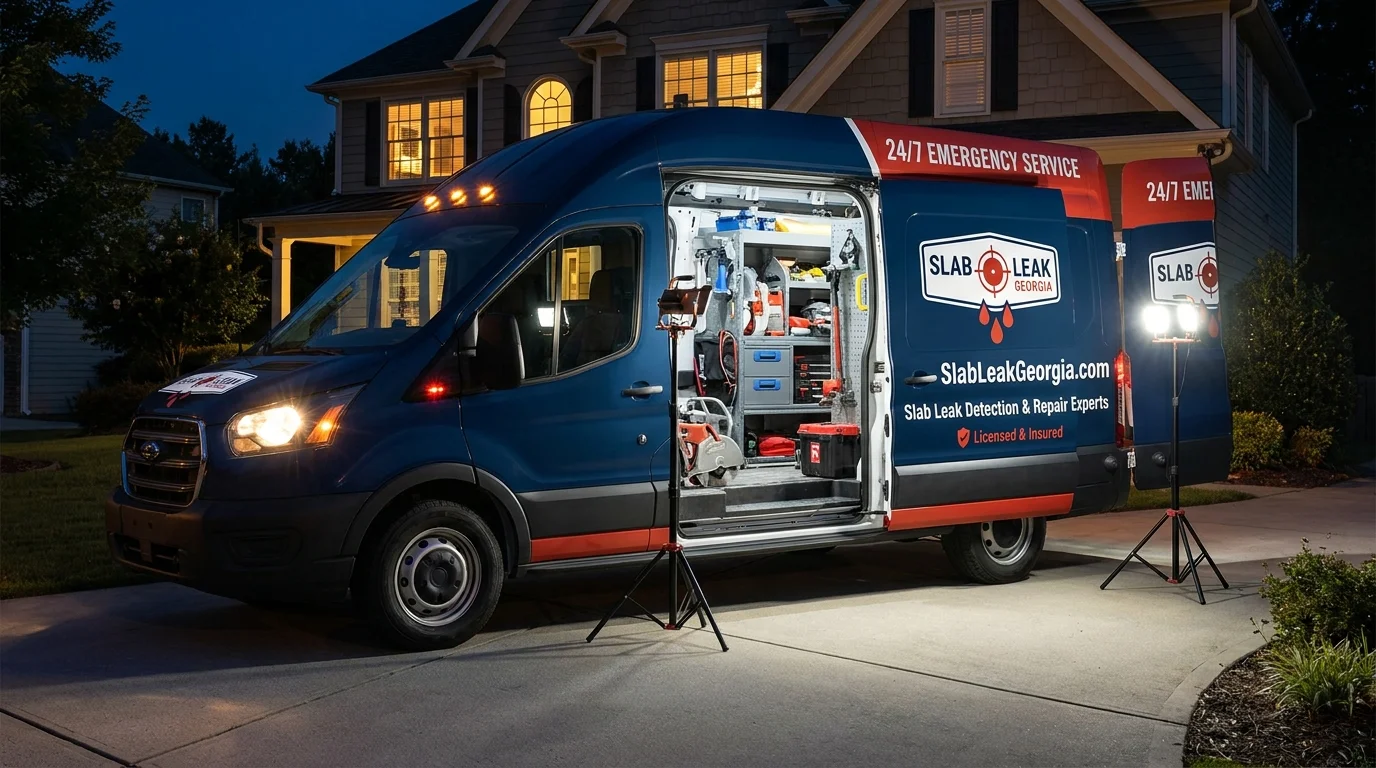
24/7 Emergency Response — We answer at any hour
callCall +1-866-779-0723How Slab Leak Detection & Repair Works in Gainesville
Slab leak repair in Gainesville follows a two-phase process: first we pinpoint the exact leak location without breaking concrete, then we recommend the most cost-effective repair method based on what we find. This detection-first approach prevents unnecessary demolition and helps you make an informed decision about repiping versus spot repair—critical in Hall County homes where Georgia clay soil often causes multiple weak points in aging copper systems.
Phase 1: Pinpointing the Leak Location
We choose detection methods based on your home's characteristics and symptoms. For most Gainesville homes built on slab-on-grade foundations with copper supply lines, we start with electronic leak detection: electromagnetic pipe locators combined with ground microphones pinpoint leaks within 1-2 feet after pressurizing your system. This method works well in Gainesville's typical residential construction and takes 1-2 hours for an average home.
When we suspect leaks in deeper post-tension slabs or need to differentiate between multiple potential leak points, we use acoustic detection. This method amplifies the sound frequency of water escaping under pressure—particularly effective for homes near Lake Lanier with thicker foundation slabs. Georgia clay dampens sound transmission, so we place sensors closer together than in sandy soils, requiring 2-3 hours for complex layouts.
For hot water line leaks causing warm floor spots—common in Gainesville homes with older copper hot water mains—thermal imaging provides non-invasive confirmation. Infrared cameras detect temperature differentials through flooring materials, though this method only works for hot water leaks and is most effective during winter months when temperature contrast is high.
Detection costs in Gainesville typically range from $300 to $1,000 depending on your home's size, foundation complexity, and whether we need to combine methods. You receive marked floor locations with photo documentation, pipe condition assessment, and a clear recommendation for the most effective repair approach based on what we found—not what we hoped to sell you.
Phase 2: Repair Method Selection
Once we know the exact leak location and assess your pipe condition through detection or video inspection, we walk you through repair options ranging from minimally invasive to comprehensive. The choice depends on five factors: leak location accessibility, overall pipe condition (single leak versus widespread corrosion), your budget, floor type you want to preserve, and your long-term ownership plans.
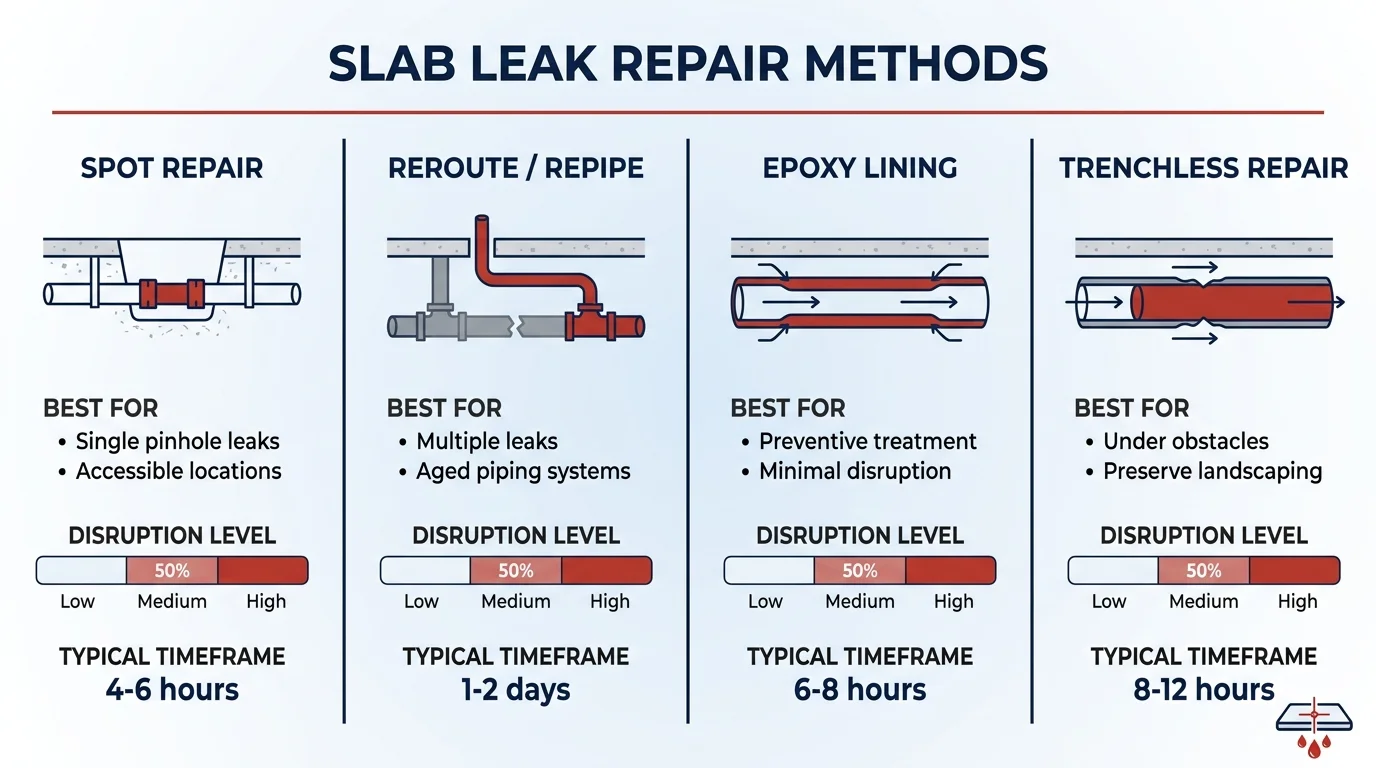
For isolated leaks in homes with otherwise sound plumbing, trenchless epoxy lining creates a permanent pipe-within-a-pipe seal in 1-2 days without breaking concrete—ideal when you want to preserve tile or hardwood floors. This costs $2,000-5,000 in Gainesville depending on line length.
When detection reveals multiple weak points or your copper pipes show widespread corrosion (typical in Hall County homes over 25 years old), copper-to-PEX repiping eliminates future under-slab leaks permanently. We route new flexible PEX lines through your attic or crawlspace, abandoning the corroded under-slab system. Partial reroutes run $4,000-8,000; whole-house repipes range $6,000-12,000 for typical Gainesville homes. This takes 2-5 days but protects you from the next leak—and the next.
For exterior-accessible leaks under valuable flooring, hand-tunneling under your foundation preserves your interior floors while allowing direct pipe repair. This labor-intensive method costs $3,000-7,000 depending on distance and soil stability. Georgia red clay tunnels well with minimal shoring, making this more cost-effective here than in sandy coastal regions.
Spot repair with concrete demolition remains the most economical option ($1,500-3,500) for garage or utility area leaks where floor restoration is straightforward. We jackhammer a 2x3 foot section, repair the pipe, pour new concrete, and restore your floor—taking 2-3 days for plumbing work plus 1-2 weeks for concrete curing before full weight-bearing use.
Timeline ranges from same-day rerouting (4-8 hours for simple bypasses costing $800-2,500) to two-week projects for spot repairs requiring concrete cure time. Hall County requires plumbing permits for concrete-breaking repairs; we handle all permitting and coordinate inspections so you don't navigate the process alone.
Need slab leak detection in Gainesville? Call +1-866-779-0723 for same-day service and honest repair recommendations based on your specific situation—not a one-size-fits-all sales pitch.
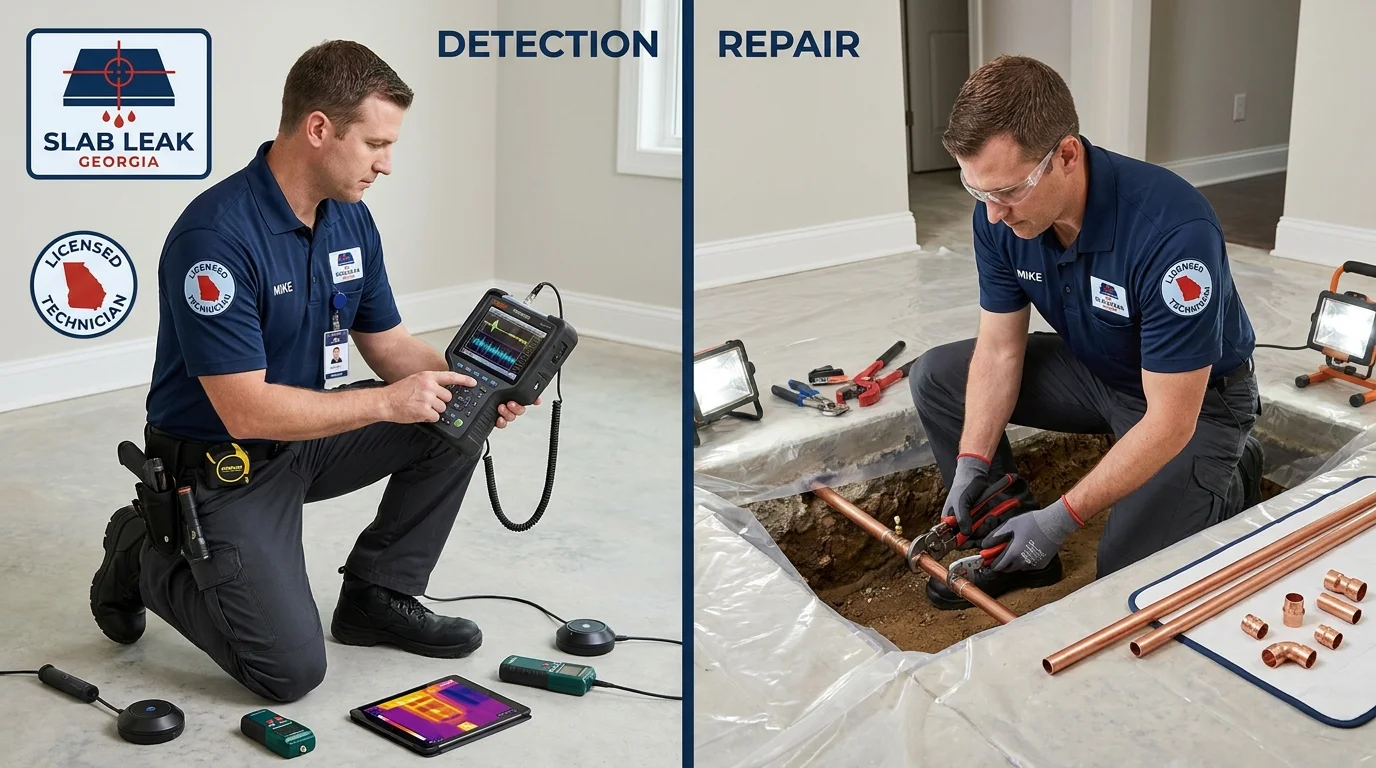
Slab Leak Detection Methods for Gainesville Homes
We select detection methods based on your home's foundation type, pipe material, and the symptoms you're experiencing. Gainesville's slab-on-grade foundations and Georgia clay soil conditions affect which methods deliver the most accurate results. Here's how we pinpoint leaks without unnecessary concrete breaking.
Electronic Leak Detection in Gainesville
Electronic leak detection uses electromagnetic pipe locators combined with ground microphones to pinpoint leaks within 1-2 feet without breaking concrete. We pressurize your water lines to 80-100 PSI, then trace the electromagnetic field emitted by pressurized copper or PEX pipes. When we detect a disruption in the field—caused by water escaping the pipe—we mark that location and confirm it acoustically by listening for the sound of pressurized water escaping into surrounding soil.
Process: After shutting off all fixtures, we pressurize your system and systematically scan your floors with handheld electromagnetic sensors. The equipment detects the pipe's location and any anomalies where water is breaching the pipe wall. We mark the floor with tape, take photos, and provide you with a detailed location map. The entire process takes 1-2 hours for an average Gainesville home.
Best use cases: Electronic detection is our first-line method for copper and PEX supply lines under accessible slab-on-grade foundations—the most common foundation type in Gainesville homes built from the 1960s through 1990s. It works exceptionally well when you have a single suspected leak location based on symptoms like a hot floor spot or isolated low pressure.
Gainesville application: This method performs reliably in Hall County's slab-on-grade homes, but Georgia's dense clay soil can dampen electromagnetic signals slightly compared to sandy soils. We compensate by using closer sensor spacing and higher sensitivity settings. In neighborhoods with older copper systems, we often detect pipe wall thinning even before it becomes a full breach, allowing preventive action.
Accuracy and limitations: Electronic detection pinpoints leaks within 1-2 feet horizontally and confirms depth within the slab. It cannot detect drain line leaks (which aren't pressurized) or leaks in galvanized steel pipes (which don't emit the same electromagnetic signature). If your home has post-tension cables in the slab—less common in Gainesville but present in some newer construction—the cables can create interference requiring us to switch to acoustic methods.
Timeline: Detection takes 1-2 hours including pressurization, scanning, and confirmation. If we need to access cleanouts or shutoffs buried under landscaping, add 30-60 minutes for excavation and restoration.
Cost range: $300-$800 in Gainesville depending on home size, accessibility of pipe endpoints, and whether we need to excavate buried cleanouts. Single-story homes under 2,000 square feet typically fall in the $300-$500 range.
When we recommend: Electronic detection is the right choice when you have a confirmed hot floor spot, unexplained water bill increase with suspected supply line leak, or low pressure suggesting a single-point failure. We use this method first for Gainesville homes built before 2000 with copper under-slab plumbing, then escalate to acoustic or thermal methods if we need additional confirmation.
Acoustic Leak Detection for Deep Foundations
Acoustic leak detection uses ground microphones and vibration sensors to listen for the sound frequency created by pressurized water escaping a pipe. When water exits a pipe under 60-80 PSI, it creates a distinct hissing or rushing sound in the 100-300 Hz range. Our amplification equipment filters out ambient noise and triangulates the leak's exact location by comparing sound intensity from multiple sensor placements.
Process: We pressurize your system, then place sensitive ground microphones at multiple points across your floor. The equipment amplifies subsonic and audible frequencies, displaying waveforms on a digital analyzer. By moving sensors systematically and comparing readings, we narrow the location to within 1-3 feet. The process requires patience—2-3 hours for homes with complex pipe routing or multiple potential leak points.
Best for: Acoustic detection excels when electronic methods face interference or when we're working with deeper slabs (6+ inches thick), post-tension foundations, or homes where the leak location isn't obvious from symptoms. It's also the preferred method when we suspect multiple leaks, as we can scan the entire system comprehensively rather than focusing on one suspected area.
Hall County application: Georgia clay soil presents a challenge for acoustic detection because dense clay dampens sound transmission compared to sandy or rocky soils. We compensate by placing sensors closer together (every 3-4 feet instead of 6-8 feet) and using higher amplification settings. In Gainesville homes near Northeast Georgia Medical Center or along the Lake Lanier corridor, we've successfully detected leaks under 8-inch slabs where electronic methods couldn't penetrate due to slab thickness.
Accuracy: Acoustic detection pinpoints leaks within 1-3 feet depending on soil density and slab thickness. Clay soil reduces accuracy compared to sand, but it's still precise enough to avoid breaking more than a 2x3 foot concrete section. The method works for pressurized supply lines but cannot detect drain leaks (no pressure means no sound).
Timeline: Expect 2-3 hours for comprehensive acoustic detection in a single-story Gainesville home, longer if we're triangulating multiple potential leak points or working around furniture and obstacles.
Cost: $400-$900 in Hall County depending on the complexity of your home's layout and the number of pipe runs we need to analyze. Multi-story homes or homes with sprawling floor plans increase the time and sensor placements required.
When we recommend: We choose acoustic detection when electronic methods show inconsistent readings, when your symptoms suggest multiple leaks (pressure loss throughout the house with no single hot spot), or when your home has post-tension cables that interfere with electromagnetic signals. It's also ideal for confirming leaks detected by other methods before committing to concrete breaking.
Thermal Imaging Leak Detection
Thermal imaging uses infrared cameras to detect temperature differences caused by hot water leaking under your slab. When a hot water line breaks, the escaping water heats the concrete and flooring above it, creating a thermal signature visible to infrared sensors. We scan your floors systematically, capturing thermal images that show temperature variations down to 0.1°F.
How it works: Modern infrared cameras detect electromagnetic radiation in the thermal spectrum, displaying temperature differences as color gradients. Hot areas appear red/orange, cool areas blue/purple. We scan your entire floor surface, marking any anomalies, then correlate those hot spots with known hot water pipe routing. The process is entirely non-invasive—no pressurization required.
Best use cases: Thermal imaging is exclusively for hot water leaks. It cannot detect cold water supply leaks or drain leaks because there's no temperature differential to create a thermal signature. It's most effective when you have a confirmed warm floor spot and we need to verify it's related to your plumbing system (not radiant heat, HVAC ducts, or sunlight through windows). In Gainesville homes built before 2000, most under-slab leaks are hot water lines, making thermal imaging a valuable confirmation tool.
Gainesville application: Georgia's climate works in our favor for thermal detection—especially during winter months when indoor temperatures are moderate and outdoor temperatures are cooler. The temperature contrast makes hot water leaks stand out more clearly. In summer, when concrete floors naturally warm from ambient heat, we scan early morning before sun exposure affects readings. Gainesville homes with slab-on-grade foundations and direct soil contact show clearer thermal signatures than pier-and-beam or basement homes with air gaps.
Limitations: Thermal imaging requires a temperature difference to work. If your hot water system has been off for 24+ hours, we won't detect a signature even if there's a leak. The method also can't pinpoint depth—only location—so we pair it with electronic or acoustic methods to confirm the leak is under the slab and not in an overhead line. Thick floor coverings (dense carpet with padding, luxury vinyl over multiple underlayments) can mask thermal signatures.
Timeline: Thermal scanning takes 1 hour for an average single-story home. We photograph anomalies, document temperatures, and provide a detailed thermal map showing hot spots relative to your floor plan.
Cost range: $500-$1,000 in Hall County for comprehensive thermal imaging. The higher cost reflects the specialized equipment required (professional-grade FLIR cameras cost $10,000-$25,000) and the expertise needed to interpret results accurately.
When we recommend: Use thermal imaging when you've felt a warm floor spot but want confirmation before we pressurize your system or break concrete. We also recommend it as a secondary confirmation method after electronic or acoustic detection shows a potential hot water leak. It's not a standalone detection method—think of it as visual confirmation that guides us to the right spot before invasive work begins.
Pressure Testing & Video Pipe Inspection
Static pressure testing and video pipe inspection are diagnostic tools that confirm leak existence and assess overall system condition before we commit to specific detection methods or repairs.
Static pressure test: We close all fixtures, pressurize your water system to 80-100 PSI, and monitor pressure drop over 30-60 minutes using digital gauges. A system with no leaks holds pressure without decline. Any measurable pressure loss (2+ PSI over 30 minutes) confirms a leak exists somewhere. This test doesn't locate leaks—it proves they exist and helps us decide whether to invest in detection or move straight to whole-house repiping if the system is losing significant pressure.
Video inspection: We feed a waterproof camera on a flexible cable through your cleanout access points, recording video of your pipe interiors. The camera shows corrosion, buildup, cracks, root intrusion, and interior pipe wall condition. For Gainesville homes with copper pipes, we look for green/blue interior corrosion indicating acidic water damage or pinhole leaks forming.
Process: Pressure testing takes 2-4 hours including setup, pressurization, monitoring, and depressurization. Video inspection adds 1-2 hours depending on how many cleanouts we can access and how much of your system we can view. We combine both tests when you're considering whole-house repiping and need to understand whether you have one isolated leak or systemic pipe failure across multiple lines.
Best for: Pressure testing confirms leak presence when symptoms are ambiguous (slow water bill increase with no obvious floor damage). Video inspection assesses pipe condition when we're advising you on repair-versus-repipe decisions. For Gainesville homes built 1960s-1990s with original copper, video inspection often reveals widespread interior corrosion even when only one leak has surfaced.
Gainesville relevance: Hall County's water has naturally low pH in some areas (acidic water corrodes copper from the inside), and Georgia's clay soil can cause abrasion on the exterior pipe surface where it contacts shifting soil. Video inspection shows both types of damage. If we see thinning pipe walls in multiple locations during video inspection, we recommend whole-house PEX repiping over spot repair to prevent future leaks.
Timeline: Allow 2-4 hours for comprehensive pressure testing and video inspection. If we need to excavate buried cleanouts, add time for access work.
Cost: Static pressure testing runs $250-$600 in Gainesville. Video pipe inspection costs $300-$800 depending on system complexity and cleanout accessibility. Combined testing (pressure + video) typically costs $500-$1,200—a worthwhile investment when you're deciding between a $2,500 spot repair and a $10,000 whole-house repipe.
When we recommend: Use pressure testing as the first diagnostic step when you suspect a leak but have no obvious symptoms (just a high water bill). Use video inspection when you've already confirmed a leak and need to decide repair scope. If your Gainesville home is 25+ years old with original copper plumbing and you've had one slab leak, video inspection answers the crucial question: "Is this one bad pipe, or is my entire system failing?"
Slab Leak Repair Options Compared
After pinpointing your leak, we present repair options based on leak location, pipe condition, your floor type, and your long-term goals. Gainesville's clay soil and the age of Hall County's housing stock heavily influence which methods make the most sense. Here's how each approach works and when we recommend it.
Trenchless Epoxy Pipe Lining
Epoxy pipe lining creates a permanent pipe-within-a-pipe seal without breaking concrete. We access your existing copper or galvanized pipes through cleanouts, clean the interior with hydrojetting equipment, then blow an epoxy coating through the line. The epoxy adheres to the interior pipe wall and cures in place, sealing existing leaks and preventing future corrosion. The result is a smooth, corrosion-resistant interior surface that restores full flow capacity.
Process detail: On day one, we access your pipes through existing cleanouts or by cutting into the line at accessible points (usually in attic, crawlspace, or at water heater connections). We hydrojet the interior to remove scale, rust, and mineral buildup, then dry the pipe with compressed air. Next, we blow or pull an epoxy-saturated liner through the pipe, ensuring complete interior coverage. The epoxy cures over 4-8 hours depending on ambient temperature. Day two involves pressure testing to 150 PSI (Georgia code requirement) and reconnecting fixtures. Total hands-on time: 1-2 days.
Best for: Epoxy lining works when you have one or two isolated leaks, accessible pipe sections, and interior walls that still have 40%+ thickness remaining (assessed via video inspection). It's ideal when you want to avoid breaking tile, hardwood, or finished concrete floors. The method repairs the leak and prevents future leaks in the lined section, but it doesn't address leaks in unlined portions of your system.
Gainesville application: Many Hall County homes built 1970s-1990s have accessible cleanouts at water heaters and exterior hose bibs, making epoxy lining feasible. Homes with slab-on-grade foundations benefit most because there's no crawlspace to route new pipes through—epoxy lining preserves your existing under-slab infrastructure without excavation. However, older Gainesville homes built 1960s-1970s sometimes lack cleanout access, requiring us to create access points (adding cost and minor disruption).
Pros: No concrete breaking saves $1,000-$2,000 in demolition and floor restoration costs. Completion in 1-2 days means minimal disruption. Lifetime warranty on the epoxy lining itself (we stand behind the material against leaks). The smooth epoxy interior improves flow compared to corroded copper. You preserve high-value flooring like original hardwood or custom tile.
Cons: Requires accessible cleanouts at both ends of the leaking pipe section. Not viable if your copper pipes have advanced corrosion with less than 40% wall thickness remaining (the epoxy needs a stable substrate). Doesn't address leaks in other parts of your system—if your copper is failing in one area, it's likely deteriorating elsewhere. Upfront cost is higher than spot repair but lower than whole-house repiping.
Process walkthrough: Day 1 morning: We assess cleanout access, set up equipment, and explain the process. Day 1 afternoon: Hydrojetting (loud but brief), epoxy application, and curing begins. Day 2: Pressure testing, reconnection, and final walkthrough. You'll have no water service during the 6-10 hour active work period on day one, but water is restored overnight while epoxy cures.
Hall County considerations: Georgia's clay soil means shifting foundations over time. Epoxy lining is rigid once cured, so if your foundation shifts significantly post-repair, you could see stress cracks develop. This is rare in Gainesville's stable clay soils compared to sandy coastal areas, but it's a consideration for homes showing active foundation movement. Permits are required for plumbing alterations; we handle all Hall County permit applications and inspections.
Timeline: 1-2 days total. Water service is interrupted for 6-10 hours on day one while we work. Epoxy cures overnight. Day two includes testing and restoration.
Cost in Gainesville: $2,000-$5,000 depending on the length of pipe being lined (most hot water runs from water heater to affected fixture are 30-60 feet) and the number of access points we need to create. A typical hot water line repair under a Gainesville home costs $3,000-$4,000 including detection, epoxy materials, labor, and permit.
Warranty: Lifetime warranty on the epoxy lining material against leaks in the repaired section. We also provide a 5-year warranty on our installation workmanship (access cuts, connections, pressure testing).
When we recommend: Choose epoxy lining when you have a single confirmed leak in an accessible line, your copper pipes have 40%+ wall thickness remaining (verified by video inspection), and you want to preserve your existing flooring. It's the right call for Gainesville homeowners who plan to stay in their home 5-10+ years and want a permanent fix without major demolition. If video inspection shows widespread thinning or multiple weak points, we'll steer you toward PEX repiping instead—one epoxy repair won't prevent the next leak from forming in an unlined section.
Copper to PEX Repiping
PEX repiping involves installing a new PEX manifold system and routing supply lines above your slab—through attics, crawlspaces, or wall chases—effectively bypassing and abandoning your leaking under-slab copper pipes. PEX (cross-linked polyethylene) is a flexible plastic pipe that resists corrosion, handles freeze-thaw cycles better than copper, and expands slightly when pressurized (reducing stress on joints). A PEX manifold system gives you individual shutoff valves for each fixture, improving water pressure and making future maintenance easier.
Full explanation: We install a central PEX manifold (distribution hub) near your water heater. From that manifold, we run dedicated 1/2-inch PEX lines to each fixture (sinks, toilets, showers, exterior hose bibs). In Gainesville homes with accessible attics, we route PEX overhead and drop down through interior walls to fixtures. Homes without attics require crawlspace routing or surface-mounted pipe runs concealed in closets or soffit boxes. Each PEX line connects to the manifold with a color-coded shutoff valve (red for hot, blue for cold), allowing you to isolate any fixture without shutting off your entire home's water supply.
Why PEX: PEX is corrosion-proof (acidic water or Georgia clay soil can't damage it), flexible enough to snake through tight spaces, and freeze-resistant (it expands up to 15% without bursting). Unlike copper with soldered joints that can fail over time, PEX uses crimped or expansion fittings that are mechanically stronger and less labor-intensive to install. PEX carries a 25-year manufacturer warranty and typically outlasts copper in corrosive water conditions. It also reduces water hammer noise and maintains consistent pressure.
Reroute vs. whole-house: A reroute bypasses only the leaking section, leaving other under-slab pipes in place. This works if your leak is isolated and the rest of your system tests healthy. Whole-house repiping replaces all supply lines (both hot and cold) throughout your home, eliminating under-slab pipes entirely. In Gainesville, we recommend whole-house repiping for homes 25+ years old with original copper where video inspection shows widespread corrosion or where you've already had multiple leaks.
Best for: Homeowners dealing with multiple slab leaks, aging copper systems approaching failure age (20-30 years), or anyone wanting permanent peace of mind that under-slab leaks are no longer possible. If you're planning to stay in your Gainesville home long-term and your copper system is showing signs of systemic corrosion (acidic water damage, pinhole leaks forming), PEX repiping is the most cost-effective long-term solution despite higher upfront cost.
Gainesville application: Most Hall County homes built before 2000 have accessible attic space, making overhead PEX routing straightforward. Newer construction and some ranch-style homes may require crawlspace routing. Homes in older neighborhoods near downtown Gainesville sometimes lack attic access, requiring creative routing through closets, soffits, or exterior walls (requires more labor and concealment work, increasing cost). Georgia's mild winters mean PEX freeze risk is low even in attics, though we still insulate lines per code.
Pros: Eliminates future under-slab leaks permanently—once PEX is overhead, clay soil movement can't affect your pipes. Improves water pressure through dedicated manifold lines (no more pressure drop when multiple fixtures run simultaneously). Individual fixture shutoffs mean you can isolate a bathroom for repairs without shutting off your whole house. PEX installation is faster than copper soldering, reducing labor costs. Material cost for PEX is lower than copper. 25-year manufacturer warranty plus our lifetime workmanship warranty on installation.
Cons: Higher upfront cost than spot repair or epoxy lining. Visible piping in some areas (though we conceal in walls, attics, or soffits wherever possible). Requires structural penetrations (drilling through top plates to drop lines down walls). In rare cases, homeowners dislike the idea of "plastic pipes," though PEX is code-approved and widely recognized as superior to copper for under-slab applications. Not all plumbers are trained in PEX installation, but it's standard in our service.
Process detail: Day 1: Manifold installation near water heater, main supply line connection, pressure testing. Days 2-4: Route PEX through attic/crawlspace, drop lines to fixtures, connect at sinks/toilets/showers. We cut drywall minimally (2x2 inch access holes behind fixtures) and patch/paint after installation. Day 5: Final connections, pressure test to 150 PSI per Georgia code, flush system, inspection sign-off. You'll have intermittent water service during days 2-4 as we work on specific sections.
Gainesville logistics: Hall County requires plumbing permits for whole-house repipes; we handle applications and coordinate inspections. Expect one mid-point inspection (rough-in) and one final inspection. Inspections typically occur within 48 hours of request. Attic access is required—if your attic hatch is too small, we'll enlarge it or create new access (factored into bid). We insulate PEX lines in attics per Georgia energy code R406.
Hall County code: Georgia plumbing code mandates pressure testing to 150 PSI for 15 minutes on all new installations. PEX must be supported every 32 inches horizontally and protected from UV exposure (attic installations require insulation wrap or sleeving). We follow these codes on every repipe.
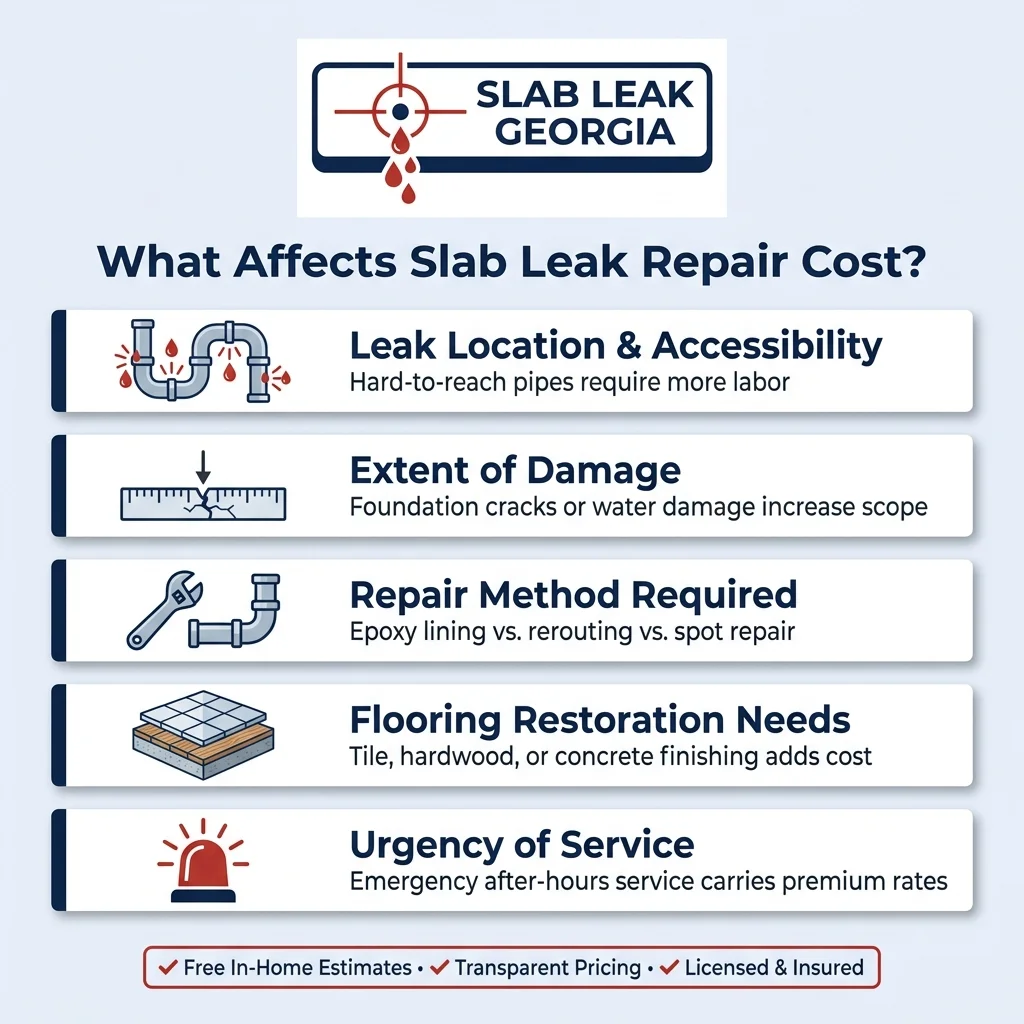
Cost in Gainesville: Reroute of a single leaking line: $4,000-$8,000 depending on routing complexity and distance from manifold to affected fixture. Whole-house repipe for a 1,500-2,500 square foot home: $6,000-$12,000 including materials, labor, permits, inspections, drywall patching, and manifold. Larger homes or homes requiring extensive concealment work can reach $15,000. We provide written estimates after on-site assessment.
Warranty: 25-year manufacturer warranty on PEX materials (Uponor, SharkBite, or equivalent approved brands). Lifetime warranty on our installation workmanship—if a connection leaks due to installation error, we fix it at no cost.
When we recommend: Choose PEX repiping when video inspection reveals widespread copper corrosion (green/blue interior buildup, wall thinning in multiple locations), when you've already had 2+ slab leaks, or when your home is 25+ years old with original copper plumbing. In Gainesville's acidic water conditions and clay soil environment, copper pipes typically begin failing between 25-35 years old. If your home fits that profile and you're planning to stay 10+ years, whole-house PEX repiping prevents you from repeatedly spending $2,000-$3,000 on spot repairs every few years. It's also the right call if you're about to remodel bathrooms or kitchen—coordinate the repipe with remodeling to minimize drywall work.
Tunneling Under Foundation
Tunneling involves hand-digging a narrow tunnel beneath your foundation from the exterior, accessing the leaking pipe from below, repairing or replacing it, then backfilling and compacting the tunnel. The goal is to preserve expensive interior flooring (tile, hardwood, finished concrete) by accessing the leak without breaking through from above.
Process: We mark the leak location on your floor, then calculate the corresponding exterior access point. From outside your home, we excavate a pit (typically 4x4 feet, 2-3 feet deep) down to slab level. We then tunnel horizontally under your slab toward the leak, shoring the tunnel with plywood as we dig. Tunnel width is 2-3 feet—just enough for a technician to fit through with tools. Once we reach the pipe, we cut out the damaged section, install a new copper or PEX section with compression fittings, pressure test, then backfill the tunnel with compacted soil. Finally, we restore the exterior excavation site.
Purpose: Tunneling makes sense when your leak is under high-value flooring you can't afford to replace (original 1920s hardwood, custom imported tile, terrazzo, polished concrete) or when interior demolition would damage irreplaceable finishes. It's also used when interior access is impossible (leak under load-bearing wall, under kitchen island with extensive cabinetry, or in homes where interior demolition would require moving heavy furniture or appliances).
Best for: Exterior-accessible leak locations within 15 feet of your foundation perimeter, homes with high-value interior finishes, and situations where homeowners prioritize floor preservation over cost. Tunneling works in Gainesville's clay soil (stable for tunneling) but less effectively in sandy soils that require extensive shoring (not common in Hall County).
Gainesville application: Hall County's Georgia red clay is ideal for tunneling—it holds its shape well, requires minimal shoring, and compacts tightly during backfill. Homes in established neighborhoods near downtown Gainesville or around Lake Lanier often have original hardwood floors or custom tile worth preserving. We've successfully tunneled under homes in neighborhoods with mature landscaping where homeowners wanted to avoid interior demolition. However, homes built on rocky subsoil (less common in Gainesville but present in some hillier areas) require jackhammering through rock in the tunnel, significantly increasing cost.
Pros: Preserves interior flooring completely—no demolition, no restoration, no floor matching challenges. Permanent pipe repair (we replace the damaged section with new pipe). No interior disruption (furniture stays in place, no drywall dust, no floor refinishing). Foundation remains intact above the repair.
Cons: Labor-intensive and expensive ($3,000-$7,000 for a typical tunnel) due to manual excavation. Requires stable exterior access (if your leak is under the center of your home, tunneling 30 feet isn't feasible). Weather-dependent (can't tunnel in heavy rain or when soil is saturated). Backfill compaction is critical—improper compaction can lead to settling and foundation issues, though we use mechanical compactors to prevent this.
Process walkthrough: Day 1: Mark interior leak location, identify exterior access point, excavate exterior pit. Days 2-3: Tunnel excavation (8-12 feet per day depending on soil conditions), shoring installation. Day 4: Reach pipe, cut out damaged section, install new pipe, pressure test. Days 5-6: Backfill tunnel with mechanical compaction, restore exterior site, final inspection. Timeline stretches to 7 days in rocky soil.
Hall County soil considerations: Georgia red clay tunnels well but expands when wet. If we tunnel during dry conditions and then heavy rain follows during backfill, clay expansion can create pressure on your foundation. We monitor weather forecasts and pause work if significant rain is expected. Sandy soils (rare in Hall County) require more extensive shoring with plywood and supports, increasing cost by 30-50%. Rocky subsoil adds time and jackhammer equipment costs.
Safety protocols: OSHA requires trench shoring for any excavation over 5 feet deep. Our tunnels typically stay under 4 feet depth, but we shore with plywood regardless for safety. Ventilation is maintained with blowers if the tunnel exceeds 10 feet. Soil stability is assessed before each shift—if we encounter unexpected sand pockets or water intrusion, we stop and reassess.
Timeline: 3-7 days depending on tunnel length, soil conditions, and weather. Typical Gainesville clay soil tunneling (10-15 feet) takes 4-5 days. Rocky soil can stretch to 7 days.
Hall County permit: Excavation permits are required for tunnels over 4 feet deep in Hall County. We handle permit applications. Inspections occur after backfill and compaction to verify proper restoration.
Cost in Gainesville: $3,000-$7,000 for tunneling repair including excavation, pipe replacement, backfill, compaction, and exterior site restoration. Cost increases with tunnel length (each additional 5 feet adds $500-$1,000), rocky soil ($1,000-$2,000 for jackhammer work), or extensive landscaping restoration (mature shrubs, irrigation lines, hardscape).
When we recommend: Choose tunneling when your leak is under irreplaceable flooring (original hardwood, custom tile, terrazzo) and within 15 feet of your foundation perimeter. It's the right call when interior demolition would destroy finishes worth $5,000+ to replace or when you're dealing with a historic home where preserving original materials is a priority. However, if your leak is centrally located under your home or if video inspection shows multiple weak points in your copper system, we'll recommend PEX repiping instead—tunneling to fix one leak won't prevent the next one from forming elsewhere.
Spot Repair with Concrete Restoration
Spot repair involves using a jackhammer to break through your concrete slab directly above the leak, excavating soil to expose the pipe, cutting out the damaged section, installing a new pipe segment, then pouring new concrete and restoring flooring. This is the most direct approach—we go straight to the problem, fix it, and rebuild.
Process: After detection pinpoints the leak location, we mark a 2x3 foot repair area on your floor (sized to allow access without unnecessary demolition). We jackhammer through the concrete (4-6 inches thick in most Gainesville slabs), remove broken concrete, excavate 12-18 inches of soil to fully expose the pipe, cut out the damaged section, and install a new copper or PEX section with compression fittings. After pressure testing, we backfill with compacted gravel, pour new concrete (matching your slab thickness), smooth the surface, and allow it to cure. Once cured, we restore flooring (patch carpet, replace tile, or refinish surface).
Purpose: Spot repair provides permanent direct access to the leak, allowing us to visually confirm the problem, assess surrounding pipe condition, and make a lasting repair. It's the most transparent method—you see exactly what was wrong and what we fixed.
Best for: Leaks in garages, utility rooms, laundry rooms, or any area where concrete/flooring replacement is straightforward and affordable. Ideal for budget-conscious homeowners who prioritize cost over preserving existing finishes. Also the right choice when tunneling isn't feasible (leak too far from exterior) and epoxy lining isn't viable (no cleanout access or advanced pipe corrosion).
Gainesville application: Many Hall County homes have unfinished garage slabs or basic tile/vinyl in utility rooms—areas where concrete breaking and restoration won't ruin expensive finishes. Spot repair is common in older Gainesville neighborhoods where homeowners are budget-conscious and plan to eventually replace flooring during remodeling. However, it's not ideal for finished living areas with hardwood, carpeting, or custom tile unless you're prepared to refinish or replace those materials.
Pros: Lower cost than tunneling or repiping ($1,500-$3,500 total). Direct visual confirmation of the problem and repair. Permanent fix—new pipe section won't leak again. Faster than tunneling (2-3 days hands-on work, though concrete curing adds time). Straightforward process with no hidden variables.
Cons: Concrete demolition creates noise, dust, and mess (we contain the area with plastic sheeting and use HEPA vacuums). Requires floor restoration (tile matching, carpet patching, or refinishing). Concrete curing time means you can't walk on the repair area for 24 hours or place heavy weight on it for 7 days. If the surrounding flooring is high-value or hard to match (original hardwood, discontinued tile), the repair may stick out visually. Doesn't address leaks elsewhere in your system—spot repair is reactive, not preventive.
Process walkthrough: Day 1 morning: Mark repair area, set up containment, jackhammer concrete (loud but typically 30-60 minutes). Day 1 afternoon: Excavate soil, cut out damaged pipe, install new section, pressure test. Day 2: Backfill, pour new concrete, smooth finish. Concrete cures for 24 hours (light foot traffic okay after 24 hours, full weight after 7 days). Week 2-3: Floor covering restoration (depends on material and contractor availability).
Gainesville concrete considerations: Hall County slabs are typically 4 inches thick (older homes) or 6 inches (newer construction). We match your slab thickness during restoration. Concrete in Georgia requires wire mesh or rebar reinforcement; we reinstall mesh during the pour. Finished concrete (smooth troweled, acid-stained, or epoxy-coated) can be matched by skilled concrete finishers, though slight color variation is common. Textured finishes are harder to match perfectly.
Flooring restoration options: For basic concrete, we trowel smooth or leave with a broom finish to match surrounding slab (included in price). Epoxy coating costs $3-$8/sq ft. Tile re-installation requires matching your existing tile (if discontinued, we source similar tiles); expect $200-$400 labor plus tile cost. Carpet patching costs $150-$300 for small sections but often requires replacing the entire room if the patch is visible. Hardwood refinishing in one area requires refinishing the entire room to blend color ($3-$5/sq ft).
Timeline: 2-3 days for plumbing repair and concrete restoration. Concrete curing adds 7 days before full weight-bearing. Floor covering restoration (tile, carpet, refinishing) adds another 1-2 weeks depending on contractor schedules and material availability.
Cost in Gainesville: $1,500-$3,500 including detection
When a slab leak threatens your Gainesville home, every hour counts. Our Hall County technicians arrive with electronic detection equipment, pinpoint the exact leak location, and provide upfront pricing before any work begins. Call +1-866-779-0723 for rapid response.
How Much Will It Cost?
Get an instant estimate based on your situation
Slab Leak Cost Estimator
Get estimated costs based on your situation
Why Slab Leaks Happen in Gainesville, Georgia Homes
Gainesville's slab leaks stem from a combination of Georgia's expansive clay soil, aging copper plumbing systems, and local water chemistry. Hall County sits on red clay that swells when saturated and shrinks during dry periods, exerting constant lateral pressure on pipes buried under concrete slabs. This soil movement, combined with the widespread use of copper pipes in homes built between the 1960s and 1990s, creates the perfect conditions for under-slab leaks that worsen over time.
Understanding what causes slab leaks in Gainesville helps homeowners recognize risks early and choose the right repair approach—whether that's spot repair, trenchless epoxy lining, or whole-house repiping. Here are the specific local factors that make Gainesville homes vulnerable.
Georgia Clay Soil Movement and Foundation Stress
Hall County's expansive clay soil is the primary culprit behind Gainesville's slab leak problems. Georgia red clay absorbs water during rainy periods and expands by 10-15%, then contracts during dry spells—this constant movement creates stress fractures in rigid copper pipes buried under your slab. The soil doesn't just move vertically; it exerts lateral pressure against pipes, pushing them against the concrete overhead and causing pinhole leaks at joints and weak points.
Gainesville's slab-on-grade foundations (the most common foundation type in ZIP codes 30501, 30507, and 30504) are especially vulnerable because pipes sit directly in contact with the clay soil. Unlike pier-and-beam foundations where pipes run through accessible crawlspaces, slab-on-grade construction traps pipes between two hard surfaces—concrete above and compacted clay below. When the clay swells after heavy rains, pipes have nowhere to flex, and copper's rigidity works against it.
The seasonal moisture cycle in Hall County makes this worse. Summer droughts cause clay to shrink away from foundations, creating voids underneath. When fall and winter rains return, the clay re-saturates and expands rapidly, filling those voids with upward pressure that cracks pipes at their weakest points—usually at elbows, joints, or sections where the copper has thinned from corrosion. Homes near Lake Lanier experience additional soil saturation from seasonal water table fluctuations.
This is why we often recommend flexible PEX repiping for Gainesville homes experiencing repeat leaks. PEX expands and contracts with soil movement without cracking, and we route it through attics or crawlspaces (when available) to eliminate under-slab vulnerability entirely. For single-leak situations, we may suggest foundation drainage improvements or moisture barriers to reduce soil saturation before repairing the pipe, addressing the root cause rather than just patching the symptom.
Concerned about clay soil affecting your pipes? Call +1-866-779-0723 for a foundation and plumbing assessment specific to your Gainesville address.
Acidic Water Chemistry and Internal Copper Corrosion
Even though Gainesville's water is moderately soft (averaging 3-5 grains per gallon according to city water quality reports), acidic water conditions in some areas accelerate internal copper pipe corrosion. When water pH drops below 7.0, it becomes corrosive to copper, dissolving microscopic amounts of metal from pipe interiors over decades. This thins the pipe walls from the inside out, creating pinhole leaks that often appear in clusters along the same line.
Acidic water combines with Georgia's naturally occurring minerals to form a weak acid inside pipes. Unlike hard water that leaves protective mineral scale on pipe interiors, soft acidic water continuously leaches copper from the pipe surface. Over 20-30 years, this internal corrosion creates rough pitting and eventually perforates the pipe wall—usually at horizontal runs under slabs where water sits longest between uses.
The corrosion isn't always uniform. Sections of pipe near water heaters corrode faster because heat accelerates chemical reactions. Cold water lines under concrete slabs in unheated areas corrode more slowly but are exposed to more external stress from soil movement. The combination of internal acidic corrosion and external clay soil pressure explains why many Gainesville homes experience their first slab leak between years 25-35 of the home's life, even if the water pressure has always been within normal ranges.
Electrolysis from poorly grounded electrical systems or high iron content in some Hall County well water also accelerates corrosion. When dissimilar metals contact each other in your plumbing system (copper pipes connected to brass fittings or galvanized steel), an electrical current flows between them in the presence of water, eating away at the copper. This hidden corrosion often causes multiple leaks along the same line, making whole-home repiping the most cost-effective long-term solution.
We test water pH during detection visits and can recommend water treatment solutions (pH neutralizers, filtration systems) to slow future corrosion if you're not ready for a full repipe. For homes with confirmed acidic water and pipes over 25 years old, we typically recommend proactive PEX repiping to avoid emergency repairs down the road.
Aging Copper Pipe Systems from 1960s-1990s Construction
Homes in Gainesville built between the 1960s and 1990s used copper pipes under concrete slabs as the standard construction practice—those pipes are now reaching their 30-50 year failure threshold. Copper's expected lifespan in Georgia clay soil is 25-40 years depending on water chemistry and soil pH, meaning the majority of Hall County's older housing stock is approaching or past its plumbing expiration date.
The problem isn't just age—it's the combination of age, soil contact, and construction methods used during that era. Builders in the 1970s and 1980s often laid copper pipes directly on compacted clay before pouring slabs, with minimal protective barriers. Modern construction uses sand bedding or plastic sleeves to reduce pipe-to-soil contact, but older Gainesville homes lack these protections. Over decades, acidic soil chemistry corrodes copper from the outside while water chemistry corrodes it from the inside, thinning pipe walls until they fail.
We see this pattern especially in established neighborhoods near downtown Gainesville, around Brenau University, and in subdivisions built during Hall County's 1980s growth period. Homes in these areas often experience their first slab leak around year 30, followed by additional leaks every 2-5 years as adjacent sections of the same pipe reach failure thresholds. By the time a home has experienced 2-3 separate slab leaks, the cost of repeated spot repairs often exceeds the cost of whole-house repiping—and homeowners are left dealing with emergency situations instead of planning proactive solutions.
Original copper pipes in these homes typically used Type M copper (the thinnest and least expensive grade), which corrodes faster than Type L or Type K copper. Type M was code-compliant at the time but wasn't designed for the aggressive soil conditions found in Hall County's clay-heavy terrain.
For Gainesville homes over 25 years old with original copper plumbing, we recommend pressure testing the entire system during any detection visit—even if you're only experiencing one leak. Static pressure testing reveals whether other sections are weakening, helping you make an informed decision between spot repair (if the system is otherwise sound) and whole-house repiping (if multiple weak points exist). This prevents the cycle of emergency repairs every few years and gives you one permanent solution.
Have a home built before 1990? Schedule a comprehensive plumbing inspection at +1-866-779-0723 to assess your system's condition before the next leak forces an emergency decision.
Permit and Code Requirements in Hall County
Hall County requires plumbing permits for any slab leak repair involving concrete breaking over 4 square feet, as well as for whole-house repiping projects. We handle all permit applications and coordinate inspections with the Hall County Building Department, so you don't navigate bureaucracy during a plumbing emergency. Permits typically cost $75-150 depending on the scope of work, and inspections are scheduled at rough-in (for repiping) and final completion stages.
Gainesville follows Georgia state plumbing codes with Hall County amendments that require pressure testing to 150 PSI for 15 minutes on any new or repaired water supply lines. All under-slab repairs must pass this test before we restore concrete and floor coverings—ensuring the repair is permanent and won't leak again immediately. For repiping projects, we install a manifold system with individual fixture shutoffs (now required under current code) even when replacing systems that lacked this feature originally.
Understanding local permit requirements helps you avoid complications. Some Gainesville homeowners attempt DIY slab leak repairs to save money, but unpermitted work creates problems when selling the home or filing insurance claims. Licensed contractors like us carry the permits, handle inspections, and provide documentation that protects your home's value and insurability.
This is why we coordinate all Hall County permitting and inspection scheduling as part of every repair—you get code-compliant work with a paper trail, and we handle the logistics so you focus on getting your home back to normal.
Gainesville's combination of expansive clay soil, aging copper plumbing systems, and local water chemistry creates a perfect storm for slab leaks in homes built before 1990. We've addressed these specific Hall County conditions in hundreds of repairs across ZIP codes 30501, 30507, and 30504. Understanding these causes helps us recommend the repair method that addresses your home's specific risk factors—not just patch the current leak but prevent future failures based on your foundation type, pipe age, and soil conditions.
Gainesville & Hall Conditions
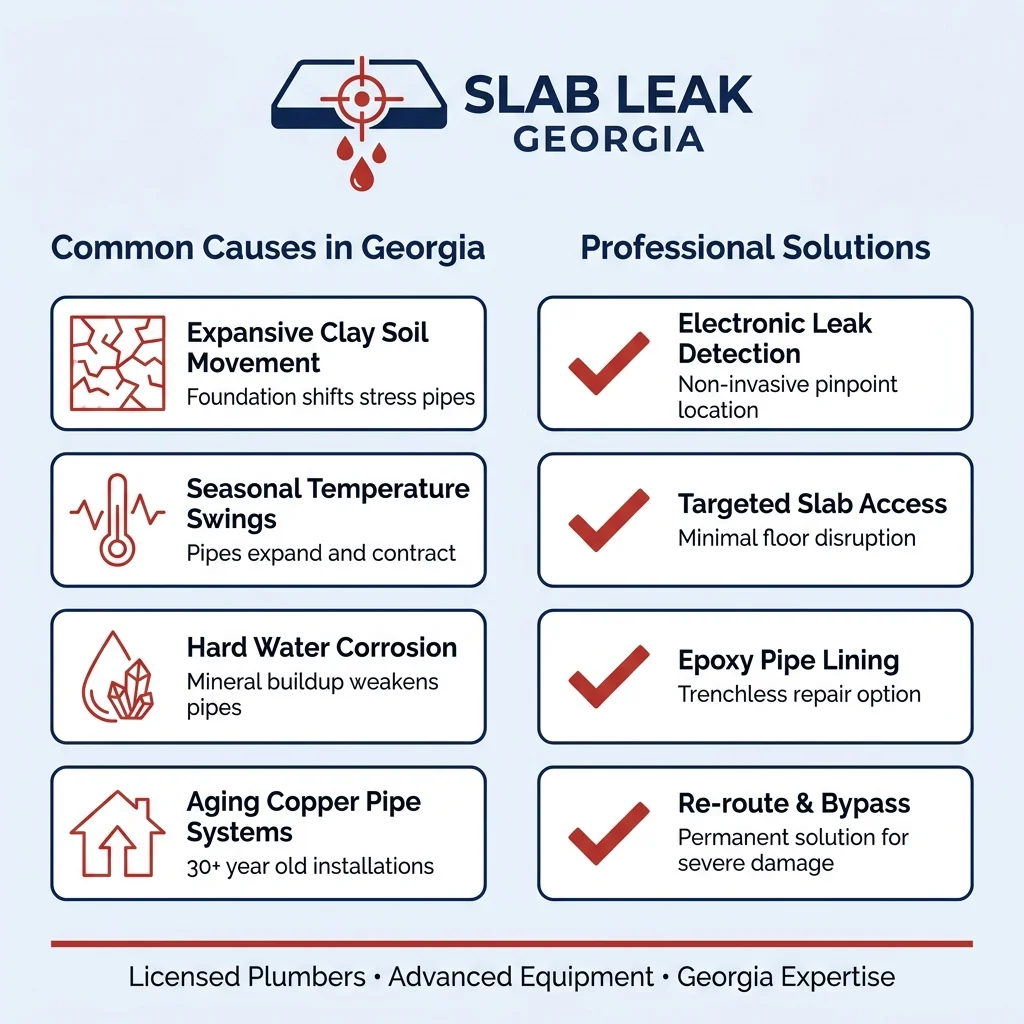
Expansive clay soil — Georgia's clay swells and contracts with moisture, stressing under-slab pipes.
Aging copper pipes — Homes built 1980-2000 are entering the 25-40 year corrosion failure window.
High water pressure — Many Atlanta-area homes receive 80-100 PSI, accelerating pipe wear.
Licensed slab leak contractors in Gainesville, Hall County — we handle all permitting, inspections, and insurance documentation. Our electronic detection technology finds leaks without exploratory concrete breaking. Call +1-866-779-0723 for a free estimate and same-day service.
Why Gainesville Homeowners Trust SlabLeakGeorgia.com
When your home's foundation is at risk, you need experienced professionals with the right equipment and commitment to quality.
Licensed & Certified
Every technician holds a Georgia Master Plumber License and undergoes continuous training on the latest detection technology.
24/7 Emergency Response
Active slab leaks don't wait for business hours. Our emergency teams are always ready to respond when you need us most.
Advanced Detection Equipment
We invest in professional-grade acoustic, thermal, and pressure testing equipment that pinpoints leaks without unnecessary damage.
Transparent Pricing
Written estimates before we start, no hidden fees, and detailed documentation for insurance claims.
Warranty Protection
All repairs backed by comprehensive warranties. We stand behind our work with guaranteed quality.
Local Expertise
We understand Georgia's unique soil conditions, building codes, and the specific challenges that cause foundation leaks in your area.
Slab Leak Repair Costs in Gainesville, GA
No hidden fees. No surprise charges. Just honest pricing for quality slab leak services.
Leak Detection
- check_circleComplete home inspection
- check_circleAcoustic leak detection
- check_circleThermal imaging scan
- check_circlePressure testing
- check_circleWritten location report
- check_circleRepair estimate included
Spot Repair
- check_circleDetection included
- check_circleConcrete access & removal
- check_circlePipe repair or replacement
- check_circlePressure testing
- check_circleConcrete restoration
- check_circle1-year warranty
Complete Re-piping
- check_circleAll new water lines
- check_circleCeiling/wall routing (no slab)
- check_circleModern PEX materials
- check_circleFull system pressure test
- check_circleSame-day water restoration
- check_circle10-year warranty
Insurance & Financing Information
Many homeowners insurance policies cover the cost of accessing and repairing slab leaks. We provide detailed documentation for insurance claims. Ask about financing options for repairs not covered by insurance.
Factors affecting cost: Leak depth, accessibility, number of leaks, pipe material, foundation type, and chosen repair method. We provide written estimates before starting any work.
How Slab Leak Repair Works
From detection to repair, we make the process simple and stress-free for Georgia homeowners.
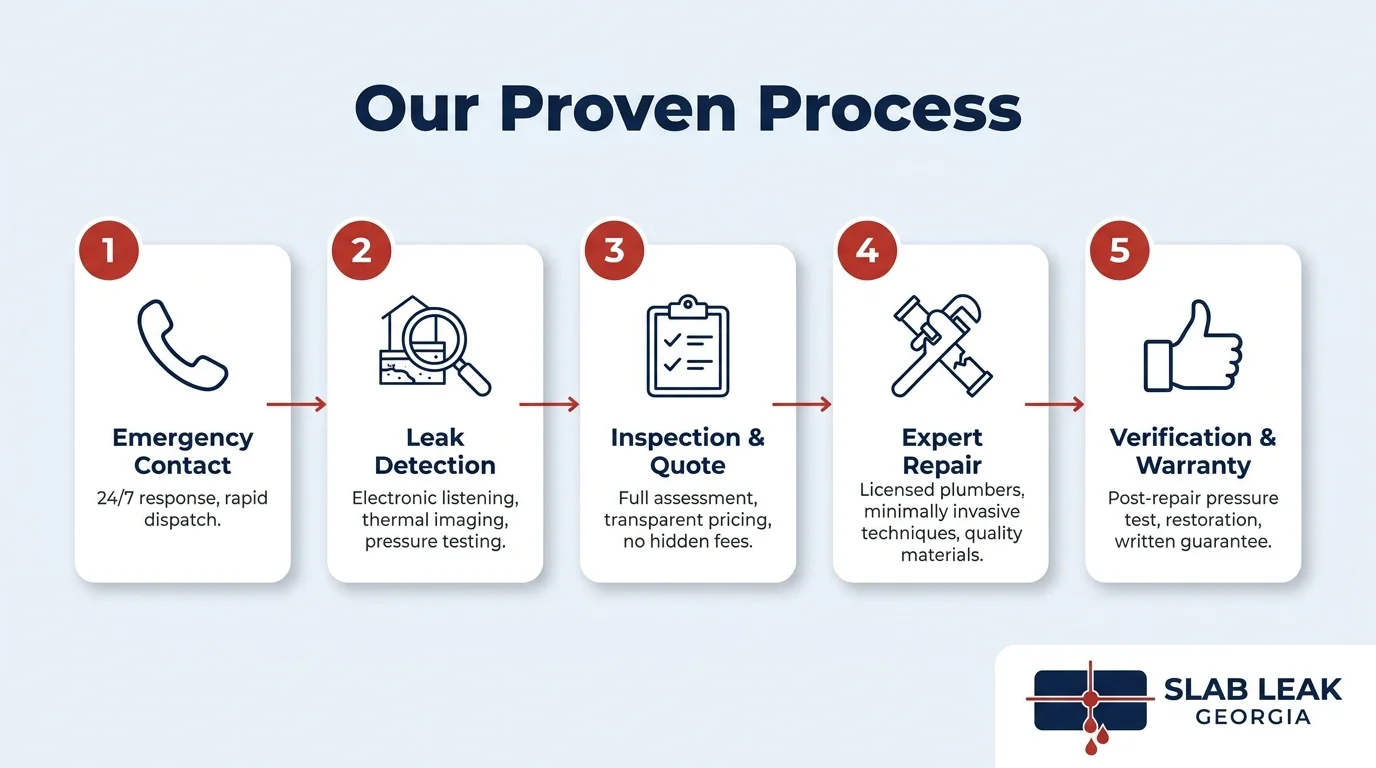
Call for Inspection
Contact us for a comprehensive slab leak inspection. We'll ask about symptoms and schedule a convenient time.
Electronic Detection
Our technicians use acoustic listening devices and thermal imaging to pinpoint the exact leak location without breaking concrete.
Repair Options & Estimate
We present all repair options with transparent pricing: spot repair, epoxy lining, or re-piping. You choose what's best for your home.
Expert Repair & Warranty
Licensed technicians complete foundation-safe repairs with minimal disruption. All work backed by comprehensive warranty.
Don't let an under-slab water leak in Gainesville destroy your foundation. Hall County's trusted slab leak specialists offer trenchless epoxy lining, spot repair, and complete repiping with full warranties. Call +1-866-779-0723 now — we answer 24/7.
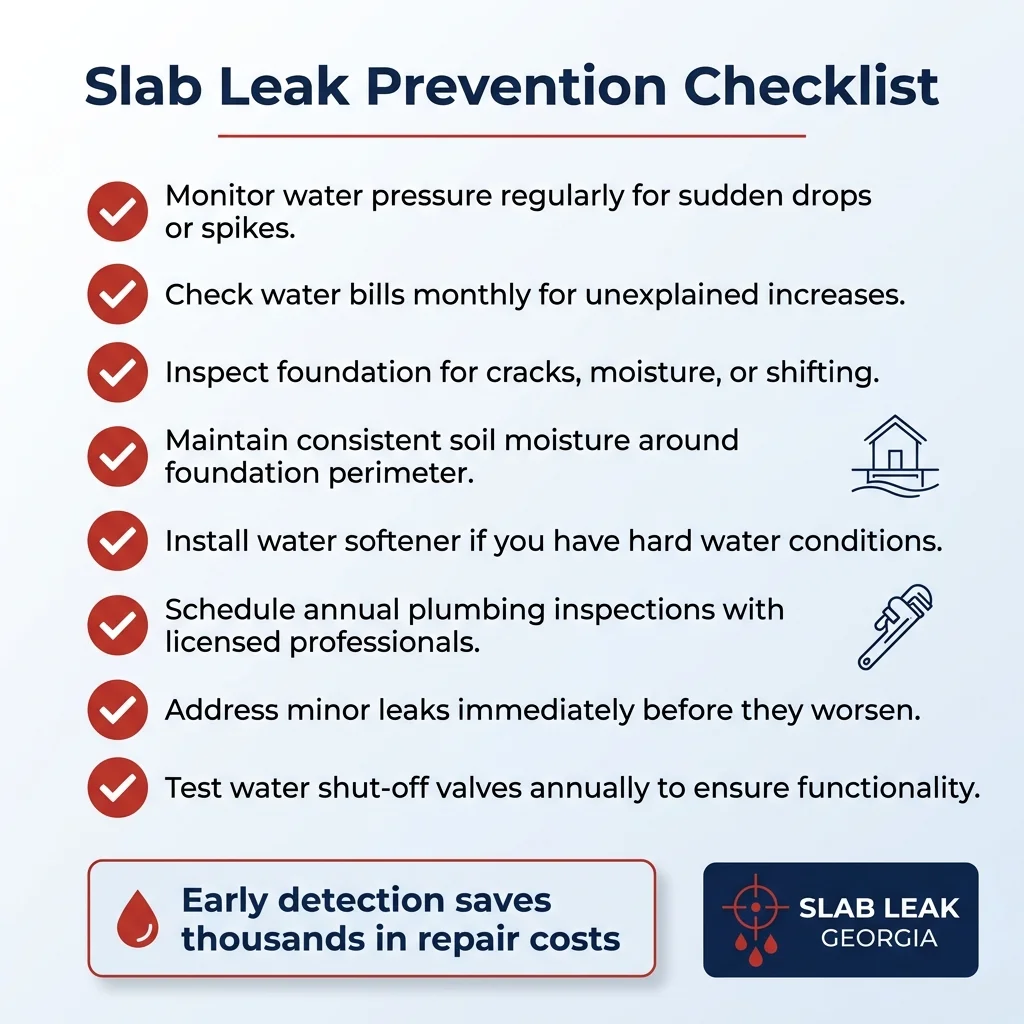
Slab Leak Prevention for Gainesville Homes
Understand your risk factors and take action before a leak damages your foundation
Aging Copper Pipes
Homes built 1980-2000 with original copper plumbing are entering the 25-40 year failure window. If your home is in this range, annual pressure testing is recommended.
Expansive Clay Soil
Georgia's clay soil swells 10-15% when wet and shrinks when dry, bending rigid copper pipes with each cycle. Poor drainage around your foundation amplifies this stress.
Water Chemistry
Atlanta's moderately hard water (8-12 gpg) combined with chlorine creates internal pipe corrosion. High pressure above 80 PSI accelerates wear by 30-50%.
Prevention Strategies That Work
Why Professional Slab Leak Service Matters in Gainesville
DIY attempts often cost more in the long run — here's the real comparison
DIY Attempt
- dangerousNo accurate detectionConsumer moisture meters can't sense through concrete. Exploratory holes cost $800-2,000 each.
- dangerousFoundation damage riskBreaking concrete without shoring causes slab sagging, wall cracks, and structural shifts.
- dangerousInsurance voidedDIY repairs are excluded from coverage. One attempt can void your entire claim.
- dangerousCode violationsFulton County requires licensed contractors for permits. Unpermitted work fines: $500-2,500.
Professional Service
- check_circleElectronic leak detectionPinpoints leaks within 1-2 feet without breaking concrete. No guessing, no exploratory holes.
- check_circleFoundation-safe repairsLicensed technicians use proper shoring and techniques that protect your home's structure.
- check_circleInsurance-compliantFull documentation, permits, and inspection reports support your claim if needed.
- check_circleCode-compliant + warrantedAll work permitted, inspected, and backed by warranty. Peace of mind included.
Gainesville, Hall County — licensed, insured, and ready to help
callCall +1-866-779-0723Licensed & Certified for Gainesville
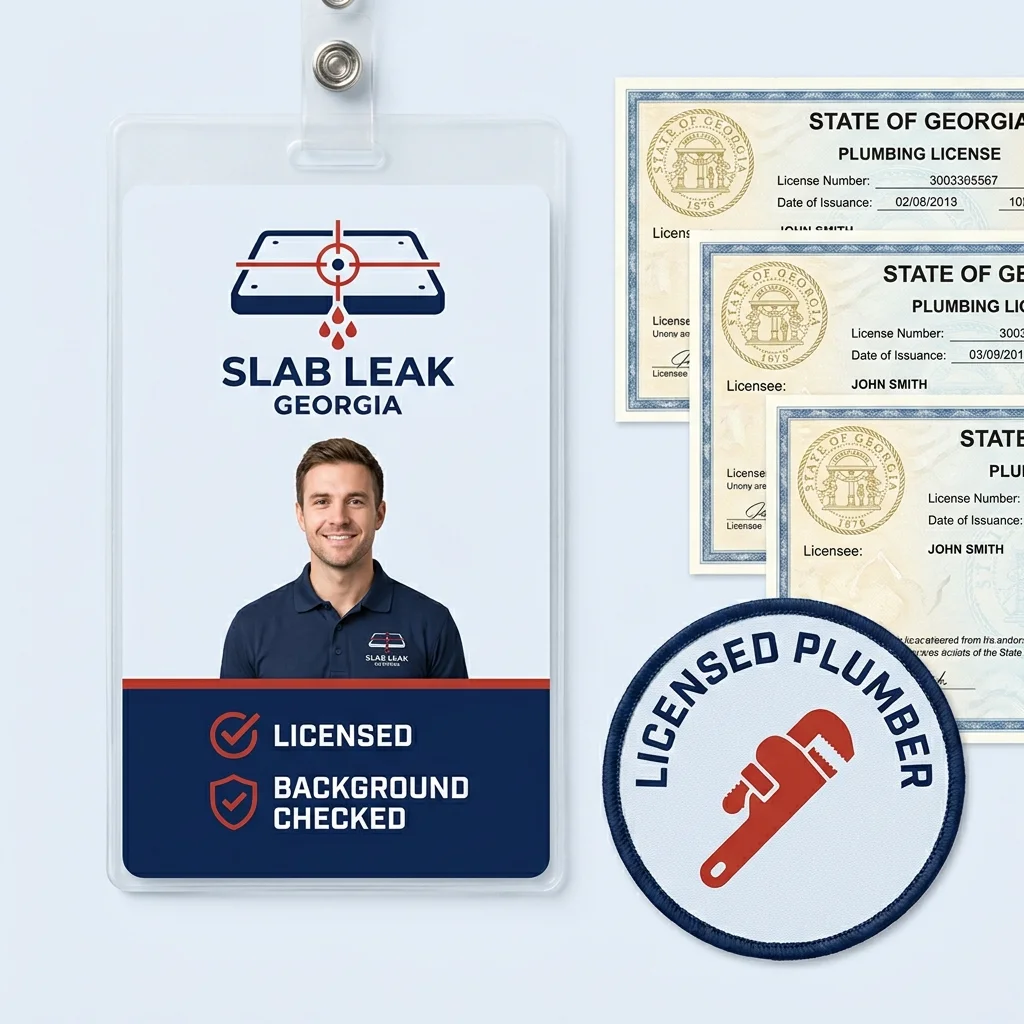
Every technician is a Georgia Master Plumber with credentials you can verify
Georgia Master Plumber
Licensed by the Georgia State Board of Construction Industry. Full compliance with all state and local requirements.
$1M+ Insured
Comprehensive general liability and workers' compensation insurance protects your home and our team.
Permits & Inspections
We handle all Gainesville permit applications and coordinate required inspections. Code-compliant work guaranteed.
Workmanship Warranty
Every repair comes with a comprehensive warranty. If anything goes wrong, we fix it — no questions asked.
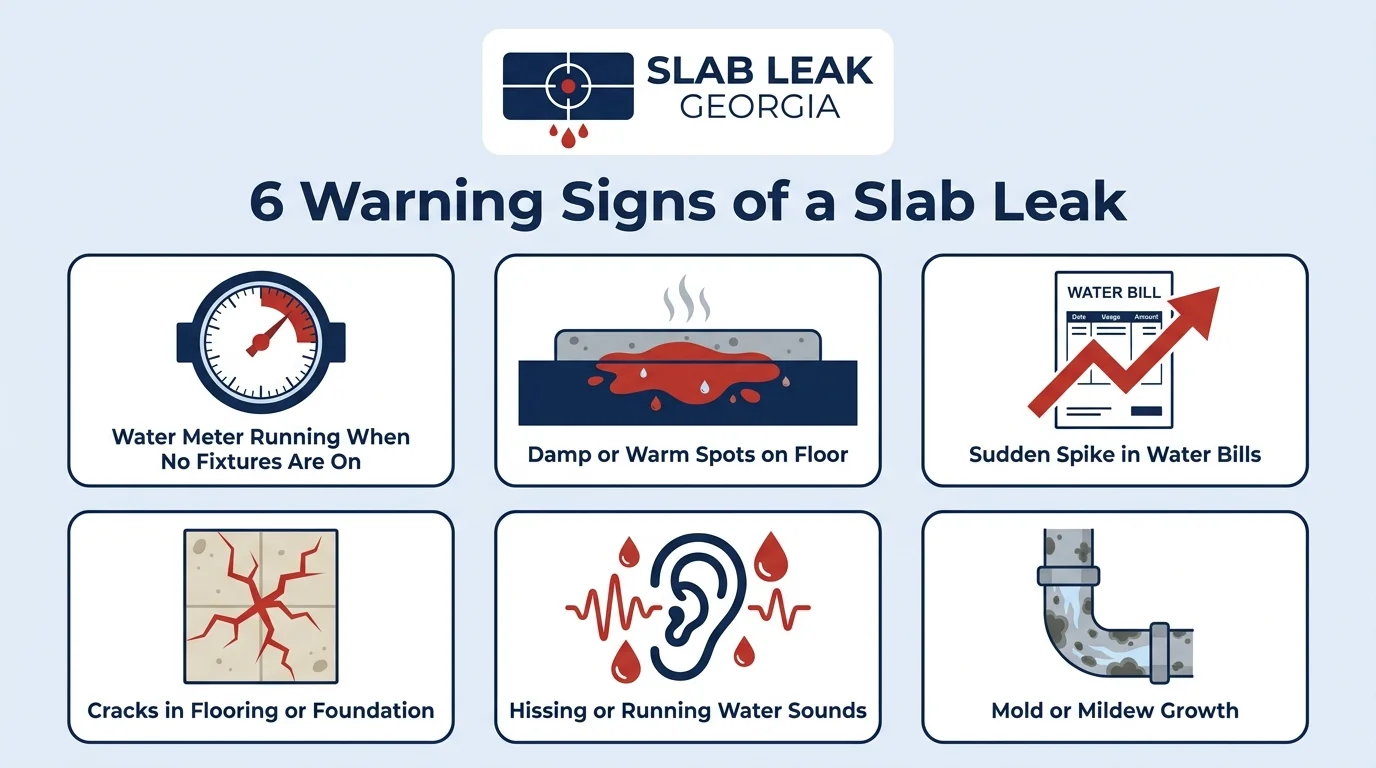
callCall +1-866-779-0723Slab Leak Warning Signs in Gainesville
Most homeowners don't recognize slab leaks until foundation damage forces costly emergency repairs
thermostatHot or Warm Spots on Your Floor
MODERATEA hot water supply line is leaking directly beneath that spot — active pressurized leak losing 20-100 gallons/day
expand_more
Hot or Warm Spots on Your Floor
MODERATEA hot water supply line is leaking directly beneath that spot — active pressurized leak losing 20-100 gallons/day
Turn off all hot water fixtures and water heater. Wait 30 min, then feel the warm area. If it stays warm, it's a continuous leak.
$2,000-5,000 in foundation repairs + $1,500-4,000 mold remediation after 2-3 months.
receipt_longSudden Water Bill Increase
HIGH30-50%+ jump with no usage change means pressurized supply line leak running 24/7
expand_more
Sudden Water Bill Increase
HIGH30-50%+ jump with no usage change means pressurized supply line leak running 24/7
Turn off all fixtures. Watch your water meter for 30 min. If the dial moves, you have a leak. Document with video.
$30-75/month in wasted water for moderate leaks. $100-300/month for severe leaks losing 200+ gallons/day.
hearingSound of Running Water
HIGHAudible hissing or rushing sound when all fixtures are off — leak losing 50-200+ gallons/day
expand_more
Sound of Running Water
HIGHAudible hissing or rushing sound when all fixtures are off — leak losing 50-200+ gallons/day
Turn off main water valve. Wait 5 min. If sound stops, it's a supply line leak. Note where sound is loudest.
Foundation repairs $5,000-10,000 if you wait months. Immediate detection limits damage to pipe repair only.
crisis_alertFoundation Cracks
URGENTNew cracks or widening existing cracks = soil erosion under slab from active leak
expand_more
Foundation Cracks
URGENTNew cracks or widening existing cracks = soil erosion under slab from active leak
Mark cracks with tape and date. Measure width daily. Growth >1/8 inch per week = immediate action needed.
$5,000 crack injection to $20,000+ underpinning. Fix leak within days limits damage to $0-2,000.
speedLow Water Pressure
MODERATELarge leak diverting water or decades of mineral buildup restricting flow in aging pipes
expand_more
Low Water Pressure
MODERATELarge leak diverting water or decades of mineral buildup restricting flow in aging pipes
Attach pressure gauge to outdoor hose bib. Normal: 50-70 PSI. Below 40 PSI = problem. Test at different times of day.
Continued corrosion leads to imminent leaks. Emergency repairs cost premium rates vs. planned replacement.
waterStanding Water Around Foundation
URGENTWater pooling at foundation with no recent rain = 100-300+ gallons/day leak, immediate structural risk
expand_more
Standing Water Around Foundation
URGENTWater pooling at foundation with no recent rain = 100-300+ gallons/day leak, immediate structural risk
Mark wet area. Turn off main water overnight. If drier in morning, source is plumbing, not groundwater.
Foundation waterproofing $3,000-8,000 + pipe repair. Severe cases requiring underpinning reach $15,000-25,000.
airMold or Mildew Smell
HIGHMusty odor or visible mold from chronic moisture under flooring — leak active long enough for mold colonization
expand_more
Mold or Mildew Smell
HIGHMusty odor or visible mold from chronic moisture under flooring — leak active long enough for mold colonization
Document with photos. Don't touch mold — disturbing releases spores. Open windows. Call for detection.
Early: $500-2,000 cleanup. Spread through walls/HVAC: $5,000-15,000 comprehensive remediation.
speedWater Meter Spinning
HIGHMeter shows flow with all fixtures off — definitive proof of active leak. No other explanation
expand_more
Water Meter Spinning
HIGHMeter shows flow with all fixtures off — definitive proof of active leak. No other explanation
Turn off ALL water-using devices. Watch meter for 30 min. Any movement = leak. Document spin rate on video.
$150-400/month in wasted water. $900-2,400 over 6 months + potential foundation damage on top.
Don't wait for foundation damage — call now for professional leak detection in Gainesville
callCall +1-866-779-0723Trusted by Gainesville Homeowners
"They found our leak in under 2 hours without tearing up our whole kitchen floor. The price was exactly what they quoted — no surprises."
— Sarah M., Gainesville
"Emergency call at midnight on a Sunday. They answered immediately and had someone here within 2 hours. Saved our home from major water damage."
— Mike R., Hall County
Repair or Replace?
Answer 5 questions — we'll recommend the best option
Repair vs Replace Decision Tool
Should you repair the leak or re-pipe the entire system?
Common Questions from Gainesville Residents
Frequently Asked Questions
Get answers to common questions about slab leak detection and repair in Gainesville.
How much does slab leak detection cost in Gainesville?
expand_more
Professional electronic leak detection typically costs $300-$600 in Gainesville. This includes a complete inspection with thermal imaging and acoustic equipment to pinpoint the exact leak location without breaking concrete. Many your County homeowners find this investment prevents thousands in unnecessary foundation damage.
What are the warning signs of a slab leak?
expand_more
Common signs include: unexplained water bill increases, sound of running water when all fixtures are off, warm spots on floors, cracks in walls or floors, mildew or excessive moisture, reduced water pressure, and foundation shifting. If you notice any of these signs in your Gainesville home, call immediately for inspection.
How long does slab leak repair take?
expand_more
Most slab leak repairs in Gainesville are completed within 1-3 days depending on the repair method. Simple spot repairs may take 6-8 hours, while epoxy pipe lining can be done in 1-2 days. Complete re-piping typically requires 2-4 days. We provide accurate timelines after inspection.
Will my homeowners insurance cover slab leak repair?
expand_more
Many Gainesville homeowners insurance policies cover the cost of accessing and repairing the leak itself, though not the damage caused by long-term leaks. Coverage varies by policy. We provide detailed documentation for insurance claims and work directly with adjusters in your County.
Can you detect a slab leak without breaking my floor?
expand_more
Yes! We use advanced electronic detection equipment including acoustic listening devices, thermal imaging cameras, and pressure testing to pinpoint leaks without damaging your Gainesville home. We only break concrete at the exact leak location after confirming its position.
What causes slab leaks in Georgia homes?
expand_more
In Gainesville, common causes include: shifting clay soil that stresses pipes, corrosion from Georgia's mineral-rich water, poor installation during construction, ground settlement, and pipe friction from expansion/contraction. Homes built before 1980 with copper pipes are especially vulnerable in your County.
Hiring a Slab Leak Contractor?
15 critical points to verify before you hire anyone
Contractor Verification Checklist
Use this checklist when hiring a slab leak contractor
badgeLicensing & Insurance
precision_manufacturingDetection Equipment & Methods
receipt_longPricing & Business Practices
history_eduExperience & Reputation
Recommended minimum: 12/15 checked before hiring
Don't Let a Slab Leak Destroy Your Gainesville, GA Home
Every hour counts when you have an active foundation leak. Our licensed technicians respond fast with professional electronic detection and expert repairs that protect your home's structural integrity.